New marae wastewater management system at Wairewa
Jun 30, 2026
Wairewa Rūnanga recently celebrated with a pōwhiri and blessing the commissioning of its new marae wastewater system, which combines mātauranga Maōri with modern day practices. The new onsite wastewater management system was co-developed with Earth Sciences NZ (formerly NIWA) under its Ecocultural Wastewater Treatment Research Programme. Funded by the Ministry of Business Innovation and Environment, the programme supports the investigation and development of culturally appropriate upgrades of wastewater treatment systems for facilities such as papakāinga and marae.
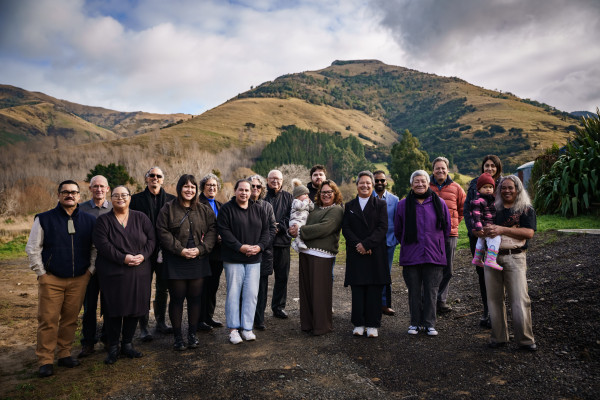
Wairewa Rūnanga whānau gather to mark the completion of the new onsite wastewater system
Wairewa Rūnanga Project Lead Kiri Panirau says that one of the main drivers for the marae to replace its wastewater system was the risk of material leaching into the whenua from the current system of septic tanks which date back to the 1980s and are reaching the end of their life.
“Our new system will protect not just the whenua but the nearby rivers and lakes and the wider environment,” she says.
“It will also protect the health and wellbeing of our whānau and manuhiri.”
The system consists of a series of tanks where wastewater solids settle out and are broken down by bacteria. The remaining liquid is slowly released onto a fine gravel wetland filter planted with native species. It then passes through a bed of woodchips and into a final planted seepage area.
Andrew Dakers was the consultant engineer on the project, and the construction was completed by Glentunnel-based company All About Sewage.
Kiri says she has learned a great deal during the five-year long project to develop and install the new system.
“I was intrigued by what was possible, and by the concept of combining mātauranga Māori with modern day practices,” she says.
Chris Tanner from Earth Sciences NZ says that working with the marae whakahaere was a vital part of the project.
“It really helped us to understand how the marae is used from day to day, as well as during large gatherings such as tangihanga. That meant we could design a system able to handle large fluctuations in wastewater flows, helping avoid any problems when the marae is hosting visitors,” he says.
Chris says the nature-based treatment system co-developed with the marae provides a robust low-maintenance solution that is able to provide reliable treatment under varying wastewater flows.
“The system is backed up by scientific research carried out over a decade.
“As well as having lower running costs, it proved less expensive to build and install than a mechanised package treatment plant,” he says.
Wairewa Marae is the only South Island marae included in the research programme, with the remaining nine marae located in the North Island.
Funding for construction of the new system has come from multiple sources including the Department of Internal Affairs, Rata Foundation and the rūnanga itself.
For Kiri, engagement with whānau about the new system has been a major part of her role as Project Lead.
“Initially, some of our whānau were not happy with the proposed location of our new system as they were concerned that it was too close to the māra kai,” she says.
“However, after engagement with whānau they came to understand why that area was the best site because it is one of the highest points on our whenua and the system relies on gravity.”
Modelling shows that the site is unlikely to be impacted by a one in one-hundred-year flood event – an important consideration given that the wider area has experienced flooding several times in recent years, and the marae provides an important civil defence role for the wider community.
Kiri says that the adoption of the new system has also required some changes of practice at the marae.
“For example, we can no longer use antibacterial cleaning products as these will kill the bacteria we need for the system to work effectively, so we have had to educate our whānau about which products are suitable to use and supply these,” she says.
Kiri says that the plants are a good indicator of the health of the system.
“If the plants die, we know that the system is out of balance,” she says.
The purchase of all 180 plants was funded by donations from whānau, including many living outside the takiwā.
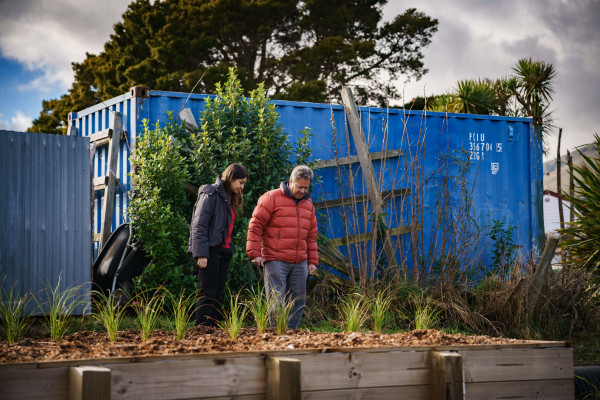
PhD student Zohreh Chalipa and Associate Professor Ricardo Bello Mendoza from UC
A PhD student from the University of Canterbury, Zohreh Chalipa is carrying out regular monitoring of the new wastewater system as the final phase of the project under the supervision of Associate Professor Ricardo Bello Mendoza.
 Top
Top