Seabird discovery reinforces link between islands
Dec 9, 2025
An unexpected discovery on Whenua Hou/Codfish Island has revealed some interesting and unexpected behaviours of tītī (also known as sooty shearwaters or muttonbirds).
In October, Te Arawhetu Waipoua (Kāi Tahu, Ngāti Maniapoto, Ngā Rauru) was assisting the Bioeconomy Science Institute: Manaaki Whenua - Landcare Research Group by checking for tītī on Whenua Hou that had been tagged with tracking devices during the 2023 and 2024 breeding seasons.
“I was checking the burrows for certain birds with trackers at night-time and there were a bunch of birds on the surface,” Te Arawhetu says.
Te Arawhetu picked up one of the banded birds and says that, on checking the ID on the band, she was surprised to discover that it was a Chatham Island bird.
“I was under the impression that they have a strong homing instinct so this discovery was unexpected,” she says.
Whenua Hou Komiti Chair Tāne Davis says that the find is a significant one which adds to the collective mātauranga (knowledge) about tītī.
“We didn’t realise that the manu (birds) interacted between islands of such distance,” Tāne says.
“This discovery highlights the separate but related work that Chatham Islands whānau and Kāi Tahu whānau have been doing on our respective islands and reflects the connection between our peoples,” he says.
The Chatham Islands tītī was banded as a chick in 2021, when birds were translocated from the Nature Reserve Island Rangatira/Hokorereoro to the Point Gap Sanctuary in a project led by the Chatham Islands Taiko Trust. The aim was to repopulate the edges of the cliff in this predator-fenced sanctuary.
Mike Bell, ornithologist and current Trustee on the Chatham Islands Landscape Restoration Trust, was one of those involved with hand-rearing the tītī chicks until they fledged.
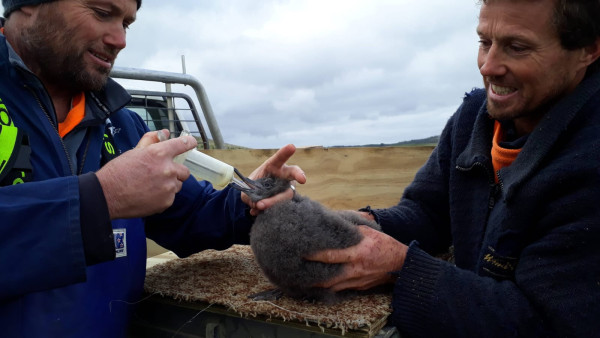
Mike Bell and Dave Bell feeding translocated tītī chick - image by Kathryn Richards
“The thinking was these chicks would return as adults to the Gap and then breed themselves, so it’s fascinating a bird has been found all the way down at Whenua Hou!” he says.
“Our knowledge about seabirds is growing all the time, and supports our understanding of the important role that they play in creating a nutrient cycle between islands and the marine environments that surround them.”
The Chathams tītī is about five years old and when found on Whenua Hou, it had apparently paired up with a much older local tītī, which had been banded on Whenua Hou in 2001 as an adult, so is estimated to be at least 28 years old.
Liz Tuanui, Chair of the Chatham Islands Taiko Trust, says this is fantastic news.
“A bird showing up down there reminds us of the southern pacific seabird ecosystem our islands are part of.
“It also shows that although sometimes birds you translocate may not return to the site, you’ve still fostered a bird that’s fledged successfully and gone on to breed elsewhere. In our current seabird environment, every chick that fledges is a success.”
The Chatham Islands, Rakiura/Stewart Island and Maukahuka/Auckland Island have been described as a "seabird triangle”. Earlier in 2025, the three islands became part of the Island-Ocean Connection Challenge (IOCC), a global conservation initiative which aims to restore and rewild 40 globally significant island-ocean ecosystems by 2030.
 Top
Top