Beneath the Sands of Moeraki
Aug 4, 2025

Kaituhi NIC LOW joins an excavation run in partnership with Te Rūnanga o Moeraki to learn what indigenous archaeology looks like today.
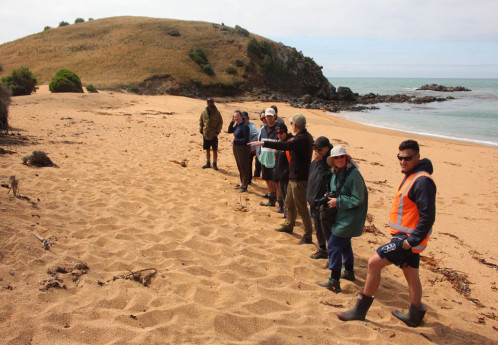
Photo credit - Robbie Titchener
JUST BEFORE YOU REACH MOERAKI MARAE THERE’S A TURN-OFF ON your right you won’t want to miss: Lighthouse Road. At its end is Kātiki Point, site of Taoka’s 17th century pā.
But before that, a small dirt road drops away to the coast. Follow that past a handful of weathered cribs to what is known as the Bottom Kaik, or Kaik 2.
There’s just the sea roaring into the twin beaches of Kawa and Tūtakahikura, seagulls wheeling overhead, and rabbits galore. As a new day arrives, the bunnies can be so dense the hillside twitches. It’s a quiet, contemplative place ... but if you squint, you can imagine how it
used to be.
Kaimoana is abundant off these beaches, and our ancestors lived here on and off for centuries before Europeans arrived. From the 1830s this became one of the biggest Kāi Tahu settlements on this coast. After the fall of Kaiapoi Pā, along with Matiaha Tiramōrehu came many of the senior leaders of various hapū and their people. Prominent Murihiku wāhine came north and married whalers. Whare sprang up. Livestock and māra kai covered the hills.
In the 1840s the people built a rūnaka hall named Uenuku, and a church. In 1868, Tiramōrehu and another Kāi Tahu leader and scholar, Rāwiri Te Maire, established a wharekura here, Otemanawharetapu. It must have been a heady time: Māori and Western ideas, technologies and peoples converging.
Life here wasn’t easy, says David Higgins, Upoko of Te Rūnanga o Moeraki. “Given there was very little freshwater on the peninsula, survival and sustainability for our people must have been pretty blimmin’ tough.”
There are accounts of Tiramōrehu and others using tanks on sledges to bring wai māori from nearby creeks. From the early 20th century, whānau gradually shifted away to be closer to the settlement at Onekakara /Port Moeraki as the Pākehā grocer and doctor refused to traverse the grass track down to the kaik.
Today, although the various urupā are the main visible reminders of where the kāik once stood, its importance lives on. “I have memories of my grandparents telling me where they were born and grew up there,” David says, “I know where all the burials are, from Rakatira Mamaru for
five generations down to three living generations today.”
It’s a place that is, however, increasingly under threat. As sea levels rise, king tides foaming up Tūtakahikura beach are stripping the foreshore and washing umu stones out of the sand, along with the chalky remnants of old shellfish feasts. Takaroa has exposed a long, dark layer of charcoal created by generations of cooking fires.
The attack is on two fronts, ki uta, ki tai. Above the beach, the rabbits have been making a mess playing at amateur archaeology. The foreshore is riddled with hundreds of burrows that are damaging the site, disturbing the past, and at times exposing surprising treasures, which is why David and the hapū have brought the real, human archaeologists in.
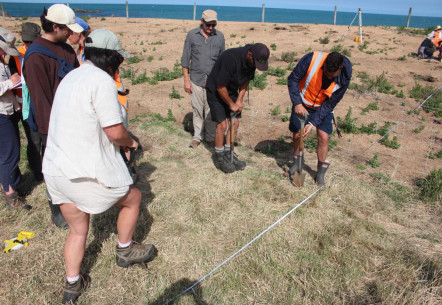
Photo credit - Robbie Titchener
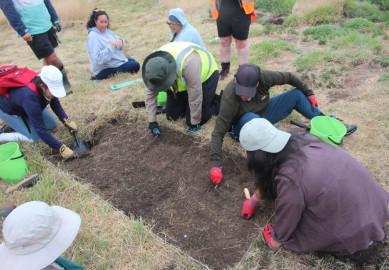
Photo credit - Robbie Titchener
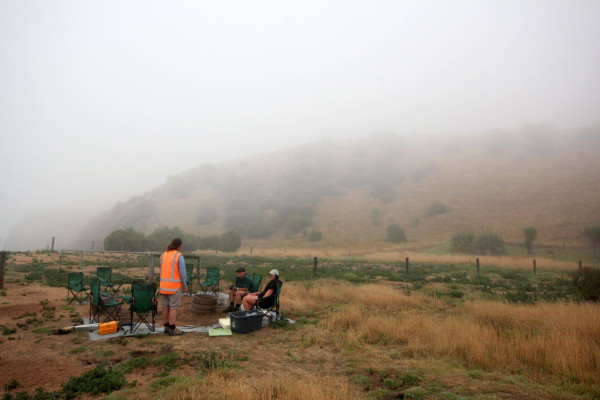
Photo credit - Robbie Titchener
On the Tūtakahikura foreshore, about 50 metres back from the beach, archaeologists, students and Kāi Tahu kaitiaki cluster round a series of rectangles pegged out with string.
I join six of my whanauka kneeling round a shallow trench. Several are relations from Murihiku; others kānohi hou, new faces. We’re working under tapu, starting and finishing each day with karakia, and with all kai kept separate from the site.
There’s a steady banter as people scrape back the sandy earth to reveal what’s underneath. Anything of note gets pored over, marked, bagged and recorded. The spoil goes into buckets, hauled to another team sitting hunched over sieves, separating everything to be analysed later in the lab.
I’m immediately struck by the whanaukataka, and the focus. Overall, it’s a meditative vibe. “Trowelling is my zen,” says Kāi Tahu archaeologist Rachel Wesley, who is the Ōtākou representative on Te Rūnanga o Ngāi Tahu.
She’s teaching us on the job. “Though sifting and sorting can be strangely zen, too.” “If it’s not windy,” says Zac McIvor (Ngāti Patu Pō of Waikato), a young lecturer in archaeology from the Ōtākou Whakaihu Waka University of Otago. “With all that charcoal content, you end up looking like a coal miner.”
He’s right, especially once you add sunscreen to the mix, but no-one cares. There’s something satisfying about getting your hands into the soil in this way.
For three weeks, under the mana of Te Rūnanga o Moeraki, the university’s archaeology programme is running its summer field school excavating here. Now in its second year, students are learning under the guidance of senior archaeologists including Rachel and Gerard O’Regan (Kāi Tahu, and Curator Māori at Tūhura Otago Museum). And this year, around a dozen Kāi Tahu whānau whose work intersects with cultural heritage, are joining them for five days of hands-on training and talks.
Together, the goal is to protect taoka, share knowledge, and learn more about how our ancestors lived. One of the first things we learn is just how close the past can feel.
We’re excavating in an old stockyard, yet just 20 centimetres beneath the turf, we’re into a midden layer, an old rubbish pile dense with the bones of things we still eat today – mangā/barracouta, hāpuku/groper – interspersed with the bones of things we do not, like kurī.
So far no-one has found anything European. It’s too soon to say, but it’s possible this is pre-contact material we are recovering. As we dig, evidence mounts. More kurī bones come to light, including a jaw.
“Awww, look at that cute little kurī,” one of the senior students says. We find seal bones, seal teeth.
Then Anne Ford, Head of the Archaeology programme, reaches into a thicket of barracouta bones and plucks out a serrated fishhook point, neatly crafted from what might be moa bone.
Given metal nails were easier to shape, it’s commonly thought that once Europeans arrived, customary technology like this fell out of use. Which is why, within a context of kurī and seal bones, the fishhook point strongly suggests we’re excavating a pre-European area.
That hook likely snagged in the flesh of that fish back in the 1700s, or before, when tīpuna like Taoka walked these shores. His pā is along the ridge so he would certainly have known this beach.
I bring up a load of barracouta bone and charcoal, and breathe in. All I can smell is moist earth, but it’s not hard to imagine the aromas of the feast.
When those doing an archaeological excavation are Māori, the dynamic changes. For one, there’s heaps of laughs; at one point the discussion shifts to arranging marriages to produce kids who would have rights to every single tītī island.
Beyond this, having whānau in the trenches also means cultural insights into whatever comes to light. Riria Cairns-Hakiwai (Kāi Tahu, Kāti Mamoe, Waitaha, Ngāti Kahungunu, Rongomaiwahine), who works for Te Ao Mārama, brings up a small greenish flake of stone on the point of her trowel.
She passes it to Tāne Tāmati (Waitaha, Kāti Māmoe, Kāi Tahu, Tūhoe), then-Curator Māori at Southland Museum, who has a background in geology. “That,” he says, “is Takiwai!” Takiwai is a valuable, translucent type of pounamu primarily found in Piopiotahi/Milford Sound.
Some of us know the beach where this flake likely came from, and we’ve heard the pūrakau about Takiwai, how she came to Aotearoa aboard the Tairea waka, and went overboard in Piopiotahi and turned to stone.
Just like that, the Murihiku whānau on site have a link to the people who lived here: hapū connections persisting across generations and time.
Despite all this, until relatively recently you wouldn’t have found many Māori involved in digs. In the Māori world, archaeology had a bad name.
“It was something done to us,” Rachel says. Wāhi tīpuna were raided, urupā dug up, kōiwi taken as ‘specimens’ for study or display. In the bad old days of finders keepers, before government protection in 1975, a respectable Pākehā hobby was spending weekends digging up old pā sites.
At Moeraki, David Higgins says, Tiramōrehu’s grave is no longer marked, after taoka were stolen from the site.
Since then, legislation has helped provide protection, and archaeology has professionalised: you need at least a Master’s degree, and years of experience, to lead a dig. This has kept the fossickers away, but also distanced Māori from our own archaeological heritage.
It’s taken the likes of archaeologist Brian Allingham, who has for decades worked with and for Kāi Tahu on our rock art, and Gerard and Rachel, to show how it can be done differently.
A turning point was Mason’s Bay on Rakiura/Stewart Island just after the Treaty Settlement. Atholl Anderson, Kāi Tahu’s most esteemed archaeologist, led a team of about 20, including whānau from Murihiku, excavating an eroding site where a carved tauihu, or canoe prow, had earlier been found.
The team unearthed other parts of a waka, perhaps from the same one. “It was hardcase. We had pūtea post-settlement,” Gerard says. “We got quad bikes, lots of gear, it was a big whānau affair. That was the start of us doing our own rūnaka excavations.”
Another eroding midden at Mahitahi on Te Tai Poutini sparked a major whānau effort, with even school kids getting involved. Once people realised the significance of these sites, they started coming forward.
“Oh, there’s a midden here, a site there. A box of pounamu tools showed up – a chap had been finding them over the years – things like that. That’s what happens when the community felt connected and involved.”
More recently, Rachel and her Ōtākou whānau have done extensive work at Papanui Inlet, salvaging and preserving taoka, including a 15th century waka hull. It’s all about reconnecting people with their past, she says, and giving hapū the confidence to assert their rights, and their own narratives about how our ancestors lived.
On the third day we break from digging to visit Tikoraki, a post-contact urupā on a nearby headland. Gerard brings us in with karakia, his voice ringing over the sound of waves below. His tipuna Teitei is here, but those waves, driving in against the clay cliffs, are destroying her resting
place at an alarming rate: the rūnaka estimates the urupā has lost 10 metres to erosion in 10 years.
How to manage coastal graves sensitively is a key question for the rūnaka, and for many other hapū. Gerard previously led two seasons working at Tikoraki in partnership with the university. This has given the hapū an understanding of the site’s history, including exactly where some of the burials are, a first step towards deciding what to do next.
Some whānau favour relocation and reburial. Others, like David, are comfortable with letting the bones return to Takaroa, although he acknowledges this makes it hard for whānau seeking reconnection.
“How do I explain who they are and how they’re connected to this place, if I don’t have those markers in the whenua to explain, yes, your greatgreat-grandfather is buried here?”
All of this is a world away from archaeologists digging up graves for study, or amateurs fossicking sites. It’s driven by the needs of the hapū. And for the Māori teams involved, Gerard says, “that experience reinforces our sense of understanding and connection and therefore
how we treasure these places.” Time is of the essence, too. “With the erosion, we haven’t got time to dick around.”
The work of an archaeologist is never done. Once these excavations are filled in and everyone has returned home, it will take years of analysis to draw conclusions about Tūtakahikura’s past.
Across Te Waipounamu erosion and development continue apace, bringing more of our past to light every week. Which is why there’s an urgent need for more Māori, and more Kāi Tahu, to get involved.
Rachel wants anyone doing kaitiaki work to be “really knowledgeable about archaeological processes, and how our rakatirataka that’s defined in the Ngāi Tahu Claims Settlement Act gives us a lot more room to exert our authority.”
This is the main reason for bringing the kaitiaki on board at Tūtakahikura … and it’s already paying off.
Kasmira Peterson (Kāi Tahu, Tūhoe) is a kaimahi for Te Rūnanga o Ōraka-Aparima. Riria Hakiwai works for Te Ao Marama Inc. They are often reading archaeology reports, or dealing with councils and developers to put heritage conditions on excavation work – from behind their desks.
After their experiences at Moeraki, they say they’ve gained the confidence to head out on site, and aim to get directly involved in briefing workers, and to help drive cultural heritage protection in their own rohe.
Kasmira even thinks she might have become an archaeologist if she’d had this opportunity when she was younger. “If I had my life to live again,” she says with a wistful smile.
At 24, Tāne Tāmati is already making the shift. As Curator Māori at the Southland Museum, he dealt with the fruits of other people’s digging, divorced from its iwi context or sense of place. He’d never been on a dig before, but in the first hour here, doing a site walkover with the other
kaitiaki, something sitting on the sand caught his eye. “I say my tīpuna probably spoke to me: ‘You might want to look over there.’” Pounamu is one of his passions, and he saw something green glinting in the sand. “I thought, ‘Oh, that looks like pounamu, but how can
this be?’ Lo and behold, it’s a small pounamu whao, a chisel.” Like that, his direction changed. He left Southland Museum soon after, and is now joining Gerard and Rachel with their kaupapa Māori archaeological focus in Otago.
“This is where I want to be,” he says, “hands on in the field, digging, exploring the history of my tūpuna.”
 Top
Top