Beyond the Ice: Reclaiming a Place in the South
Jul 29, 2025

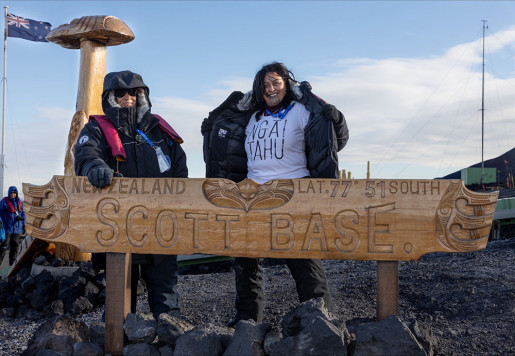
Kara and Rachael with the carved pou at Scott Base.
Beyond the Ice: Reclaiming a Place in the South Pacific
nā NIKKI-LEIGH CONDON
Of all the places on Earth to be standing,
Antarctica was the last place Kara
Edwards thought she would find herself.
But in early 2025, alongside her cousin
Rachael Forsyth, she set foot on the icy
continent as part of a pioneering kaupapa
driven by Murihiku Regeneration.
Kaituhi NIKKI-LEIGH CONDON caught up with
Kara to hear first-hand about her experience.
“I found out six weeks before departure,” Kara says.
“Murihiku Regeneration’s project manager contacted me – I felt incredibly humbled.”
At first, Kara was hesitant. “Despite coming from a seafaring family, I have a terrifying fear of the sea and open water,” she admits.
“Ultimately though, the incredible opportunity that was laid at my feet was more compelling than my fears.”
The invitation came through a growing partnership between Murihiku Regeneration – formed by the four Murihiku Papatipu Rūnanga – and Heritage Expeditions, a family-owned cruise line with more than 40 years’ experience operating conservation-focused voyages to Antarctica and the Southern Ocean.
Murihiku Regeneration was established to protect and understand the Southern Ocean – from Murihiku to Antarctica – while embedding indigenous leadership and perspectives into this critical space. Kara and Rachael were offered positions on the February 2025 cruise as part of that mahi.

A penguin on Macquarie Island
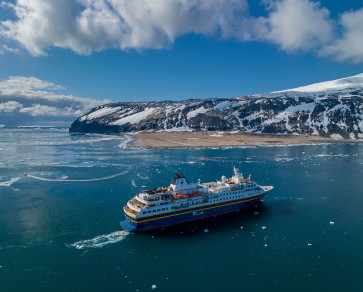
The ship arriving to Cape Adare

Sea lions on Macquarie Island
The voyage, In the Wake of Shackleton, retraces the routes of early Antarctic explorers. Heritage Expeditions runs multiple trips each season on vessels carrying up to 140 guests.
“As soon as we set off, I knew it would be the hīkoi of a lifetime,” Kara says. “The other guests on board were so interesting. They all came from diverse socio-economic
backgrounds and had a real hunger for adventure.”
Just two days into the journey, the vessel reached the Snares Islands – a protected subantarctic conservation hotspot. “The scale of biodiversity in such a small area was overwhelming. We were looking at a completely untouched landscape. We couldn’t even step foot onto the island.”
From there, the voyage continued steadily south, deeper into the Southern Ocean. Each day brought new encounters with wildlife and the awe of the Antarctic environment.
“There was a period where we had whales beside the ship every single day – it was incredible.”
The group also witnessed penguins, sea lions “as big as the zodiac,” and the aurora australis lighting up the sky in streaks of green and violet. Navigating the Southern Ocean provided both physical and emotional challenges.
“Getting out of the ship into sideways driving snow in 0 degrees, in a boat sitting in an ocean with a two-metre swell and stepping off into the zodiac was a unique and challenging experience,” she recalls. “But making the leap every day was so worth it for what we got to experience.”
Kara and others gathered mussels and pāua for genetic testing, supporting research on whale migration and oceanographic patterns.
“There is real research happening on these trips. Being part of that mahi grounded our cultural contribution in something bigger. It proved that the knowledge systems we carry can inform and enrich Western science.”
The expedition also included visits to historical sites like the huts of Shackleton and Scott. “It was eerie,” Kara says. “Like walking through
a moment in time.”
Another defining moment was visiting the carved pou at Scott Base. “We were able to greet and hongi this amazing taonga and presence and know that our people were with us in that moment,” Kara recalls. “There is a piece of us there – physically and spiritually.” But the vast, stark landscape had its own emotional weight.
“One of the things that stood out that I didn’t expect was how much you miss the ngāhere, greenery, and trees. Coming from South Westland, where I’ve been immersed in the native bush all my life, I looked around and saw nothing that symbolised home.”
Life on board was a blend of science, learning, and cultural sharing. Each evening, scientific lectures were delivered by the ship’s crew and researchers, and Kara and Rachael were invited to lead three sessions on Kāi Tahu history, pounamu, and te reo Māori.
A trip highlight was the Waitangi Day celebration led by Kara and Rachael, where guests wove three kono. “One stayed on the ship, one was given to Te Rūnanga o Hokonui, and one to Te Rūnanga o Ngāi Tahu,” Kara explains. “It was a way to leave a piece of ourselves in each place.”
For Kara, a key takeaway was the hunger for indigenous narratives. “There was a glaring gap in the stories being told – no connection to Māori voyaging or knowledge. That’s what Murihiku Regeneration is hoping to change.”
Murihiku Regeneration is focused on restoring and enhancing connections with the Southern Ocean, from local waters to the Antarctic. Their vision includes creating new pathways for rakatahi and rūnaka members to engage in scientific, cultural, and environmental roles related to marine conservation. The initiative also seeks to influence
policy, foster capability, and ensure iwi voices help guide decisionmaking in critical conservation areas. This journey marked an early milestone in Heritage Expeditions’ engagement with iwi, helping to build shared knowledge and respect for the region’s cultural and ecological significance. The kaupapa is about more than participation – it’s about re-indigenising spaces.
“Many people travel to Antarctica from around the world, and there are very limited spaces for New Zealanders. We have a role and a responsibility to ensure our voice is present in these places – not just as a cultural addition, but as leaders in conservation.”
She believes indigenous knowledge is essential to the Antarctic space.
“It goes beyond legends and myths. Our kōrero and experience delve into science, conservation, weather knowledge – all borne of thousands of years of adventuring in this space. As indigenous people, we don’t view species in isolation; we view them as part of
the wider cycle.”
Murihiku hapū have voyaged to the subantarctic islands for generations. That voyaging legacy, Kara says, is part of the reason she felt compelled to go. “We need to share our kōrero and experiences with the world, and we need to be the ones holding the pen. What we bring to the experience is a valuable commodity, and we need to be conscious of who we share that with.”
Looking ahead, Murihiku Regeneration plans to develop culturally embedded resources and create more opportunities for iwi to be involved in future voyages. They also aim to engage in broader discussions around conservation ethics, indigenous inclusion, and Antarctic access.
“When you’re used to being Ngāi Tahu among your peers, you forget the power of that outside of your own context. It was a reminder that there is always a role to be played in sharing our perspectives – particularly when it comes to protecting the places most vulnerable to change.”

Kara and Rachael
 Top
Top