Celebrating 25 years of supporting whānau wellbeing
Dec 19, 2025

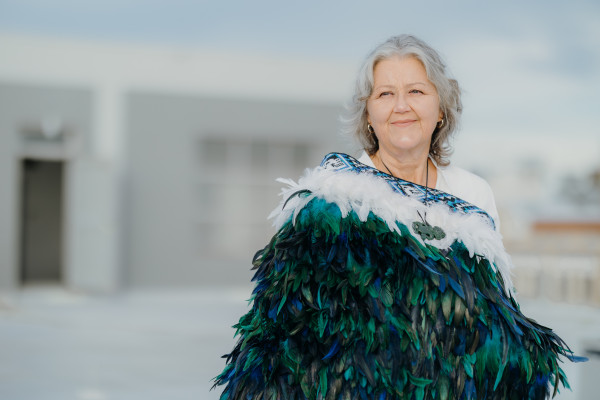
Tracey Wright-Tawha
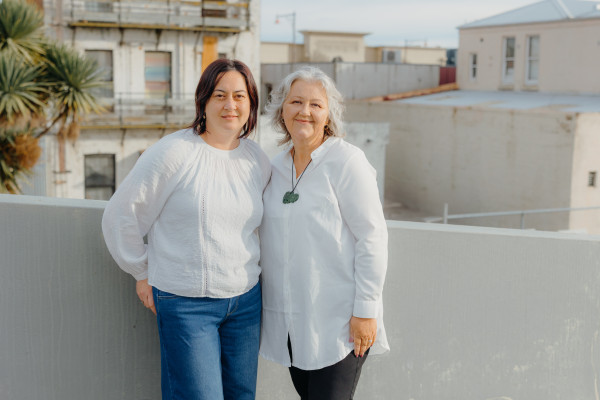
Melanie Reid (Genereal Manager) and Tracey Wright-Tawha (Kaiwhakahaere) of Ngā Kete
Celebrating 25 years of supporting whānau wellbeing
Nā, Anna Brankin
From working in a stationery cupboard with no computer or money, Tracey Wright-Tawha has built Nga Kete Matauranga Pounamu Trust into an organisation that touches thousands of lives each year. As the Murihiku charitable trust celebrates its 25th anniversary, its founder and CEO reflects on the journey, the kaupapa, and the tipuna who light the way.
EVERY SO OFTEN TRACEY WRIGHT-TAWHA (KAI TAHU – ORAKA APARIMA) MAKES TIME IN HER BUSY SCHEDULE TO sit down in the reception area of Nga Kete Matauranga Pounamu as if she’s a whanau member arriving for an appointment, rather than chief executive of the busy agency.
“I think it’s important to experience the meet, greet, seat encounter that whanau have when they come into our space,” Tracey says. “One day I was downstairs in our GP practice and I decided to just sit in reception for a minute. I wanted to see if it was warm enough, if the TV was too loud, if people seemed comfortable and happy. This kaumātua came in and sat down and looked across at me and said ‘It’s warm in here, isn’t it?’ and I asked if he wanted me to open a window. He replied ‘I’m not talking about the temperature. I’m talking about the people.’”
That moment – captured in a chance encounter – speaks to everything Tracey and her team have built over the past 25 years. Nga Kete Matauranga Pounamu Trust isn’t just a health and social services provider: it’s a place where people can bring their whole selves, where a taua’s visit to the GP might naturally flow into conversations about budgeting advice for her children and safe sleep for her mokopuna.
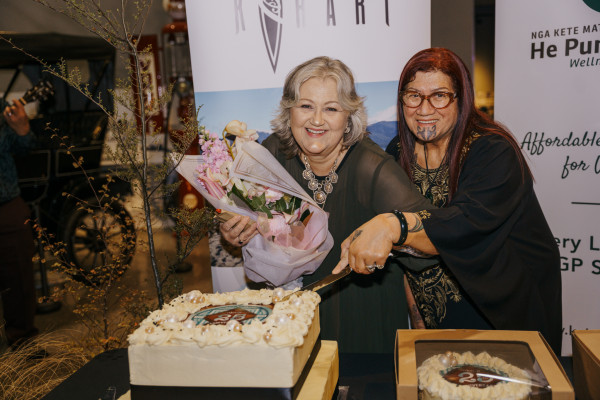
Tracey Wright-Tawha with Marcia Te Au Thompson at the 25 year anniversary celebration
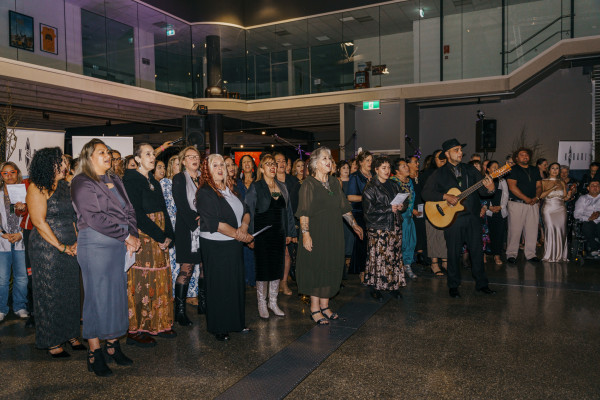
Nga Kete kaimahi in waiata at the 25 year celebration
The Trust’s story began in September 2000 in a stationery cupboard in the office of Te Puni Kokiri in Invercargill. “I had no money, no computer and, frankly, no idea,” Tracey laughs. What she did have was the mandate of her rūnaka, Oraka Aparima, and an unwavering belief that whanau in Murihiku deserved better health outcomes.
Over the course of a single year, several kaumatua had died unexpectedly and Tracey started thinking about the alarming statistics
around Māori dying 10 to 12 years younger.
“I remember talking to Whaea Dawn Wybrow and she said ‘Well, why don’t you do something about it?’ I pointed out I had no experience in health and she said, ‘Yeah, but you’re a good project person. You can pull the building blocks together and manage it all,’” Tracey recalls.
“So with the backing and mandate of Oraka Aparima and guiding health stalwarts, which was really important to me, I got started. I was pretty determined to make it work – I also had a mortgage and two tamariki, and I needed an income.”
That determination paid off four months later when Nga Kete Matauranga Pounamu Trust secured its first contract with the Land
Transport Safety Authority, which gave them money to work with whānau who didn’t have roadworthy vehicles, helping them to get licensed and able to access essential healthcare.
That first contract was just the beginning. In its first year Nga Kete transported about 1,600 people into primary health services. By the second year it was more than 2,000. Today, the agency has 126 kaimahi, about 40 key contracts, and an annual budget of around $12 million.
There are about 140,000 encounters with whanau each year. It runs two GP practices, mobile nursing, and mental health services. Their mental health and addiction counselling service is a pillar of the agency and has seen exponential growth.
For Tracey, these details tell only part of the story. “Nga Kete is really based on believing that whanau are the experts in their own world. We get the privilege of walking with them when they need some support to navigate a certain issue or break cyclical behaviours.”
Compliment Tracey on the organisation’s success and she will immediately deflect praise, telling you about her first employee, Teina Wilmshurst, who has been with the agency for all of its 25 years, or her general manager Melanie Reed, whom she says is so in sync they can finish each other’s sentences.
She also highlights many other kaimahi who have made Nga Kete Matauranga Pounamu Trust what it is today. “This isn’t the pursuit of one, it’s the pursuit of many. I might be the CEO, but this organisation simply wouldn’t be here if it weren’t for the amazing staff who actually turn aspirations into reality.
“It’s about the alchemy of a range of skills and experiences that come together and illuminate a way forward.”
This philosophy permeates everything Nga Kete does. When staff bring their whole selves to work – perhaps a registered counsellor who
mentions she loves art – Tracey’s response is to explore how that gift can serve the community, and suddenly Nga Kete can offer art therapy.
The result has been a suite of innovative programmes and approaches that funders regularly praise, and a workplace where staff feel supported and empowered to do their jobs well.
While funders praise their innovation, the feedback that matters most to Tracey comes from whanau – like the kaumatua in reception that day, or the man she interviewed after he spent time in the crisis respite centre, a former motel repurposed for mental health respite care and stabilisation.
“This person had been diagnosed when he was 16. He told me that since that day he had been made to feel like he was a mental health patient and nothing more. “But when he came to us, he said, ‘You just asked me my name, and then I just got to be there. I had my own room, my own bathroom, I was encouraged to join in activities like planting the garden or going down the beach to collect driftwood, to help cook dinner or just to enjoy having it cooked for me. I feel that I have a voice, that I can contribute, that there’s a place I belong.’”
That sense of belonging and contribution isn’t accidental – it’s built into the organisation’s foundational model. Te Poha Oranga is drawn from Murihiku’s traditional muttonbirding practices.
“If you look at tikaka and hauora for the deep south, it was definitely associated with our tītī practices. It takes a whole whānau to achieve that, from harvesting the birds, to processing them, to actually creating the pōhā,” Tracey says. “If you unpick that, it’s about the intrinsic worth of every member of that whanau and the contribution they make to their wider whānau. It’s about whakapapa: our people, our practices and our places – altogether these things create a watermark of how we do what we do as an agency – we are stronger together.”
Tracey’s grit and determination, and her deep connection to Murihiku and its people, were inherited from her family. She comes from a working class whanau who understood the value of determination and community contribution.
Her father worked as a grader driver and later in the freezing works. Her great-grandfather, George Radford (Kāi Tahu, Kāti Mamoe,
Te Atiawa), was a firefighter in Wellington who moved to Te Anau in the late 1940s, felled trees and milled the wood to build a general store he and his wife ran for years.
“I grew up in Te Anau, and we travelled around a lot between one set of grandparents in Orepuki and another set in Te Anau,” Tracey says.
“My great-grandmother lived out at Colac Bay, where our marae is, and I remember being out there and helping her bring the cow in for milking, making butter and cheese, as well as getting meat out of the meat safe.”
From a young age Tracey was drawn to helping others. “I was always the kid in the neighbourhood who was rescuing animals – I came from such a nurturing, loving family that I guess I had a bent towards those kinds of things.”
But it’s her tipuna from further back who truly guide her path. Tracey tells the story handed down to her, of Mereana Teitei, daughter of Pahi and Paki, who made the remarkable decision to travel by waka from Cosy Nook to Moeraki.
“Her father had drowned at sea, and she wanted to get to Moeraki to live out the rest of her days with her sister,” Tracey recounts. “The story goes that when she was rounding the Otago Peninsula a storm broke out and she recited karakia to call two whales to come either side of the waka to create ballast.
“Then, as she approached Moeraki, her sister was woken by the birds and was able to run down to the foreshore in time to call the
waka in.”
The lessons of Mereana Teitei were reinforced by experiences Tracey has had over the years, exploring the southern islands visited and
occupied by her tīpuna, a rare opportunity to see middens with evidence of fires and sleeping areas.
“Our people made their way across the ocean and across those islands, and when I followed those footsteps it made me really emotional,” she says. “They didn’t just want to survive, they wanted to grow and flourish. They had dreams and aspirations. Here I am today, a continuation of their footsteps, and I just want to do them proud.”
That sense of continuation, of being part of something that stretches back through generations and forward into the future, shapes how
Tracey thinks about succession. “I’m nearing the end of my career. So now it’s about handing on the mantle to somebody else and preparing for me to exit or do something quite different.”
Characteristically, she is approaching this transition with the same consideration and insight she has brought to her role over the past
25 years. “You have to have a sense of paying it forward when you move on from something, to help role model or shine a light for others who dare to step forward into leadership or senior management roles.”
There is no doubt Tracey will leave big shoes to fill. Thousands of whānau are healthier, more connected, more able to flourish because
one determined wahine decided her people deserved better – and then made it happen, one encounter at a time.
“I see my role as having been the holder of the moemoeā – that we as Māori can cut our own track forward to wellbeing, that we put our own tikaka and customs at the forefront of the way we do things,” she says.
“Our ancestors didn’t get it wrong. They were highly intelligent, influential, entrepreneurial can-do go-getters. We are the living footprint of their work. In a hundred years’ time I hope my own mokopuna look back and say, ‘Well, that old girl didn’t know much, but she gave it a bloody good try.”
 Top
Top