He Whakaaro: We are not the radicals
Aug 4, 2025

The following is an extract from Kaiwhakahaere
Justin Tipa’s Waitangi Day 2025 address at Ōnuku.
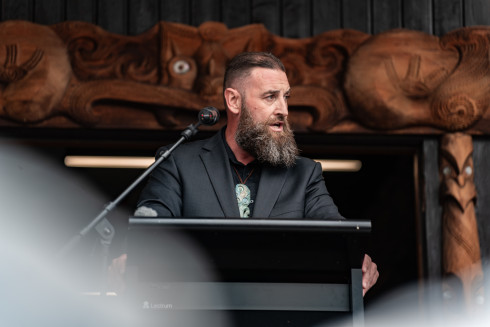
Jutsin Tipa
HE WHAKAARO: We are not the radicals
The past couple of years have witnessed a dramatic shift in the cultural and political
landscape of our country. The 2023 election consummated this shift and, as a result,
we’ve seen a clear deterioration in the Treaty relationship in the past 18 months.
We’re living through a critical juncture in our history, where the machinations of modern party politics threaten to corrupt the dignity of our nation’s complex and contingent identity.
One thing I want to say upfront is: “We are not the radicals”.
As our politics have become more polarised, I’ve become increasingly aware of how the ‘radical’ label is used to undermine the constitutional identities of iwi Māori and cast iwi corporate entities as inherently nefarious. I take issue with that narrative.
We are not the radicals. A nation is not a blank canvas!
It’s an inheritance.
It’s our inheritance – all New Zealanders.
It’s a real place, home to real people living real lives, whose collective experiences have shaped a real and defined history.
For New Zealand, that history begins with Te Tiriti o Waitangi. Te Tiriti is not just words on a page. Real people stood across from each other, each with their own understandings and intentions, each with their own mana and mandate, and each making the decision to intertwine their fates, mō ake tonu atu.
Here at Ōnuku, it was Iwikau and Tīkao who signed Te Tiriti. Many of their descendants are among the Ōnuku and Kāi Tahu whānau looking after us today. That’s why, as Kāi Tahu, we return each year to the sites where Te Tiriti was signed in our takiwā.
To remember that Te Tiriti o Waitangi is not merely a relic of a long-forgotten and distant past, it’s (both literally and figuratively) part of the ground on which our nation stands.
I think that’s one of the things that has annoyed me most about public discourse. These were the instructions Captain William Hobson received in 1839 from Colonial Secretary, Lord Normanby.
The Articles of the Treaty are also clear:
• Right to Govern
• Protection of Tino Rakatirataka
• Same Rights and Duties
That’s our starting point.
So, when Iwikau and Tikao signed Te Tiriti here at Ōnuku, they committed to a constitutional monarchy where the right to govern rests on the protection of rakatirataka; and to a society where their people and descendants would enjoy the same rights as the settler population.
They did not commit to a constitutional republic where the rights of the majority consistently override those of the minority, and in which the rakatirataka – the distinct rights and authority of iwi Māori – would be erased entirely.
We should not abandon the unique elements of our national inheritance in favour of the ever-shifting political moods that dominate our social media feeds.
Whatever path we take forward from here should be built on the real and dignified authority of our shared past, rather than on the vague and amorphous ambitions of those who would rather impose their own ‘tyranny of the present’.
And I’m not saying there isn’t room to disagree about what it means to give effect to Te Tiriti and Treaty principles.
What I’m saying is that we’ve got to have these disagreements in good faith — without making a mockery of the complex and contingent nation we’ve inherited.
I think we’re failing at that at the moment. And it’s not just the Treaty Principles Bill, it’s a general attitude of some in this country that is dismissive and disrespectful of the unique constitutional identities of Iwi Māori.
‘We are not the radicals.’ on Treaty matters over the last 18 months.
Too much of the conversation has been focused on abstract philosophical debates about the nature of sovereignty and the true meaning of liberalism.
Rather than helping us to deepen and refine our understanding of modern New Zealand as it actually exists, these abstract philosophical debates have been used as smokescreens to advance shallow ideological agendas and play party politics.
True political leadership is about meeting people where they are and synthesising the interests of various strands of society into a workable whole. It’s a complex and messy task, but it’s important.
When there’s an absence of this type of leadership, voices that represent comparatively simpler and shallower viewpoints begin to shine through.
Not because of the strength of their position or mandate, but because they’ve got a simple philosophy that provides simple answers to the complex questions we are inevitably confronted with.
This is why our political debates – particularly those concerning the Treaty – have come to be dominated by minor parties.
Our major parties are struggling to articulate a political vision that builds on the distinct character of our nation – one that people can embrace with confidence and commitment.
So instead, we get an ACT party neoliberal thought experiment, posing as a source of moral principle and national unity. And we’ve seen what that’s doing to our social fabric!
If our country continues to divide and fragment, we will lose the trust and stability – we will lose the fundamental good faith – that makes economic growth and prosperity possible in the first place.
I don’t have all the answers, but on the Treaty question I think it starts by getting back to basics and putting a stake in the ground.
‘Sincerity, justice, and good faith.’
 Top
Top