Rāpaki School House Reopens
Aug 4, 2025

Nā Ila couch
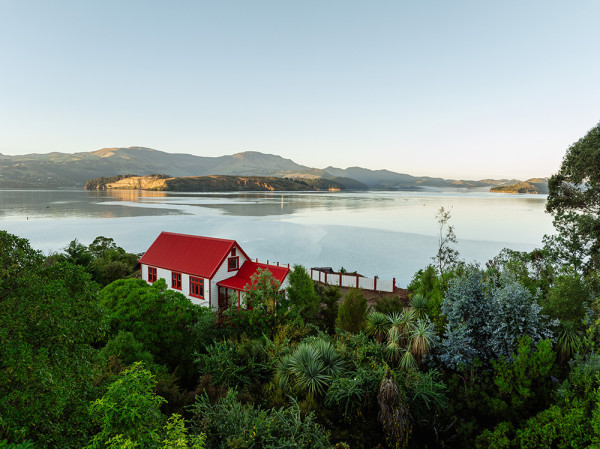
Providing spectacular views of Whakaraupō, the newly renovated 150-year-old schoolhouse at Rāpaki was relocated away from the cliff-face to protect it from ongoing coastal erosion.
Whāia te mātauranga hei oranga mō koutou
“ALRIGHT, WE NEED OUR ELDERS UP THE FRONT,” COMES THE COMMAND to the rōpū gathered outside the newly refurbished Rāpaki whare kura. “Who are you calling old?” a lone voice answers back. The group breaks into laughter. Karakia signals the beginning of the Whakatuwhera, and the group files into the sunlit schoolhouse. The weather is perfect for reopening the old schoolhouse, or the Rāpaki Native School as it was known when it first opened on November 5, 1876. About 50 tangata whenua and manuhiri have gathered inside, including former students Aunty Trudy (Gertrude) Warnes and Robert Tikao. And sitting alongside them is Aunty Doe (Reihana) Parata, former Te Waipounamu Māori Girls’ College, Christchurch matron. Too young to attend classes at Rāpaki before the school closed in 1946, she still remembers waiting outside the kura for lunchtime when the big kids would come out to play.
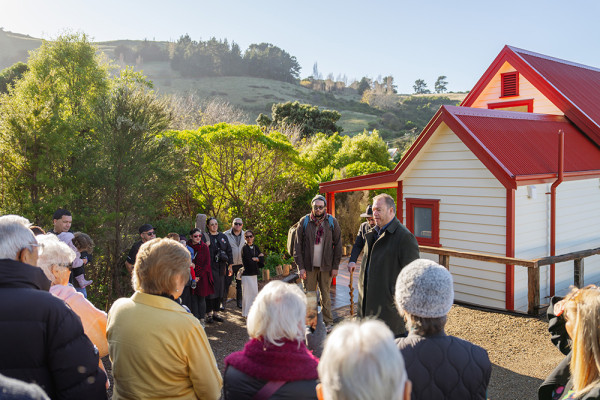
Outside, tamariki are exploring the newly fenced-in school grounds, climbing over 150-year-old foundation stones left in place to indicate where the schoolhouse once stood. Initial restoration plans proposed keeping the building in its original spot, but the threat of ongoing coastal erosion led to moving it away from the cliff-face. As for the renovations, priority was given to preserving and enhancing much of the existing structure. However, meaningful changes were made, including a newly constructed window on the northwestern end of the building that features a perfectly framed view of Te Poho o Tamatea. All original sash windows were restored and double-glazed, including a window fitted for scenes shot in the schoolhouse for the 2022 film, We Were Dangerous.
The front door of “the old hall”, Te Wheke, donated by Dame Whina Cooper decades ago, was set aside when the building was brought down and has since been repurposed as the new external door near the kitchen. Sunlight floods the schoolhouse, and kaiwhakataki, Nathan Pohio,
shares his thoughts on the colour scheme.
“I was honoured to be asked to look at the materials and from there make decisions for us. I started with the roof, and I wasn’t sure about it at first, but the colour we have, spoke to me the most. It reminded me of the kokowai we would get at Red Cliffs. It had a whakapapa to it. It’s an exterior colour that links back to our wharekarakia. Inside, we’ve got a chalky feel that reminds me of Ōamaru stone. It makes us feel warm, at home and awhi.”
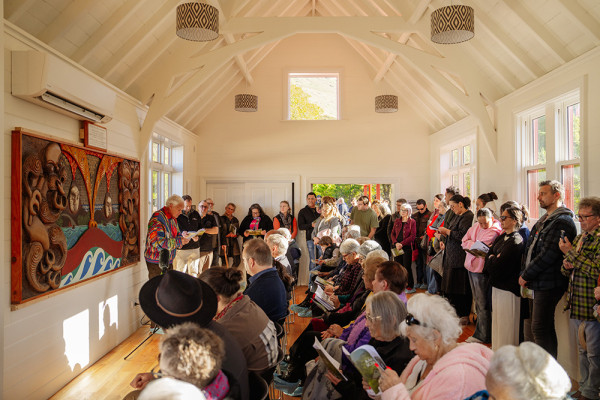
Mātua Donald Couch addresses manuhiri and tangata whenua, celebrating the opening of the newly renovated schoolhouse, which first opened on November 5, 1876
Guest speaker Areta Wilkinson, whose tāua, Marewa Elizabeth Manihera, taught in Port Levy and the Rāpaki Native School before becoming the first wahine Māori principal in the North, shares her whānau history with the rōpū.
“I gather that the Rāpaki Native School was Marewa’s first teaching assignment after graduating from teachers’ training college sometime in the 1930s. She was known as “teacher” as most of her students were whānau. Tāua took teaching very seriously and promoted education, but sadly this came at a loss of te reo Māori in our whānau. “I am thrilled the schoolhouse has been renewed and will present opportunities for knowledge transmission and exchange.”
Mātua Donald Couch rises to address the group. A former teacher and author, he is writing several pukapuka, including one about the schoolhouse. Donald speaks about the significance of the building and what it means to him as a descendant of one of its foundation students.
“This place played a big role when we had to adjust to newcomers and learn to read and write. Every whānau will tell a different story. For instance, the very first class, my taua Kitty Paipeta, was there. “I’ve always looked at my taua as a real example of a bilingual, bi-cultural person. She knew both languages and both cultures. She came back here as a teacher, and she knew her way around the Pākehā culture. As one of her descendants, I’m grateful for that. This place has given a lot of people a chance to get on in the new world.”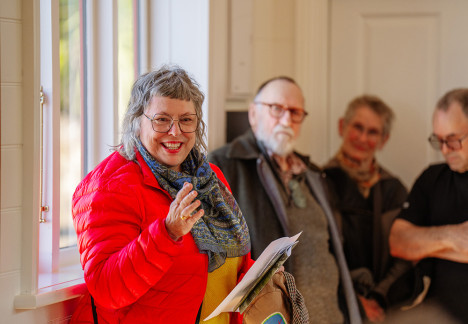
Above, from top : Areta Wilkinson shares memories of her Taua, Marewa Elizabeth Manihera, known as ‘Teacher’ by those she taught at The Rāpaki Native School.
The rōpū gathers outside as the whakatuwhera begins.
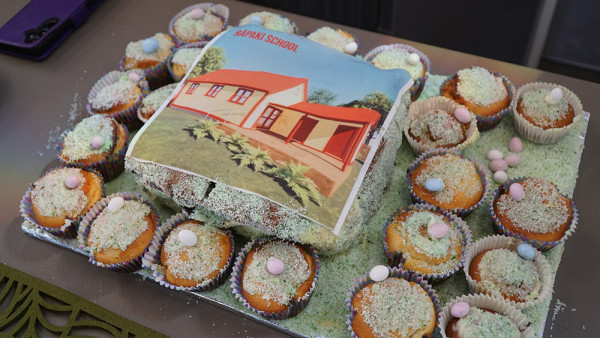
Celebrating the day with a cake that perfectly captures the newly renovated schoolhouse (PHOTOGRAPH: ILA COUCH).
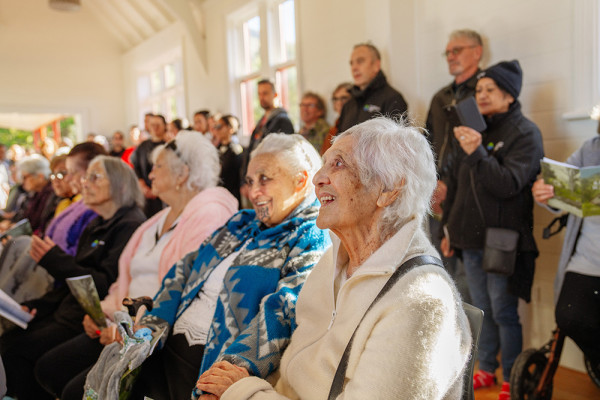
Mauhiri and tangata whenua listen to speeches in the schoolhouse, warmed by the sun and insulated by new double-glazed windows.
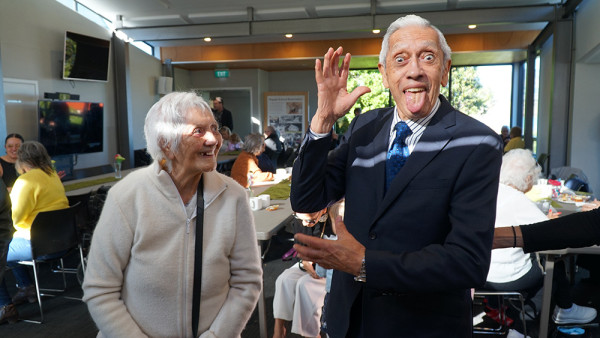
Pūkana! Special guests, former Rāpaki students Gertrude ‘Trudy’ Warnes and Robert Tikao.
At the start of speeches, the rōpū join in waiata. The final act of opening the schoolhouse is carried out by Robert Tikao, who unveils the new plaque. Back in the wharekai, over cake and coffee, memories are shared. A schoolhouse history video plays in the background and a memento of the day’s celebrations, a keepsake booklet, is distributed.
The following text is from that booklet.
Rāpaki School: A brief history
Nā Donald Couch
During its 70 years of operation, Rāpaki School provided more than 100 tamariki with the opportunity to live safely at home with their whānau, within the community they knew, while gaining the skills they needed to survive and thrive in a changing world.
Rāpaki Reserve 875 was given legal status in 1870, and as was the policy of the time, the expectations were placed on Māori to set aside land to build their schools and share in the cost of the buildings and teachers’ salaries. With the goal of assimilation, the 1867 Native Schools Act only allowed for English to be spoken in these schools.
On 5 November 1876, Rāpaki Native School opened. The earliest class list, dated November 1878, included nine pupils:
Richmond Momo [Te Retimana Momo] b. 19 Nov 1869 (9 yrs)
Walter Momo [Waata Momo] b. 23 Dec. 1868 (10 yrs)
William Levy [Wi Riwai] b. 1869 (9 yrs)
Patahepa Kelly [Patehepe KuiKui Pere] b. 1868 (9 yrs)
Emma Piper [Ema Paipeta] b. 31 May 1866 (12 yrs)
Kitty Piper [Kiti Paipeta] b. 9 March 1868 (10 yrs)
Margaret Piper [Makareta Paipeta] b. 24 June 1870 (8 yrs)
Putere Tuti [Puruti = Flutey / Fluerty]
Miriam Solomon [Horomona]
There may have been up to another nine children of school age in Rāpaki at that time, but some parents resisted the new ways and kept ttheir children home. Primary school attendance was not compulsory for Māori until 1894. Despite the Government policy to ‘Europeanise Māori’, mātauraka endured. There are regular references to Rāpaki children singing “native songs” or performing “action songs”, all of which required te reo Māori. It remained a regular part of school activities, whether the teachers were Pākehā or Māori.
By 1881, the class roll at Rāpaki School was 30. Little River had 17 students, Ōnuku 40 (including a large number of Europeans) and Kaiapoi (Tuahiwi) 49. That same year, Native Schools were transferred from the Native Affairs Department to the Education Department. Official public records in the Appendices to the Journals of the House of Representatives (AJHR) sing the praises of Rāpaki School and its students.
1881 “Excellent results were obtained at Rāpaki.”
1883 “Rāpaki always makes a good appearance at examinations,
this time it did particularly well.”
1884 “The Rāpaki people have always shown an encouraging interest
in their children’s education.”
1886 “Rāpaki is always a capital school, and it still is.”
1887 “The Natives deserve very great credit for the way in which
they keep up the attendance under rather disadvantageous
circumstances.”
The “disadvantageous circumstances” referred to catastrophic illnesses that plagued the kāika in the latter years of the 19th century. In 1898, teacher E.A. Hastings detailed the devastating effects of rubella, measles and influenza among his attendees.
“For months past, there has been much sickness, owing in many cases to hard living and privation. This settlement has been suffering from a serious epidemic of influenza.”
His descriptions make for difficult reading. A teacher at Rāpaki from 1895 until 1904, and again from 1911 to 1922, Hastings wrote several letters to Wellington, imploring the Government to contribute to the purchase of medicine and other essential supplies.
At his retirement celebration in the Rāpaki Hall, Hastings was presented with a piupiu. One hundred years later, in 2023, his descendants returned the piupiu to Rāpaki. The taoka is now temporarily but safely kept in Te Puna o Waiwhetū the Christchurch Art Gallery.
By 1908 it was determined that the Māori of schools in North Canterbury district were practically “European in habits of life and thought” and, therefore, there was no real reason for the separate existence of Native schools. The Native schools at Kaiapoi, Rāpaki and Little River became state schools.
During the Depression, from February 1930 until November 1932, Rāpaki school was closed. The Canterbury Education Board decided to transport Rāpaki children the three and a half miles to West Lyttelton Primary School by taxi, not bus.
Amongst the recorded memories of former students who attended. Rāpaki School are reflections from Douglas Couch, a student from 1938 until the end of 1945. He recalled two classrooms – one with a kitchen sink and cupboards.
The main classroom had an open fireplace; light was provided by kerosene lamps hanging on a pulley from the main classroom ceiling. Senior boys had to split firewood and fill coal buckets to heat the main classroom.
There were also school vegetable gardens and flower beds. Subjects taught included the alphabet, English, spelling, writing, reading, arithmetic, multiplication, history and geography.
Rāpaki School wasn’t exclusively for Māori children. The Wilkens family lived just west of Taukahara towards Governors Bay, and some of their children attended Rāpaki School. During the war there was food rationing, but it was also a time when Rāpaki School pupils and their families provided “Māori entertainment” to help raise patriotic funds to assist the Armed Forces overseas. These performances were held in Lyttelton’s Harbour Light Theatre or local halls.
While rolls for the school have been hard to find, the last class of 1946 records these students:
Rachel (‘Topsy’) Keith Marewa (Nuke) Tikao
Elena (Lena) Tikao Hine (Tweet?) Tikao
Waitai Tikao Robert Tikao
Josette Hutana Edward Hutana
Hine Ari Hutana Riri A E McConnell 9
Joseph Garner A Gavin Couch
After Rāpaki School closed, it was off to West Lyttelton School again by taxi (with some to St Joseph’s). When the passenger train from Lyttelton to Christchurch stopped in 1972, some students biked to Governors Bay and caught a bus over the hill to Cashmere High School. Others went to Linwood, Hagley, Shirley Boys, Avonside and Sacred Heart.
Several Rāpaki girls went to Te Waipounamu College. The 1970s and 1980s were probably the low points in terms of traditional Rāpaki culture. In the late 1980s, the Government introduced the Maccess programme, a Māori Access Scheme and part of the Mana Enterprises Development Programme, which subsidised employment schemes tailored to Māori.
In Rāpaki those programmes were located at the schoolhouse. By the 1990s, Kōhaka Reo were being established in the Ngāi Tahu takiwā and Rāpaki mothers decided to establish a pre-school playgroup in their community. It would seek to use te reo and Māori cultural behaviour whenever possible but not be tied to the stricter requirements of a formal kōhaka.
Funding was available from the Government and the Rāpaki rūnanga agreed to make the old school building and site available. There was much work to be done. The building had to be completely painted, a new wharepaku was built, and an access bridge across Ōmaru stream.
Thanks to volunteers the playgroup ran from 1995 until 2001. At least 15 former Rāpaki tamariki became teachers and of those, seven attended Rāpaki School.
Rāpaki has seen fit to rehabilitate this school building, and the hapū to recognise and be proud of this essential part of our history. We can be sure the Rāpaki Schoolhouse will continue to be well-used.
 Top
Top