Restoring the mauri of Rakiura
Dec 18, 2025

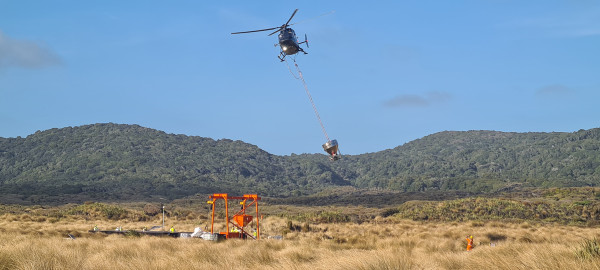
A helicopter distributing bait as part of the operation to save the pukunui
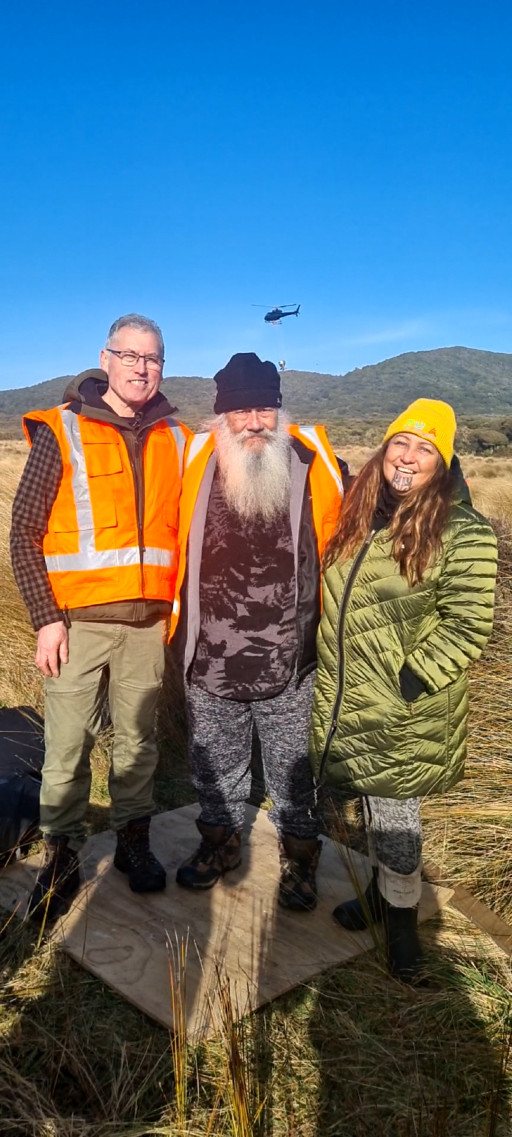
Tāne Davis Stewart Bull and Estelle Pērā Leask
Restoring the mauri of Rakiura
Nā Deborah McPherson
TO THE UNASSUMING TOURIST, RAKIURA MIGHT SEEM LIKE A HAVEN FOR native wildlife. Being greeted by kākā and tui at your accommodation and seeing adverts to join kiwi-spotting tours can give first-time visitors the impression the island is an untouched paradise. But first glances can be deceiving. While the absence of stoats has allowed larger birds such as tokoeka/brown kiwi to persist, many species that once thrived on Rakiura disappeared decades ago as ecosystems that were once in balance failed to adjust to rats, cats and possums.
Some taoka such as the hakuwai/tutukiwi/Stewart Island snipe, South Island kōkako, pekapeka/greater short-tailed bat, and matuhituhi/cbush wren were lost forever.
Kākāpo were removed from Rakiura in the 1980s and 1990s and relocated to the safety of predator-free islands such as Whenua Hou.
Other species have found refuge on neighbouring Ulva Island and the predator-free Tītī Islands. But those that have managed to cling on are in peril of losing the battle for survival.
Among these are the hoihō/yellow-eyed penguin and the pukunui/Southern New Zealand dotterel. The trajectory of the pukunui population puts it on course for imminent extinction. With only 105 birds remaining and high vulnerability to predation by feral cats, the fate of this tiny manu is one of the many drivers for the Ngāi Tahu whanau working hard to make the dream of a Predator Free Rakiura a reality.
Tāne Davis, Estelle Pērā-Leask, Ulva Goodwillie and Stewart Bull are members of the Kāi Tahu leadership group advancing the Predator Free Rakiura kaupapa. In August they were invited to observe a significant milestone when the first phase of the predator control operation started on the island, targeting wild cats and rats living within range of the area where pukunui breed each year.
“It felt significant to be able to watch the work being carried out,” Estelle says. “This is the result of a lot of work by a lot of people, much of it non-remunerated. While the future of the pukunui is still uncertain, this predator control operation gives these taoka a fighting chance.”
Although important, the pukunui is only a small piece of the overarching vision, which is to restore the island so that kakapo and other wildlife previously found there, like the tieke, mohua and tītīpounamu, can return.
“It has been a long-awaited dream to bring back the mauri of the motu,” Tane says. “We really want to share with Kāi Tahu whānau how excited we are and how much we have wanted this for such a long time.”
Ngāi Tahu representatives from the four Papatipu Rūnaka ki Murihiku – Awarua, Hokonui, Waihōpai and Oraka-Aparima – have been instrumental in progressing Predator Free Rakiura.
“Predator Free Rakiura is an example of co-governance and co-management in effect,” Estelle says. “Without the Kāi Tahu voice through the Engagement and Advisory Group (EAG) and the level of support we have provided to the Department of Conservation, this
would never have happened.”
The EAG is an advisory body that acts as a connector between the project and governance teams and the community. Tāne Davis
represents the Rakiura Tītī Islands Administering Body on the EAG; Stewart Bull represents the Rakiura Titi Committee; and Gail Thompson is the representative for Awarua and the other Papatipu Rūnaka ki Murihiku. Together they work with Predator Free Rakiura community representative Ulva Goodwillie and Rakiura Māori Land Trust representative Riki Everest.
In her capacity as a trustee of Te Puka Rakiura Trust, Estelle is a member of the Ngai Tahu Leadership Group, which also includes the
five EAG members and Te Puka Rakiura Trust Co-Chair Dean Whaanga.
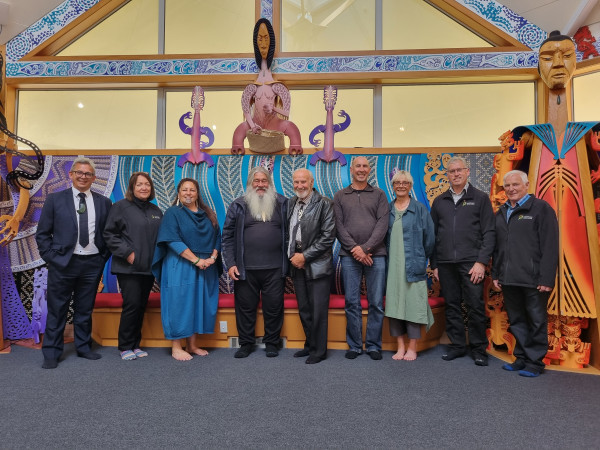
At Te Rau Aroha Marae, from left: Dean Whaanga, Ulva Goodwillie, Estelle Pērā-Leask, Stewart Bull, Michael Skerrett, Riki Everest, Gail Thompson, Tāne Davis, Gary Neave.
Al Bramley, Tumuaki/Chief Executive of Zero Invasive Predators, the organisation involved in delivering the Predator Free Rakiura project, says working in partnership with mana whenua is something ZIP strives for in its work.
“The support of Papatipu Runaka ki Murihiku and their role as kaitiaki to restore the mauri of Rakiura have been the driving force that has enabled this important kaupapa to go from an idea to action.”
Darius Fagan, General Manager – Predator Free Rakiura for Zero Invasive Predators, says the Kai Tahu whanau involved in the project
have been generous in sharing their matauranga to highlight why this work is so important.
“It presents an opportunity to rectify losses of the past and restore the mauri of Rakiura. “Our work has had unwavering support from Kai Tahu, especially when it has been difficult and the passion of the people is a huge motivator for us all.”
Key milestones for the project include the signing of the Predator Free Rakiura Memorandum of Understanding in 2019 by then Conservation Minister Eugenie Sage, local council representatives and Ngāi Tahu representatives, including Tā Tipene O’Regan.
In June 2023, strategy and research consultancy Kauati finalised the Ngāi Tahu Expectations and Aspirations Action Plan for Predator Free Rakiura, which serves as the foundation for mahi on the project, centred around the concepts of rangatiratanga and kaitiakitanga.
The success of iwi and whanau-led eradications of predators on the small islands surrounding Rakiura, including many of the 36 Tītī Islands, Rarotoka, Whenua Hou and Ulva Island, has enabled titi and other seabird populations to thrive.
The abundance of birds contrasts sharply with larger islands where birdsong in Rakiura National Park has become notable by its absence, as have the formerly large flocks of seabirds that used to congregate outside Oban. Murihiku kaumātua Michael Skerrett has seen the impact the arrival and removal of predators can have on island ecosystems.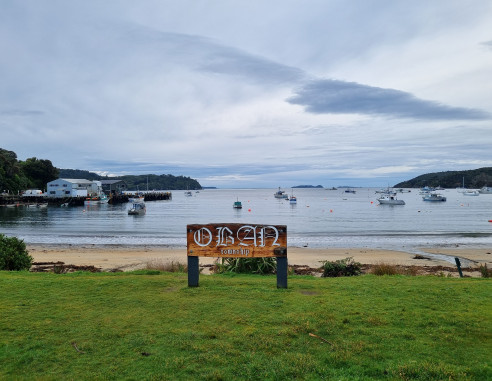
“I have been going to Taukihepa/Big South Cape Island for 71 years,” Michael says. “Before the invasion of rats, the noise of birds on the
island was incredible. In 1964, the rats invaded and the next year there was silence. “After the rats were finally eradicated 40 years later, not only did the birds flourish again but geckos, weta and seedlings also re-appeared. While none of us like toxins, 1080 is the best tool we have currently to hold the ground for our threatened species. “It is critically important that we do this – the offshore islands surrounding Rakiura cannot safely remain predator free until Rakiura is predator free.”
Estelle has also seen a glimpse of what Rakiura could be again through her involvement with the Motupohue Hill Environment Trust. In 2008, the Trust embarked on an ambitious restoration project to bring birdsong back to the area through trapping, weed control and habitat restoration.
During the years since the project began Estelle says she has seen bird numbers explode. “You see flocks of kererū in huge numbers on Bluff Hill now that you never saw before, and I was born and raised on Bluff Hill, so I know how silent it was. The understory and sub canopy in our forest is so lush that you cannot see five metres into it, whereas on Rakiura you can see
a hundred metres into it.”
In February, Estelle spoke at an event hosted by Te Rūnaka o Awarua at Te Rau Aroha Marae in Bluff, launching the entry of Rakiura, Maukahuka and the Chatham Islands into the Island-Ocean Connection Challenge (IOCC). The IOCC is a volunteer collective of non-governmental organisations, governments, funders, scientists, individuals and island communities dedicated to restoring and rewilding 40 globally significant island-ocean ecosystems by 2030.
While there is much support within the local community on Rakiura for the project’s goal of removing possums, feral cats, rats and hedgehogs from the island, the use of toxins such as 1080 is opposed by some despite scientific evidence the poison is biodegradable, breaks down quickly and is rapidly diluted to undetectable levels in water.
“There has been Kai Tahu representation right throughout this project and Tane has been present at every consultation held with the local community on the island,” Estelle says. “We carry the responsibility to do this work with our tipuna on our shoulders and for our mokopuna.”
 Top
Top