Review | TIAHUIA: A KARANGA TO MY MOTHER
Jul 27, 2025

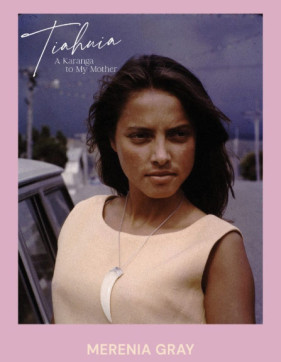 TIAHUIA: A KARANGA TO MY MOTHER
HUIA PUBLISHERS
RRP $45.00
The debut book Tiahuia – A Karanga to My
Mother by Merenia Gray (Ngāi Tūtehuarewa,
Ngāti Irakehu, Ngāi Tūahuriri and
Rangitāne), is a visceral and tender tribute
from an adult child to her mother.
Starting small, the work began as a
private love letter, as Merenia prepared for
her mother’s death. Under the guidance of
acclaimed author Witi Ihimaera, the writing
morphed into an essay on aroha through
the heartfelt poetry, evocative imagery and
intimate reflections that Merenia lovingly
shares with readers.
Tiahuia Ramsden (1944–2019) was a
daughter of Henrietta Merenia Manawatu
Te Rā, herself a granddaughter of Teone
Taare Tikao (c. 1850–1927). Tikao had an
encyclopaedic knowledge of Kāi Tahu,
particular the Canterbury region.
This book is not an essay on mātauraka
Māori, although it includes passages about
Kāi Tahu history, people and places.
Rather, Merenia Gray narrates the personal
and pivotal relationship Tiahuia had with
Te Puea Heerangi, (leader of the Kiingitanga
in the early 20th century), through the
author’s grandfather, Eric Ramsden. The first
Pākehā journalist permitted into the inner
workings of the Kiingitanga, Eric initially
interviewed Te Puea in 1927 and coined the
phrase ‘Princess of Māoridom’.
Eric and Te Puea became close. When
his pregnant wife, Merenia, was too ill
with tuberculosis to raise their baby,
Te Puea opted for the baby to be raised at
Tūrangawaewae under her watchful eye.
The book features original letters between
Te Puea, Merenia and Eric tracking the early
years of baby Tiahuia.
Merenia describes the pain her mother
spoke of decades later, at being torn from
Ngāruawaahia at nine years old and sent
to Wellington to live with a father and
two siblings she had never known. Her
survival is a tribute to the young woman’s
adaptability and nous.
Tiahuia went on to establish a career
and marry highly accomplished lawyer Neil
Gray. They raised a dynamic, social, artistic
family of five in Wellington. Merenia reflects
on the complex identity Tiahuia endured,
while committing to feeding her tamariki
a strong sense of being Māori in 1970s and
80s urban New Zealand.
Tiahuia – A Karanga to My Mother
oscillates from a child looking up to her
mother as a young girl, to being an adult
mother herself. It leaves a deep impression
of kissing a last goodbye to treasured elderly
parents, wishing we could speak to them
just one more time. 
 Top
Top