Review | TOI TE MANA: AN INDIGENOUS HISTORY OF MĀORI ART
Jul 17, 2025

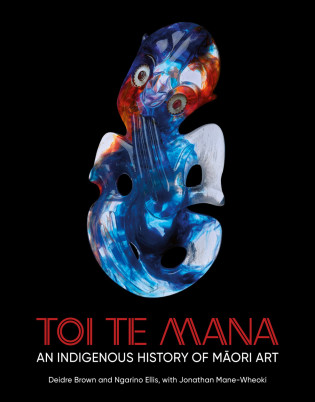
TE MANA: AN INDIGENOUS HISTORY OF MĀORI ART
Nā DEIDRE BROWN (NGĀPUHI, NGĀTI KAHU),
NGARINO ELLIS (NGĀPUHI, NGĀTI POROU),
AND THE LATE JONATHAN MANE-WHEOKI
(NGĀPUHI, TE AUPŌURI, NGĀTI KURĪ)
AUCKLAND UNIVERSITY PRESS
RRP $99.00
Toi Te Mana: An Indigenous History
of Māori Art has recently been
honoured with The BookHub Award
for Illustrated Non-Fiction at the 2025
Ockham New Zealand Book Awards.
This tohu is not just recognition of
academic excellence but a powerful
affirmation of toi Māori and the
mātauranga that sustains it.
REVIEW nā SASCHA WALL
Toi Te Mana: An Indigenous History of Māori
Art is a publication that reflects the vast
landscape of Māori art history.
A taonga in its own right, this pukapuka
reclaims, re-centres, and re-articulates
our narratives of toi Māori from a te ao
Māori perspective. Written by Deidre
Brown (Ngāpuhi, Ngāti Kahu), Ngarino
Ellis (Ngāpuhi, Ngāti Porou), and the
late Jonathan Mane-Wheoki (Ngāpuhi,
Te Aupōuri, Ngāti Kurī), it’s not just a book
but a whare kōrero – a repository of kōrero
tuku iho, whakapapa, and mātauranga
woven through centuries of toi Māori.
Structured through the guiding
framework of Ngā kete e toru: 1. te Kete
Tuatea, 2. Te Kete Tuauri and 3. Te Kete
Aronui, the book resists the linear nature
of colonial art history and instead follows
a kaupapa Māori approach to presenting
history and knowledge.
Each kete draws on the depth of
pūrākau, whakataukī, mōteatea and waiata,
embedding art forms within the rhythms of
whakapapa, whenua and wairua. In doing
so, te kaituhi ensures it is Māori voices that
guide the narrative.
From the intricate raranga of our tīpuna
wāhine to the whakairo of our whare
tipuna, from the curved lines of moko to the
contemporary media of digital art and film,
Toi Te Mana traverses the rich diversity of
Māori artistic expression. It does not treat
these forms as static artefacts — they are
atua, continuing to evolve and respond to
the world.
What sets Toi Te Mana apart is the way
it speaks to “honouring medium as mauri.”
Every material, from pounamu to pixels,
carries its own whakapapa.
Each form is treated as a continuation of Māori life and
being – not an adaptation but a becoming.
Whakairo lies at the heart of our visual
whakapapa. Toi Te Mana elevates its
importance not just as art, but as a container
of wairua and ancestral presence.
Wharenui are described not simply as architecture but
as living ancestors – their poutokomanawa,
amo and heke pulsing with the breath of
those who came before.
Regional distinctions in style are
celebrated as reflections of whenua and
hapū identity, reminding us that whakairo
is story and storyteller, and examples such
as Te Hau-ki-Tūranga or the more modern
innovations of Lyonel Grant’s Ngākau
Māhaki, serve to illustrate this.
The book weaves a moving narrative
around raranga and whatu – not as crafts
but as sacred acts of remembrance, care and
continuation. Kākahu are acknowledged
as vessels of mana, worn with dignity and
woven with aroha.
Examples are the Kahu
huruhuru of Te Arawa and the finely-woven
contemporary works of Veranoa Hetet,
which also represent intergenerational
mātauranga.
From the earliest photographic portraits
to mid-century printmakers, Toi Te Mana
recognises how Māori have consistently used
introduced media as visual demonstrations of identity and vision.
Early studio portraits become acts of
assertion and whakapapa. Artists such as
Paratene Matchitt and Cliff Whiting take
customary knowledge and embed it into
contemporary forms. Their mahi is not
about fusion – it’s about reclamation and
mana motuhake.
In Te Kete Aronui, ngā kaituhi reference
artists who move with light, sound and
code, reaffirming our atua are not confined
to past forms.
Lisa Reihana’s In Pursuit of Venus [infected] is
referenced as a dynamic reimagining of an early
encounter between Pākehā settlers and Māori,
rich with indigenous agency and critique.
These contemporary artists speak the
language of now, but do so grounded in
kaupapa and tikanga. They push beyond
gallery walls to reclaim space for our stories.
Alongside Lisa Reihana, the experimental
film work of Nova Paul and the immersive
installations of Shannon Te Ao stretch the
threads of whakapapa into new realms,
where mauri continues to flow.
Toi Te Mana reminds us our art is alive –
as much in our marae as it is in museums,
on screen and in the breath of every
karanga.
It invites us to bring our stories
forward, to honour the hands that made
them, and to trust the artists of tomorrow.
Toi Māori has never stood still. It moves,
it listens, and with mana, it leads. 
 Top
Top