Takapūneke: a sight of national significance
Dec 18, 2025

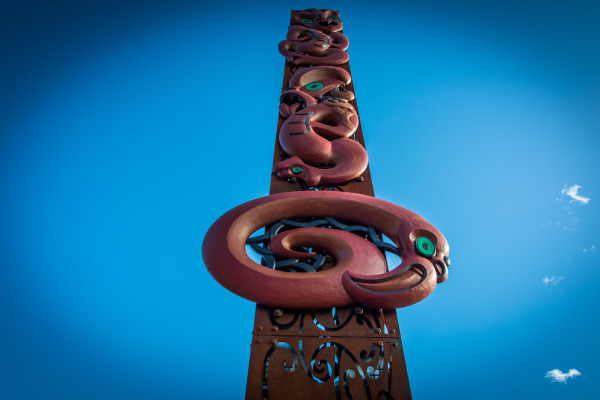
Takapūneke: a site of national significance
Nā Anna Brankin
Takapūneke is being transformed into a place of healing and learning. Through a partnership with Ōnuku Runanga and Christchurch City Council, Takapuneke will feature sculptural landscape design that tells the site’s stories, walking trails through regenerated native bush, a cultural centre and space for reflection. The story of this wahi tapu connects directly to Te Tiriti o Waitangi and, finally, it’s being shared.
WHEN RIK TAINUI, CHAIR OF ONUKU RUNANGA, DRIVES PAST TAKAPUNEKE on his way to Ōnuku Marae, he thinks about his brother every time. “As soon as I drive past there and see all the work that has been done, I’m instantly connected to him,” says Rik. “I keep thinking about how proud he’d be of what we’ve done as a whānau.”
His brother, the late Pere Tainui, along with George Tikao (Waitai) and Maurice Gray, were the visionaries who dreamed of transforming
Takapuneke from a desecrated dump into a place of healing and remembrance. Although all three tāne have now passed, their vision is
becoming a reality on the sloped site between Akaroa and Ōnuku, where one of Aotearoa’s most significant – yet least talked about – historical events unfolded nearly two centuries ago.
Takapūneke is first thought to have been occupied around 1820. As well as a small fishing village, it was known for its role in the thriving harakeke trade between local Kāi Tahu and takata pora. Harakeke was collected from various sites across the peninsula, then brought to Takapūneke to be prepared for trade.
“Uncle Pere used to say that Takapūneke was basically a harakeke processing plant,” says Keefe Robinson-Gore, a member of the co-governance group who has also become keeper of the site’s stories. “Ropes made from flax were superior to the hemp ropes that Pākeha
sailors had been using at the time.”
It was also the trading quarters of Te Maiharanui, the paramount chief of Kāi Tahu in the Canterbury region in the 1820s. In November 1830, Ngāti Toa chief Te Rauparaha arrived at Takapūneke aboard the brig Elizabeth, hidden below deck with a party of his warriors. Captain Stewart was ostensibly there to trade for flax.
When the Elizabeth came to anchor off Takapūneke, Te Maiharanui was absent. Several days of onshore negotiations ensued, during which Ngāti Toa stayed hidden to maintain the pretence of a peaceful trading mission. When Te Maiharanui returned, unsuspecting, to Takapūneke, he boarded the boat to trade, as was customary. He was captured alongside his wife and daughter, and a massacre followed in the village.
The prisoners were taken to Te Rauparaha’s stronghold on Kāpiti Island. On the journey, Te Maiharanui and his wife made the
heartbreaking decision to kill their daughter.
To Keefe, this action speaks of their deep foresight: “They knew that she would likely be enslaved or forced to marry one of their captors.
Whether it was to protect her from a life that was very different from the one they wanted for her, or to prevent Ngati Toa from gaining a foothold in the rōhe by marriage, there was a measure of prudence in their decision that protected what we had for future generations.”
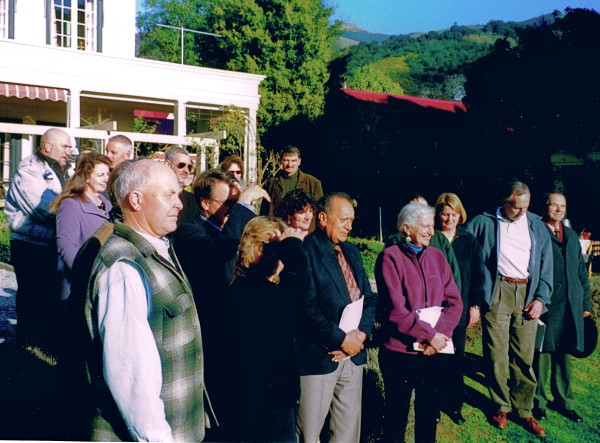
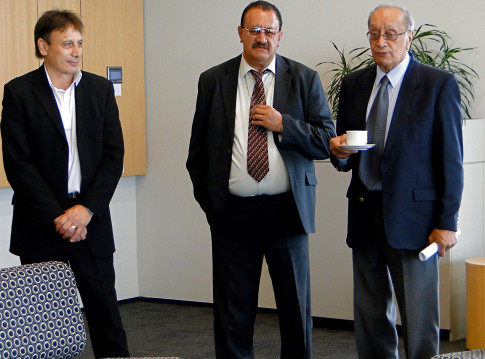
 Above: Blythecliffe, Akaroa at the end of a pivotal hui where representatives
of New Zealand Historic Places Trust, Onuku Runanga and Akaroa Civic
Trust met and discussed Takapuneke for the first time. The group includes
Pere Tainui (back), George Tikao (front row, centre), Harry Evison (front row,
rightmost), John Wilson, Anne Salmond and others. September 8, 2001.
Takapuneke, c.1925. PHOTOGRAPH: JESSIE BUCKLAND, AKAROA MUSEUM
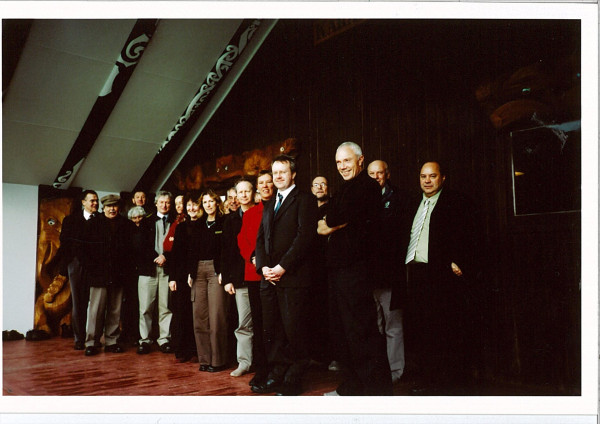
Right: A meeting to discuss the Takapuneke Reserve proposal was hosted
by Ruth Dyson (centre, red jacket) at Onuku marae on 2 July, 2004. Among
those attending was Peter Richardson on behalf of Helen Clark, the Minister
for Culture and Heritage (in front of Dyson) and Bob Parker, Mayor of Banks
Peninsula (front, right). PHOTOGRAPH: VICTORIA ANDREWS
Te Maiharanui was taken to the mainland opposite Kapiti Island and executed. The Elizabeth Affair, as it became known amongst the British, horrified authorities when they learned of Captain Stewart’s complicity. The incident contributed directly to Britain’s decision to strengthen their presence in the country, appointing James Busby as the first British resident and setting in motion the events that would lead to the signing of Te Tiriti o Waitangi in 1840.
“This story really encapsulates what it is about Takapuneke that is so special in terms of its national significance,” Keefe says.
After the massacre, Takapuneke became tapu – the site of lost lives and a symbol of betrayal. Those who survived moved further down the harbour to Ōnuku, where the marae stands today.
Keefe explains one interpretation of the sites’ respective names: “Takapuneke – to have moved from your original location and Ōnuku –
literally of distance, the place over there. So the old place and the new place.”
For generations, kaumatua told their children to stay away from Takapūneke. It was a bad place, they said, although many didn’t know
exactly why. For many years the land was farmed by Pākehā families, the distinctive red farmhouse a landmark in the bay. The first farmer gathered the kōiwi he found and burned them. In the 1960s, Banks Peninsula District Council built a wastewater treatment plant directly where the village once stood.
During construction, middens on the small flat were destroyed, wiping out archaeological evidence of the site’s use. In the late 1970s
a rubbish dump was added. The way the land was being used never sat right with local whanau, but they didn’t have the resources or relationships to make a difference.
Then, when the council proposed subdividing the land in 1996, something shifted. “Believing that the subdivision was inevitable, we went along with it reluctantly, because part of the proposal included returning two parcels of land to us,” Rik recalls. “That was better than nothing, which is what we’d had up until then. But then we decided, actually, that’s still not good enough.”
Keefe remembers these conversations – heated hui at the marae in which the Ōnuku whanau were called “waka jumpers” by council
representatives.
“I was just this little ten-year-old kid at the time; didn’t really understand what was happening. All I knew was that they wanted to put houses on a piece of land that was really important to us. Those discussions started my journey to learning more about Takapūneke.”
The fight to protect and reclaim Takapuneke has become a decadeslong journey involving countless hui, strategic relationship building, and persistent advocacy. Tangata Tiriti allies including acclaimed historians, well-known politicians, public servants, and local community advocates provided cultural support. The bay was finally declared a wahi tapu area by the New Zealand Historic Places Trust in 2002, offering it protection from further development. In 2010, the Takapūneke Historical Reserve
was formalised.
“The key thing has been building really strong relationships, and making sure the council understands the story of Takapūneke,” says
Rik. “The co-governance model itself has become a powerful example. We’ve demonstrated that this co-governance model actually can work if both parties buy into it.”
Rik credits former mayors Bob Parker and Lianne Dalziel for backing Takapuneke, and current Mayor Phil Mauger for ensuring the project continues. Council staff like chief ranger Paul Devlin and project manager Steven Gray have been equally important, as has the
co-governance group chair Pam Richardson.
Landscape architect Debbie Tikao entered the picture in 2014, working alongside Pere, Waitai and Maurice to support them to establish a co-governance group and translate their vision into design. “We would have these hui with the three of them, recording their stories,” she recalls. “Waitai talked about the history of the site and its significance. Maurice would talk about connecting with the stars, how
the pou needed to face certain ways, aligning with constellations.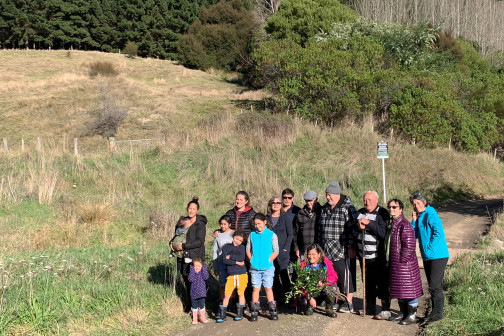
 Above: Pere Tainui with a group from Onuku at Takapuneke, 2019. PHOTOGRAPH: DEBBIE TIKAO
Rik Tainui, James Robinson and Waitai Tikao in the Mayor’s Lounge in 2012 after the presentation of the Takapuneke
Conservation Report. PHOTOGRAPH: VICTORIA ANDREWS
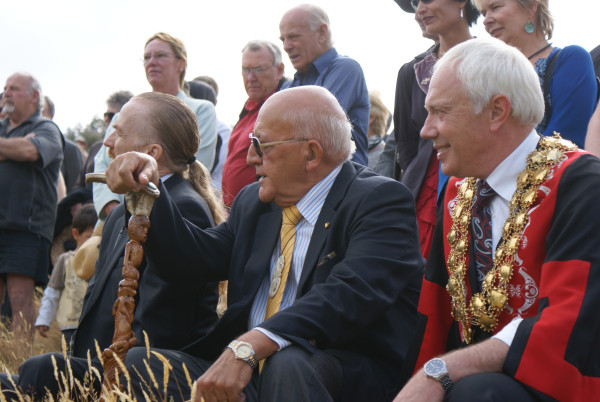
Blessing of the land at Takapūneke that was to have been subdivided and planting of commemorative trees, 7 February
2010. Ruth Dyson, MP for Port Hills electorate, formerly Banks Peninsula electorate (back, left), Ta Tipene O’Regan (centre), Mayor
of Christchurch, Bob Parker (right). PHOTOGRAPH: HERITAGE NEW ZEALAND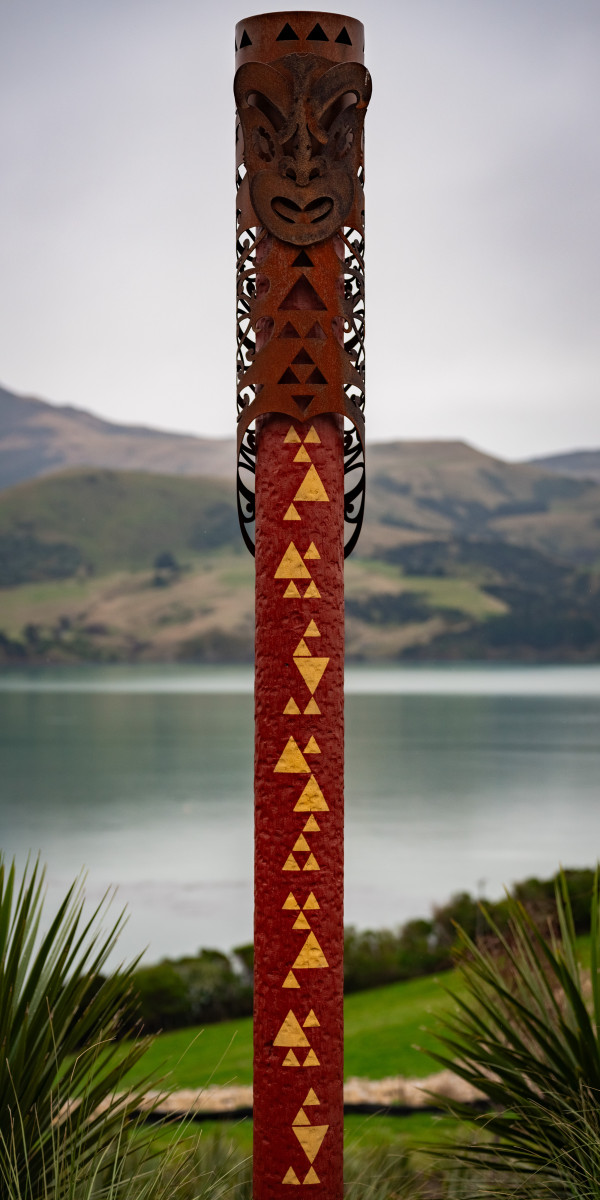
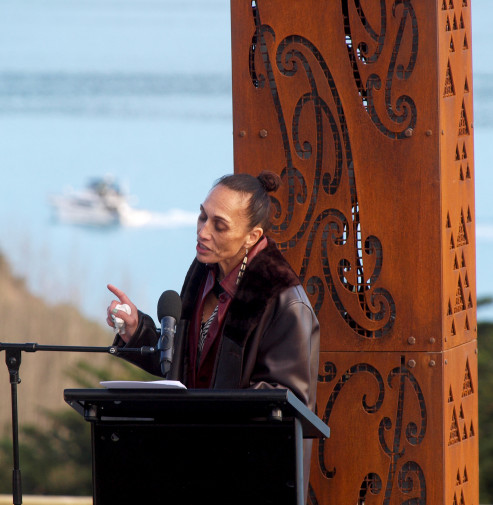
Above: Members of the Takapuneke Reserve Co-Governance Committee
at the unveiling of Pou-tu-te-Raki-o-Te-Maiharanui, the park of reflection,
at Matariki, 24 June, 2022. From left: Rik Tainui, Pam Richardson (Chair).
Dr Kelly Tikao, of Onuku Runanga addressing the the crowd at the
public opening of Pou-tu-te-Raki-o-Te-Maiharanui, the park of reflection,
Matariki, 24 June, 2022. PHOTOGRAPH: COURTESY THE AKAROA MAIL
“Pere painted a picture of his vision for the future which was to create a place for our tamariki, a place they would be proud of. And then one after the other they passed away. But we had enough of the vision from those three to create the design.”
For Debbie, the complexity of translating spiritual concepts and history into physical design has been challenging and rewarding.
“It’s absolutely a passion project for me.”
Takapūneke will eventually have four distinct areas, each featuring a pou carved by Fayne Robinson aligned with different seasonal constellations. Te Atutahi o Takapūneke (park of silence) is the most sensitive, where the original village stood. This will be protected by palisade-style fencing, accessible only for cultural purposes.
Te Whai Ao o Takapūneke (park of healing) comprises the bushclad valleys where walking trails and boardwalks will wind through regenerating native forest. And at the centre, a facilities hub will include the restored Red House as a café and reading room, event spaces, and eventually a cultural centre with exhibition space and a shop for Ngāi Tahu artists.
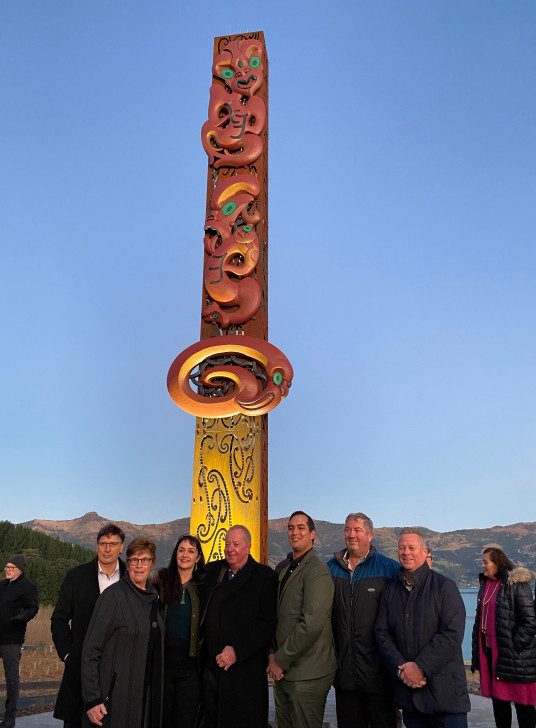
Members of the Takapuneke Reserve Co-Governance Committee at the unveiling of Pou-tu-te-Raki-o-Te-Maiharanui, the park of reflection, at Matariki, 24 June, 2022. From left: Rik Tainui, Pam Richardson (Chair), Debbie Tikao, Nigel Harrison, Keefe Robinson-Gore
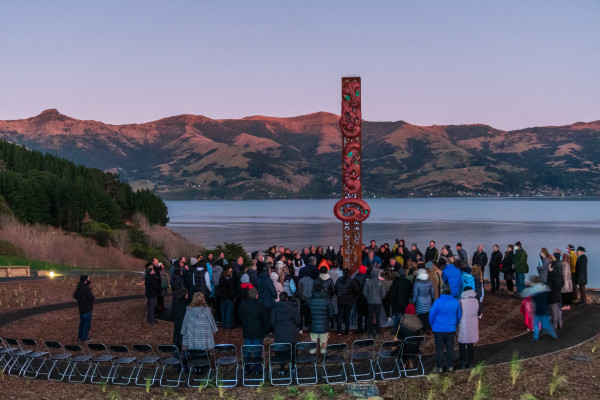
Whānau at the unveiling of Pou-tu-te-Raki-o-Te-Maiharanui, the park of reflection, at Matariki, 24 June, 2022
But it’s Pou-tu-te-Raki-o-Te-Maiharanui (park of reflection) where visitors can experience the vision most fully. This section features three large-scale takarangi built into the landscape, double spirals symbolising creation as dynamic movement, unfolding of the cosmos, and the passing of time through past, present and future.
“Maurice explained his aspirations for Takapuneke – to showcase matāuraka Māori to the world; to create pathways and restore the connections between the whenua and cosmos; and restore mana and mauri to people and place,” says Debbie.
“There were many more instructions, but these three points encapsulate the main intent. Translating these aspirations, and those of Waitai and Pere, into design was the challenge. The dynamic form and layered meaning of the takarangi jumped out as the form that would enable us to unfold the many stories of Takapūneke and shape a powerful landscape of meaning, reflection and learning.”
The first takarangi was completed in 2022, a double spiral of paths built into the sloped landscape. As you enter the spiral on the paved
path, chevrons carved into the ground tell the story of Takapūneke’s history. The final chevron is blank, representing the story yet to be told.
On the way out of the spiral the path becomes gravel. “That’s in homage to the next generation, acknowledging that their path is still yet to be formed by their own aspirations,” Keefe says.
The second takarangi, completed at the end of this year, tells the story of harakeke – the flax that made Takapūneke a thriving trading
post in the 1820s. It features a seating area, enclosed by a stunning sculptural roof that radiates outward like the sun, with intermediate beams to be coloured in the hues of the kereru feathers, mimicking their wings in flight and honouring the manu kaitiaki that watch over this landscape. Beneath it sits a centerpiece made of resin embedded with muka fibre.
“It talks about weaving together past, present, and future,” Debbie says. “Harakeke formed the basis of early trade between Europeans
and Māori, but it also talks about innovation. We’re still discovering new things about this super plant – from soaps and hand creams to wall finishes and surfboards. It reminds us that within nature we can find solutions to the challenges ahead.”
The complexity of building circular structures on steep slopes has made progress slower than anticipated. But for Debbie, who has worked as a landscape architect for 26 years, compromise isn’t an option.
The third takarangi, currently under construction, will explore the theme of relationships – acknowledging the site’s painful history and the partnership that has made restoration possible. It will stand near the Britomart Memorial, a symbol of colonisation, creating a conversation between past and future.
The vision extends far beyond what’s already built. Plans include a nature play trail where children can learn about forest ecology through the story of Tāne Mahuta, with stepping stones and carved pou depicting layers of the forest system.
The main car park, designed to sit above the old landfill area, will include a waharoa – a large shelter structure providing interpretation and access to the reserve. Nine smaller pou markers, designed by Fayne Robinson, will be laid out in alignment of Matariki, each facing towards significant sites around the harbour – traditional schools of learning, food gathering areas, sacred mountains.
By 2030 or 2031, the wastewater treatment plant will be decommissioned, allowing the site’s full restoration. “We’re probably looking at another eight years to complete everything,” Debbie says. “The bodies of work are significant – the website, the interpretation strategy, lighting design, cultural centre. But we’ve been at this for over a decade. We know how to be patient.”
The site is already making a big impact. When Ōnuku Runanga recently hosted a group of First Nations leaders from Canada, they
visited Takapūneke and shared its history.
“One of the chiefs asked us if he could call to our ancestors, and we said ‘yes’. He called and started this beautiful call, just as he would do to his own ancestors in Canada,” Rik says. “There wasn’t a dry eye in the group. Everyone had tears streaming down their face and I stood there thinking that we never could have predicted just how important this project would end up being.”
As Takapūneke continues its transformation from massacre site, to dumping ground, to sacred sanctuary, it stands as testament to the power of persistence, partnership, and the determination to honour those who came before – and those who dreamed of what could be.
In the words of Waitai: “Tell the people – let them know what it is, why we have cried over this land.”
“It’s not about forgetting what happened,” Keefe says. “It’s definitely about knowing and remembering. But we want to move beyond the anguish. For a long time this place was untapped, untouched, and a lot of that was due to the horrific things that have happened to us. But I love that we are at a stage now where we get to create rather than fight. Tell the people – let them know what it is, why we have cried over this land.”
When completed, Takapuneke will stand alongside Waitangi as a site of national significance – a place where the past is honoured, the present is built on partnership, and the future is shaped by possibility. Takapūneke Historic Reserve is open to the public. The first two takarangi are accessible, with the third expected to be completed soon. Visitors can access audio tours via QR codes on site, with Keefe Robinson-Gore as narrator, sharing the stories that have waited so long to be told.
 Top
Top