Nomad: Living the old ways, creating new pathways
Dec 19, 2025

Nomad: living the old ways, creating new pathways
Nā Nikki-Leigh Māhakanui Wilson-Beazley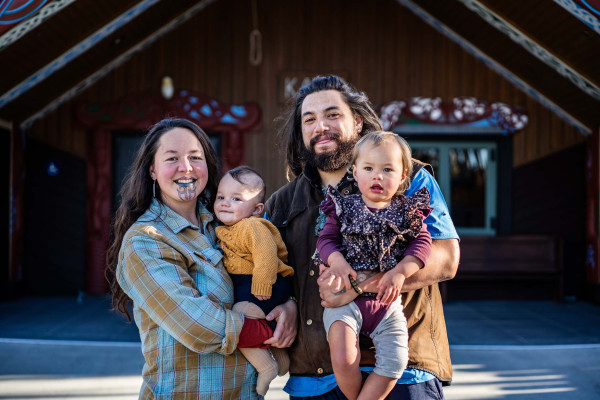
ON A STILL MORNING BY THE RIVER, THE FIRE IS ALREADY CRACKLING AND SPITTING INTO LIFE. Two small pairs of gumboots thud across the grass while papa checks a net and mama sorts out breakfast. It looks like a scene from television, and it is, but for the Mahuika whānau it’s just another day.
That lifestyle became the foundation for Nomad, the Maori Television series launched earlier this year by Kahurangi Mahuika and Ashlea Williams.
The show follows their whānau – Whaiariki (4) and Tiniura (2) – as they live closely with the land, travelling Aotearoa and meeting others who are rediscovering traditional, sustainable ways to live.
They live primarily on Te Tai o Poutini but rarely stay in one place for long. Over the past year they’ve lived in a tent, a caravan, and at times on marae, shifting wherever the wairua leads. One month they might be camped beside a river; the next helping at a wanaka hundreds of kilometres away.
“We always wanted a life that felt true to who we are,” says Kahurangi. “A life where our tamariki
and our values come first – where we can live by our tikaka, keep learning, and stay close to the
whenua.”
Before building this life with Ashlea, Kahu spent years in the kahere. “I knew as soon as I set foot in the forest it was where I belonged,” he says. “When you live with the land you slow down, you listen, and everything starts to make sense.”
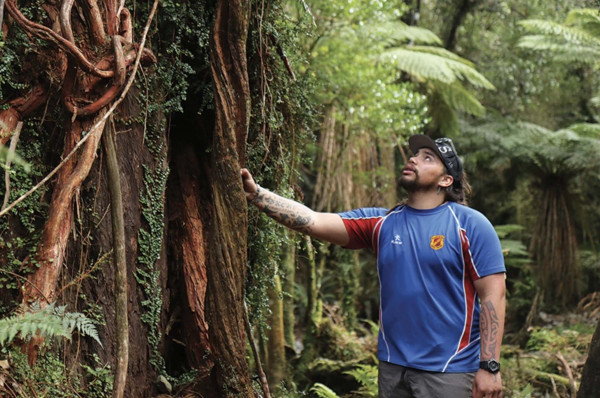
As a young man he worked seasonally – one week on the tops of Mt Ruapehu, the next in the depths of Fiordland – moving with the cycles of nature and working wherever the wairua took him. Kahurangi didn’t arrive at this life by chance. He grew up whitebaiting, hunting, and practising mahika kai on Te Tai o Poutini. His upbringing was filled with examples of self-reliance and
connection to the tiao.
His grandfathers had spent their early lives in the bush; one in the Kaimanawa Ranges, the other deep in the dense Haast forests. Their stories, and their ways of providing for whānau, gave him a lifelong respect for living off the land.
After finishing Hato Paora College he began his career as a wilderness guide in the Hollyford Valley, where he spent long days leading visitors through landscapes layered with whakapapa and story.
“Spending all that time in the taiao, sharing our stories, that’s when I realised I wanted to live more closely with the whenua, to walk the talk,” he says.
That experience led him to co-found Te Ara Whakatipu – a Kāi Tahu leadership and environmental education programme designed to
help rakatahi connect, or deepen their connection, to their Kāi Tahu heritage and the whenua. As lead guide, Kahu helped young people build confidence and cultural awareness through time spent on the land – learning to navigate, harvest and understand the whakapapa of each place they visited.
Ashlea’s journey ran in parallel. After completing her Master’s degree, she attended an indigenous conference in Auckland and watched Te Mana o Te Moana, a documentary about waka voyaging around the Pacific.
“I just knew – that’s me,” she says. “I started volunteering on a waka, turning up to maintenance days, and learning navigation. I loved that I could see my whakapapa reflected back in those people and that kaupapa.
“I didn’t grow up connected with my marae or the whenua. It wasn’t until I found waka hauora that I felt like I’d found my place in the world. For me, my place is being on the water – on the ocean. My father was a diver, and I love diving too. When I got older I realised that’s how he connected with his culture, through the moana.”
It was on a celestial-navigation hikoi that Kahurangi and Ashlea first met, united by a shared passion for kaupapa Māori and wānaka. “A lot of our values aligned,” says Ashlea. “We both wanted to live off the grid and not be tied down to a nine-to-five job. It all just made sense.”
Kahu’s mahi remains grounded in the same values today. He contracts for his runaka, supporting kaupapa that protect native species and promote kaitiakitaka across Te Tai o Poutini. He also works in tourism, helping businesses integrate Kai Tahu stories and values into their experiences.
For a time, he was caretaker at his marae, where he continues to support on the pa and lead rakatahi excursions – roles that keep him
deeply connected to his community and the whenua. Ashlea and the tamariki are almost always with him, sharing in the experiences that connect their whānau to the wider community.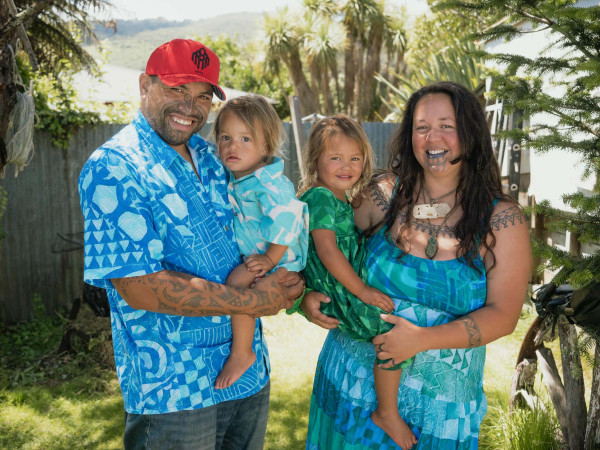
“Every decision we make – where we go, what mahi we do – it’s all about our tamariki and the values we want to pass down,” says Ashlea. “We try to live in a way that feels meaningful, that reflects who we are.”
Living as modern nomads comes with its challenges. Money is tight, travel constant and privacy rare. But for them the rewards are far greater. They’ve learned to live within their means, stretching every dollar and finding abundance in time, freedom, and shared experiences.
“The thing is, we don’t feel like we go without – we never have,” says Kahu. “What people live off in a month, we can stretch out. We don’t need much – our life is built around experiences, not things.”
Between them, Kahurangi and Ashlea have spent the better part of their adult lives training in as many kaupapa Maori as possible –
mau rakau, waka ama, kapa haka, te reo Māori, rokoā Māori, whakapapa – you name it. Those experiences have shaped who they are and how they live, grounding them in the values that underpin everything they do.
When Māori Television approached them about filming Nomad, they saw it as an opportunity to share their lifestyle; not as something unusual or nostalgic but as a living expression of Maori values still thriving across
the motu.
“Every person who appears in Nomad is someone we already had a relationship with – friends, whanau, people who were expressing their mana motuhake in their own way,” says Kahu. “We wanted to highlight those who are already doing the mahi, living in ways that reflect who we are as Māori.”
Each episode highlights whanau who are reconnecting with the taiao in their own ways – growing kai, working in conservation, and caring for the land and waterways.
“Showcasing our whenua and the people of the South Island; that was big for us. We wanted to show that there are other pathways for
whanau to live, not just one mould to fit,” says Kahu.
Nomad reminds viewers that living Māori values isn’t just about reflecting on the past but about recognising and nurturing what’s
already around us.
“Our tipuna lived this life,” says Kahu. “They were nowhere near as comfortable as we are – they had to do it a lot tougher. But they had manaful lives and theirs would have been kaupapa-driven, just like ours.”
Ashlea was initially hesitant about sharing their lifestyle with an audience but ultimately chose to take part in the series to preserve their journey for future generations. “I did it for our kids. One day, when I’m not here, they can look back and see: this is how we lived, who we were.”
Through Nomad, the Mahuika whanau hope to show that Māoritaka isn’t defined by one look, one practice, or one place. It lives through intention and the small, everyday choices we make.
“For anyone starting out on your journey of discovering your Māoritaka,” says Kahu, “find your passion, your pathway. Is it kapa haka?
Is it waka? Mau rakau? Reo? Whakapapa? Waiata? Everyone has a thing
and your tīpuna are always there, waiting for you.”
Ashlea adds: “As soon as we start defining what it means to be ‘Māori’ we start creating barriers. All you need is whakapapa – that’s
all you need to start connecting and start your journey. Māoritaka is for everyone.”
For Kahurangi and Ashlea every move, every season and every challenge has been a reminder of why they chose this path. To live
with purpose and to raise their tamariki in the embrace of their culture.
“Living with the whenua teaches you patience,” says Kahu. “It teaches you to slow down, to listen. The land reminds you that everything moves in cycles – growth, loss, renewal. That’s how we try to live too. “It’s not a perfect life, but it’s ours and it feels right knowing our kids will grow up grounded in who they are, surrounded by everything that matters.”
 Top
Top