Tikaka Takihaka Renaissance
Jul 28, 2025

Tikaka Takihaka Renaissance
nā ANNA BRANKIN
Last year, TE KARAKA editorial team
experienced significant personal loss
within a short time. Editor Adrienne
Anderson-Waaka lost her beloved
husband Gary Waaka, while deputy
editor Sascha Wall farewelled both of
her grandfathers in quick succession.
As they planned their next issue, familiar
themes surfaced – grief, takihaka, and
how we, as Kāi Tahu, move through loss.
They tasked kaituhi ANNA BRANKIN with
exploring this kaupapa on their behalf.
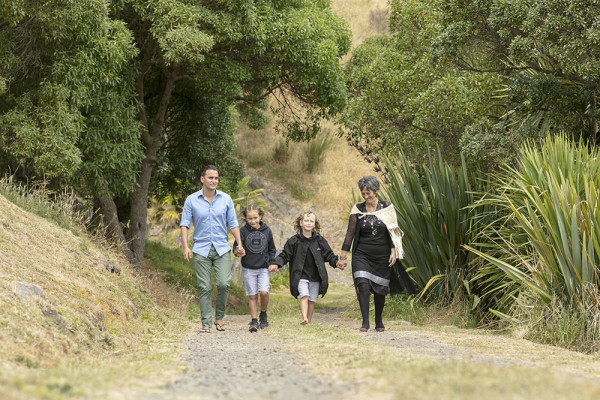
Jymal Morgan with his mother Karen and tamariki Kiniwai and Pewhairangi. Waitangi Day at Ōnuku 2019
JYMAL MORGAN (NGĀI TAHU, NGĀTI IRAKEHU) HAS SPENT A SIGNIFICANT part of his life supporting others through this tapu process, and in doing so has learnt that takihaka are not only about the deceased. “Tikanga tangihanga are focused on providing strength, solace and
healing to those who remain and carry the burden of loss and grief,”
he says.
Tangihanga is a process developed over millennia, and there
is a science to the tikanga involved – a process of many small activities
that collectively provide a foundation for a healthy grieving process.”
Over the years, Jymal has had the privilege of exploring Kāi Tahu tikaka, including those associated with takihaka.
“It would be naïve to look at these aspects of ourselves without acknowledging that we are operating within a colonial construct, that is intent on telling us what we can, should and can’t do – even in death,” he says.
He also acknowledges that tikaka and takihaka practice are continuing to evolve, having seen firsthand how death is handled differently depending on people’s connection to and knowledge of tikaka.
“Equally, we’re seeing a renaissance of all things Māori and
Ngāi Tahu,” he says.
“We’ve gone through the language renaissance, the toi Māori renaissance. Now we are starting to turn our attention to other areas of cultural practice, and one of those is death. As our confidence as an iwi grows, so too is our ability to embrace our own tikanga as the right way – regardless of other models that have become the norm.”
Fortunately, Jymal says, now there is enough tribal knowledge and capacity to start piecing together new practices, informed by tikaka and designed for a contemporary world.
“As a tribe, we have a better understanding of our own language now,
a deeper understanding of tikanga, and we’re starting to unlock clues
that are recorded in waiata, in karakia and in manuscripts. The colonial
process attempted to strip us of our knowledge, and we are now in an
ongoing process of reclaiming ourselves.”
Jymal’s knowledge of tikaka takihaka became personal in 2022 when his mother, Karen Morgan, was diagnosed with cancer, later dying at home surrounding by her whānau during evening karakia.
“My mother was the youngest of her siblings and the leader of our whānau. We were not surprised when she encouraged us to lean into her unfortunate situation, to further develop our tangihanga practice and expose our wider whānau, hapū and iwi to the value of tikanga.”
After making sure that the whānau was on board – something Jymal says is important, because takihaka is about whānau as much as anything else – they made their own plans for Karen’s death, leaning heavily on mātauraka.
One of the first steps was to involve Betsy Williams (Kāi Tahu, Moeraki), their whanauka and tohuka manaaki tūpāpaku at Manaaki Funeral Services. Betsy and Karen had several discussions, all of which the whānau were privy to, to agree a pathway forward.
Following this, Karen’s sister Ngaio, a weaver, approached other members of the community to contribute to the weaving of a whāriki. The hope was to bypass the use of a casket and instead use the older practice of wrapping tūpāpaku in a finely woven takapau (harakeke whāriki).
“We also knew we wanted to wash and prepare Mum at home, so we did,” Jymal says. “It was all of us together – her moko, her kids, her siblings, nephews, nieces and wider whānau who washed her, wrapped her in sheets and put her back on her bed and slept there with her until morning.”
Karen had chosen to steer clear of embalming, believing that introducing chemicals interferes with the natural course of things. Instead the whānau gathered copious amounts of kawakawa and laid it all around her, both against her skin and above her clothing, refreshing it every day throughout her tangi.
“We weren’t entirely sure what the impact would be, but based on the knowledge that it had played a significant role in pre-contact tangihanga, we were pretty confident that the scent of the kawakawa and the antimicrobial properties would play a key role in providing protection – and we were right,” says Jymal.
For Betsy, Karen’s tangi remains the benchmark for traditional practices.
“I had a few hui with Karen before she passed, and made quite a few arrangements. She did not want to be embalmed, even though her tangi was about four days, but she looked amazing,” she says.
For Betsy, an interest in takihaka began in childhood as she observed her father Joseph Tipa (Uncle Darkie) provide support to their wider whānau.
“My dad used to look after the family when it came to death. It was something that his own father had done before him,” she recalls.
“It wasn’t his profession, not at all, but it was his responsibility within the
family – caring for the tūpāpaku.” Betsy was fascinated with his stories.
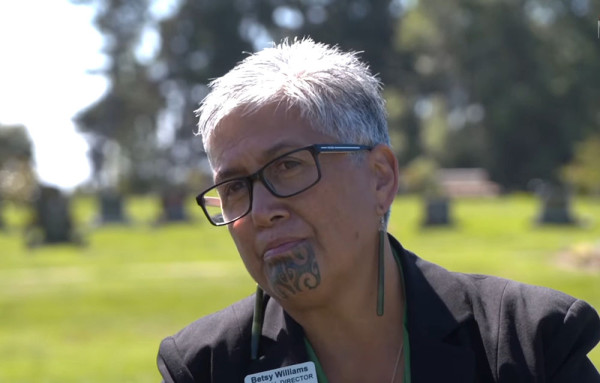
Betsy Williams
“My first memories of grief were my uncles Ray and Nuku, who we absolutely loved to bits. At their tangi, I was that kid who was all over the casket, wanting to peer in. I was curious. I wanted to know if they were still them, where their wairua had gone,” she says. “As early as high school, I started talking about becoming a funeral director.”
Although she didn’t become one until many years later, she still brings that same curiosity and reverence into her mahi.
“For me, it’s not just about the tūpāpaku – it’s about looking after the whānau.”
When whānau ring to request her services, they’re often overwhelmed at the prospect of navigating the various processes and procedures around takihaka.
“More often than not, people say, ‘We don’t know what to do.’ My opening line is always, ‘How about I come round and we can have a kōrero and a cuppa.’”
She guides whānau through practical and spiritual decisions. “There are sometimes things to navigate, depending on whether or not they need to go to the coroner. When it comes to embalming, it’s not always the option people want, but they have to balance it against the sort of tangi they want. Because nature is eventually going to take its course, and not everyone has the mandate and confidence to do what Karen’s whānau did.”
Betsy says that although Māori may have lost touch with some of their traditional practices, some things have endured.
“In Pākehā families, it’s very much, ‘Oh, you’ve died, the undertaker will take you
and we’ll see you again at the funeral,’” she says.
“Even though we have lost touch with the way we did things before, Māori have kept a few
instincts. We know we need to care for the tūpāpaku, that we don’t want to leave them alone.”
Betsy helps them to navigate the logistics, supporting them with decisions like driving the casket to the taki themselves, or washing and dressing the tūpāpaku. In fact, this last part is something she strongly encourages.
“A lot of people ask me to come and wash and dress their loved ones, and I say absolutely, but I ask them to be in the room with me,”
she says.
“Sometimes they help, sometimes they just sit there. But I tell them, that’s where the
grieving starts. You’ll laugh, you’ll cry, you’ll tell stories. You’ll realise that their feet look like just
someone else’s in the whānau. You’d be amazing at how much it will help you.”
As Betsy continues to support whānau to reconnect with these practices, Jymal reflects on what it meant for the grieving process of his whānau – and what it might mean for others.
“Allowing for, and trusting totally in tikanga to guide the process was amazingly beneficial, because it ensured we were intimately connected to every part of the process – which is by design,” he says.
“Tikanga tangihanga ensures that you are not an observer, nor merely a participant – you are the process, you are the tangihanga.”
He explains that if we continue to follow non-Māori models and outsource our death practices, only retaining the marae as the location alongside the basic pōwhiri protocol, we will never realise the depth of healing offered by the takihaka process.
“After we buried my mother, I was healed and ready to return to the living. That is only because
of the particular tangihanga process we experienced – the tikanga had done its job,” he says. “I know that her wairua has returned to Hawaiki, which we are all intimately connected to. She is
not lost to us – we just have a different relationship now.”
Jymal poses the challenge that, as an iwi, we may need to focus some attention on reteaching ourselves how to grieve in our own, distinct way.
“It is only on the odd occasion that you hear the tangi hotuhotu, tangi apakura, tangi mōteatea – that really heart wrenching cry that, when you hear it, draws up every emotion and extracts it from you, which is all part of the healing process,” he says. “I am yet to see grown men cry without regard for who is watching. I also observe the difficulty whānau pani have in simply allowing themselves to grieve, instead trying to occupy themselves with the mundane and ordinary tasks of the marae.”
Jymal believes we have embraced a more conservative, stoic grieving process from other cultures – a process he says that is not our own.
“Like most things, even those which seem so innate and natural, grieving is a learnt skill that is handed down through generations. If we want to grow and enhance our tangihanga practice, and its potential for healing, we need to relearn the art of grieving and understand the
physical and human infrastructure required to enable it.”
Takihaka require collective and deliberate effort at the whānau, hapū and iwi level, involving tohuka from many knowledge domains to navigate and give effect to their intent and purpose of takihaka – kairaraka, kaimanaaki tūpāpaku, pae wāhine, pae tāne, kai tito, rakatira, pā whakawairua, kaikawe tikaka, hāpai ō (rikawera, mahika kai
practitioners).
“The exciting thing is that our culture is always evolving and this includes tangihanga. There is so much opportunity and learning ahead of us, that will inevitably strengthen our healing and resilience through tikanga.
“Some of these changes will provide new, innovative solutions that are deeply rooted in Ngāi Tahu tikanga and principles, while others will be in the reintroduction of older traditions that have been awaiting our attention. For example, while we have become accustomed to our tūpāpaku being laid out within our wharenui or halls, Ngāi Tahu has a well-recorded wharemate practice.”
Wharemate were temporary structures erected beside the whare tupuna for the sole purpose of
housing the deceased and the whānau pani. These were sacred spaces where the tūpāpaku and whānau pani could remain undisturbed, separated from marae activity.
“The wharemate recognised the importance of the grieving process for the whānau pani, and provided space for that to occur,” Jymal explains. “As whānau pani your role is not to look nice, to look presentable – it is to grieve.”
For Betsy and Jymal, the heart of traditional Kāi Tahu death practices lies in allowing space for grief – not rushing it, not sanitising it, but recognising it as sacred. Whānau are encouraged to take part in the whole process – not just as mourners, but as guardians of their loved
one’s transition between life and death.
“Not every whānau will have the luxury of time, the wider iwi support or the inclination to do what we did,” Jymal says.
But our experience gives me and my whānau the confidence to help others to consider similar choices. As Māori, as Ngāi Tahu, we are in the process of
reclaiming ourselves through practice. I am confident that we will reteach ourselves and reimagine aspects of the tangihanga process to unlock further the potential healing power of tangihanga.”
There is no single right way to grieve, but by listening to those who carry both lived experience and mātauraka, we begin to remember what was once instinctive – to care for the dead as we care for the living, and to let grief be felt, fully.
For Adi and Sascha, their grief is something they still carry. It moves with them; sits quietly beside them. Their hope is that by opening up this kōrero, others might feel a little less alone in their own seasons of loss – and a little more confident in finding their own path through it.
 Top
Top