Weaving across time
Dec 19, 2025

Weaving across time
Nā, Nikki-Leigh Mahakanui Wilson-Beazley
WHEN MASTER WEAVER HAMUERA MANIHERA FIRST STOOD BEFORE THE kahu tikumu at London’s Royal Botanic Gardens, Kew, it was a moment of reconnection. The 19th-century cloak, woven almost entirely from tikumu fibres, had not been worn for more than 160 years.
“It was like meeting a long-lost friend or whanau member,” says Hamuera. “There was warmth, familiarity, and a sense of reunion,
even though our time together was brief.”
For years he had studied the ancient kakahu remotely through books, photographs and video calls with curators caring for it. “But none of that prepared me for the feeling of being in its presence,” he says.
“Photographs and words never quite capture the scale, the texture, or the mauri that flows through taonga.” That moment marked the beginning of a two-week residency at the Royal Botanic Gardens, where Hamuera and his wife Naomi were invited to study and document the kahu tikumu, a garment woven almost entirely from tikumu, donated to Kew by Walter Mantell in 1856.
“Our goal was to bring that knowledge home and allow it to inspire the making of a new taonga, shaped by this encounter,” he says. The trip had been months in the making. Over late-night video calls and collaborative research, the couple built a close relationship with Kew’s staff, especially senior research leader Mark Nesbitt, who invited them to work with him on a successful funding application to the Bentham-Moxon Trust.
That grant made their journey possible and opened doors to other museums across Europe. In France they spent time at the Musée du quai Branly – Jacques Chirac, viewing kakahu collected during the 1826 Dumont d’Urville expedition. In the UK they were welcomed at Cambridge and Oxford Universities, the British, Natural History and Perth museums, and the National Museum of Scotland.
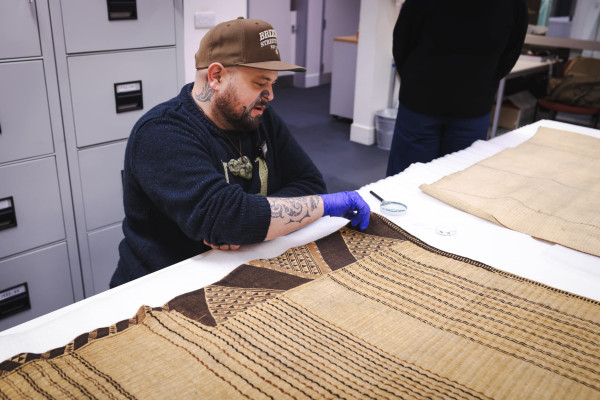
Each visit, says Hamuera, added “another layer to the journey and reminded us just how widespread taonga Maori are, and how important it is to reconnect with them.” “Before leaving, my biggest hope was that Naomi and I could honour the taonga properly, to warm its mauri, to really listen and learn from it, and then to bring that matāuranga home to Aotearoa, where it could be shared and carried forward.”
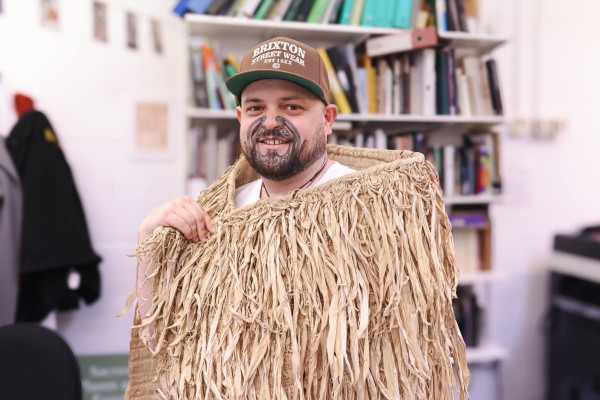
During their residency, Hamuera was offered the chance to wear the kahu tikumu for the first time in more than 160 years. “To be honest, I never set out with the intention of wearing it,” he says. “But when the opportunity arose, it felt both deeply special and a little
frightening. “One of my kuia, Te Hemoata Henare, stood with me, and alongside textile conservator Luba Nurse, they placed the kākāhu carefully around my shoulders. Because of its fragile dyed black fibres, every adjustment had to be done with the utmost care. There were no taura to secure it, so I held it closely around me.”
The weight of the garment was striking – slightly heavy yet soft and warm. “It felt as if it was still doing the job it was created to do,” he says. “Despite its age, the kakahu remains in remarkable condition. The tikumu whenu are still strong, and much of the muka aho still intact. Wearing it after more than 160 years was a moment of deep connection – one I’ll carry with me always."
The artisanship revealed a mastery few could appreciate without seeing it in person. “This kakahu was unlike any other I’ve seen,” says
Hamuera. “The kaupapa was woven almost entirely from rau tikumu, with muka used primarily for the aho. What stood out was the precision in the spacing of the aho and the way the weaver alternated rows of whatu aho rua to build structure and strength.
“The dyed whenu were also striking – deep blacks from paru and rich reds from tanekaha or toatoa bark. That interchanging of colours created a rhythm that was both practical and beautiful. It showed not only technical skill but also the creative decisions of the weaver, who was clearly working with deep knowledge of materials and design.”
Inside Kew, the kahu tikumu is housed under carefully controlled conditions, with precise regulation of temperature, humidity and light. Textile conservators use digital microscopy and fibre analysis to monitor its condition over time without direct contact, preserving the muka and tikumu for future generations. “It was reassuring to see that level of care,” says Hamuera. “But what
impressed me most was their openness – they wanted to understand the taonga as a living being, not just an object.”
Weaving was part of Hamuera’s life long before this trip. He grew up in Te Tauihu, surrounded by the hands and stories of weavers. “My kuia, Nellie Robb (née Manihera), was a weaver,” he says. “There was a group of kuia that used to get together for kaupapa like weaving tukutuku for different marae around Te Waipounamu and fundraising for different kaupapa. It was just a part of our whānau.”
He began helping his kuia when he was about 10, plucking feathers and sorting fibres. “She then taught me the art of taniko and whatu in my early teens. My practice was refined by my mother, Dianne Robb, who was also taught by my kuia and Te Hemoata Henare.”
Over the years he was guided by some of the country’s most respected weavers, including Ranui Ngarimu, Reihana Parata, Morehu Flutey-Henare and Veranoa Hetet, each contributing to his understanding of the art form.
“Weaving for me is an intentional connection to my kuia,” he says. “She passed when I was 18. It reminds me of her teachings, her humour, and her presence. When I weave, she’s right there with me.
“As I’ve started to reconnect to other traditional practices within te whare pora, it’s also become about revitalisation, responsibility, and intergenerational transfer of knowledge. It is whakapapa and it is art, but it is practical and tells a story. It carries whakapapa and connects us to the taiao and the whenua.”
Preparation remains one of the most important parts of his work. “The process of preparing materials is a lengthy process, but rewarding. I usually only use natural, native materials. There are specific places I harvest and most of them hold a special connection for me, places where my tipuna once lived, places that hold the stories of my whānau. “Sometimes preparing materials can take several months, but I always make sure I finish prepping before I start to weave. If the prep isn’t right, you’ll see it. There’s nowhere to hide in weaving.”
His tikaka reflects practical and wairua principles. “For me, karakia is one of the most important aspects of weaving. From beginning to end, karakia provides guidance, whether harvesting raw materials, starting the first row, lifting your energy, or completing the final lock-off of the kākāhu. In moments of unease, karakia restores balance and grounds me physically.”
Returning home to Aotearoa, Hamuera says he had two clear goals. “The first was to take all the new teachings and insights I had gathered overseas and weave them back into my own practice. Every taonga had something to teach, whether it was a technique, a material, or simply the way it carried its mauri.
“The second was bigger than just my own practice. It’s about creating pathways and tools to whakamana the taonga that remain in Europe and to help reconnect them with Aotearoa and with weaving communities and uri across the motu. Those taonga still hold knowledge and still belong to our story.”
The experience also reminded him how fragile the resources that sustain rāraka have become. “Many taonga I saw overseas were made from species now extinct or endangered,” he says. “That reality speaks not just to climate change, but to the wounds of colonisation, the damage to Papatūānuku, the predators brought here and the restrictions that limit how we can care for what remains.”
His message for future weavers is simple but urgent. “Observe our tāiao closely, the world keeps shifting, and with it, our resources. Listen to the call of your tīpuna taonga. Visit them if you can. And when the time is right, bring them home.”
Looking ahead, he believes some taoka will one day return while others may remain overseas. “For some, the whakapapa is clear, and their return can restore vital connections. For others, their origins remain uncertain. But each one still carries something to teach us.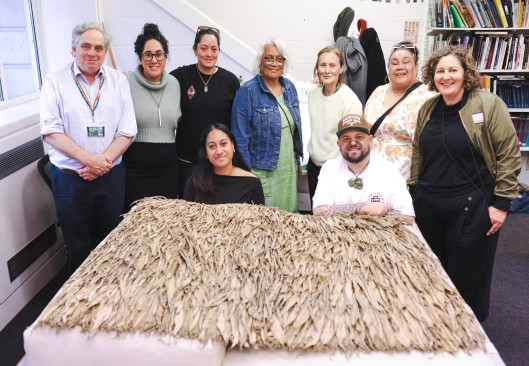
 Top
Top