Whāia te Ara o te Kareao: Taoka form the Ngāi Tahu Archive
Aug 3, 2025

Kareao is the official website of the Ngāi Tahu Archive. Named after the ubiquitous supplejack, Kareao is an apt metaphor for the website which leads from one point to another, linking, connecting, and ultimately taking explorers in myriad directions of discovery. Whāia te ara o te Kareao is a regular TE KARAKA feature sharing important and interesting stories from the Ngāi Tahu Archive with our readers, which they can explore further on Kareao.
Kaiapoi Pā Monument Unveiling 1899
On Easter Monday 1899, Ngāi Tūāhuriri welcomed manuhiri to Kaiapoi pā for the unveiling of a monument erected to mark the place where the famous pā was established by Ngāi Tūāhuriri chief Tūrākautahi. The striking monument consisting of a stone column inscribed with the words ‘Ngai-Tahu’ and topped with an impressive 1,100-kilogram tekoteko was designed in consultation with Ngāi Tūhaitara by the well-known Christchurch architect, Samuel Hurst Seager and carved by Charles Kidson. At 12 metres in height, at the time of its construction it was the tallest monument in New Zealand.
An estimated 4,000 people attended the unveiling including Kāi Tahu from throughout Te Waipounamu and iwi representatives from all over the country. Dignitaries included Premier Richard Seddon, the Hon. Hori Kerei Taiaroa, Member of the Legislative Council, and Tame Parata, Member of the House of Representatives for Southern Māori. In his opening address, chair of the monument committee, Tame Green, described the pā as ‘the site of our ancient capital’, and stated that the monument was intended to, ‘commemorate an epoch in our history’ and stand as a testament of ‘our interesting past’. Seddon responded on behalf of the Crown before Taituha Hape, and the St Stephen’s Church choir lead a procession around the former walled boundaries of the pā to whakawātea the site. A religious service followed, before Green again took to the podium to provide a brief outline of the history of the pā. He then invited Seddon to officially unveil the monument, a task which proved difficult when the cords holding the kākahu draped over the monument broke, leaving the tekoteko only partially ‘unveiled’. The formalities concluded with Tame Parata delivering a closing speech before the assembled crowd moved to the adjacent paddocks to enjoy kai and entertainment.
The event captured the attention of local journalists and photographers whose efforts have left us, more than 125 years later, with a detailed visual and written record of the day. Photographic journalism was relatively new to New Zealand at the time and the Weekly Press where many of these images first appeared, was a leader in the field. The photographs featured here are taken from a series of albums compiled by journalist, businessman, local historian, and local body politician Joseph Lowthian Wilson who worked as the Kaiapoi agent for the Christchurch Press. Kāi Tahu-related images from these albums have been digitally repatriated to the Ngāi Tahu Archive and are available to view on Kareao. The original albums are held at the Alexander Turnbull Library.
The striking monument consisting of a stone column inscribed with the words ‘Ngāi-Tahu’ and topped with an impressive 1,100-kilogram tekoteko was designed in consultation with Ngāi Tūāhuriri by the well-known Christchurch architect, Samuel Hurst Seager and carved by Charles Kidson.
In his opening address, Chair of the Monument Committee, Tame Green, described the pā as ‘the site of our ancient capital’, and stated that the monument was intended to, ‘commemorate an epoch in our history’ and stand as a testament of ‘our interesting past.
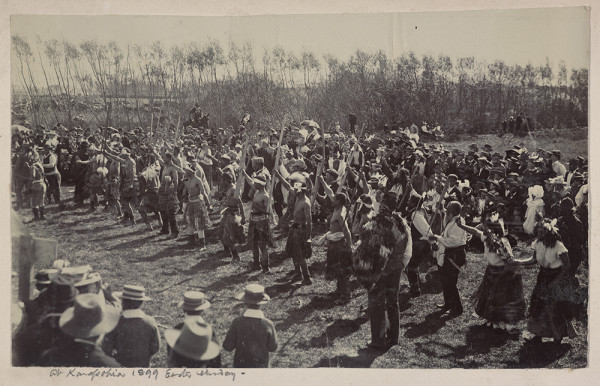
Haka pōwhiri at the unveiling of the Kaiapoi pā monument. PA1-q-1135-37-01, Alexander Turnbull Library.
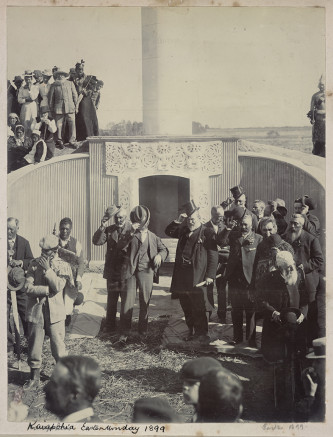
Official guests and representatives doff their hats at the Kaiapoi pā monument unveiling. Members of the official party include (front row, left to right, starting fourth from left): Taituha Hape (treasurer of the monument committee), unidentified, Premier Richard Seddon, Tame Parata (Member of the House of Representatives for Southern Māori), Tame Green (chair of the monument committee), Teone Taare Tikao. The Hon. Hori Kerei Taiaroa (Member of the Legislative Council) is in the back row with the top hat. PA1-q-1135-38-01, Alexander Turnbull Library.
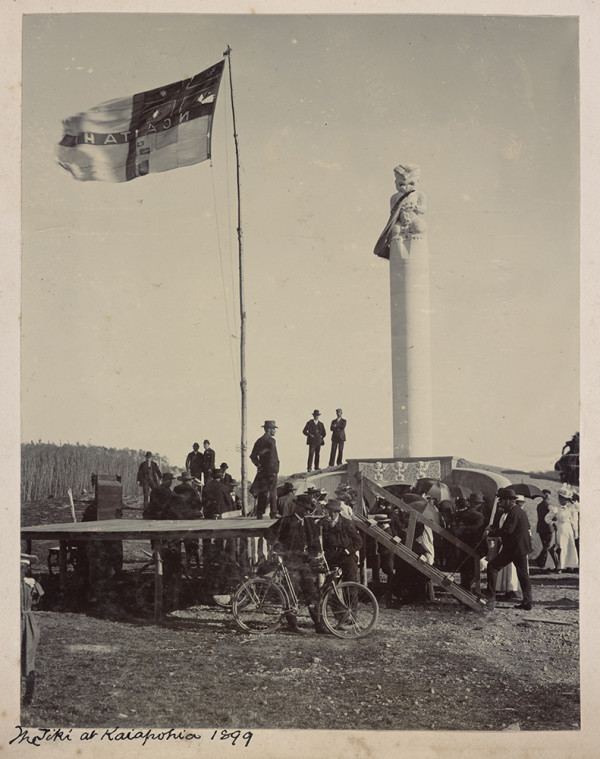
Te Kara o Te Whakaminenga o Ngā Hapū o Nu Tireni, or the Flag of the United Tribes of New Zealand, inscribed with the words ‘Ngai Tahu’ across the red crossbar of the St George’s cross, flies from a wooden flagpole in front of a temporary speaking podium following the unveiling of the Kaiapoi pā monument. The flag, chosen in 1834 by rakatira from the Far North as an assertion of their mana and rakatirataka, was also adopted and used by iwi Māori throughout the country, including Kāi Tahu, as a symbol of Māori authority and autonomy. PA1-q-1135-37-02, Alexander Turnbull Library.
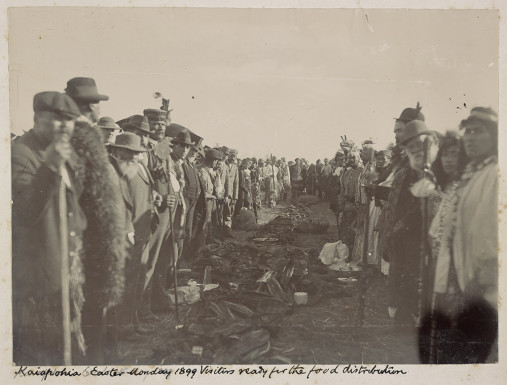
Waiting for the hāngī to be opened at the Kaiapoi pā monument unveiling. Whānau from Wairewa prepared the hāngī which included beef, tuna, potatoes, cabbage, and puddings served on harakeke plates. PA1-q-1135-60-03, Alexander Turnbull Library.
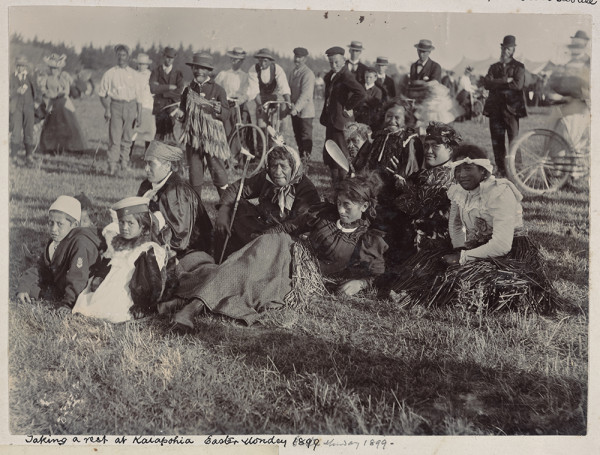
A group of wāhine and tamariki at the Kaiapoi pā monument unveiling. PA1-q-1135-55-03, Alexander Turnbull Library.
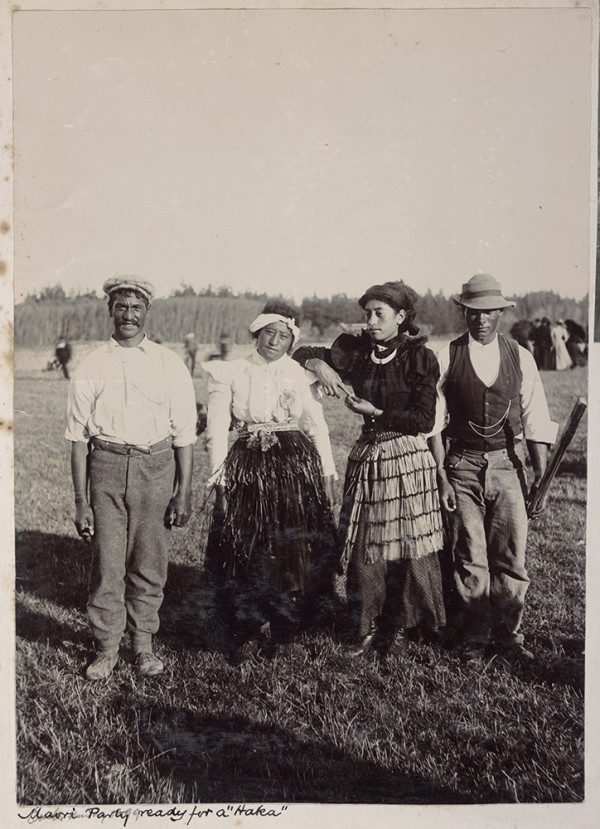
Group portrait of four attendees at Kaiapoi pā monument unveiling. PA1-q-1135-56-01, Alexander Turnbull Library.
Te Kōhaka-a-Kaikai-a-Waro or Kaiapoi pā was established by Tūrākautahi, the son of
Tūāhuriri and one of the principal rakatira
who led the Ngāi Tūhaitara migration
to Canterbury. The pā became a major
Kāi Tahu trading centre and stronghold.
Its existence and strategic importance
enabled Kāi Tahu to take control of the rest
of the island through both warfare and
political alliances with Kāti Māmoe. In 1828,
the pā became embroiled in battles with
Ngāti Toa. After Ngāti Toa attacked
Kaikōura, Te Rauparaha visited Kaiapoi
on the premise of peace. On hearing of
the recent Kaikōura attacks, several
high-ranking Ngāti Toa chiefs were killed.
Te Rauparaha managed to escape and
returned two years later for revenge.
Kaiapoi was under siege for about six
months, and eventually the palisades
of the pā were burnt down, allowing
Ngāti Toa to attack. Many people were
killed, and survivors escaped through the
surrounding swamplands. This attack was
part of a devastating period for Kāi Tahu
with the loss of many people in several
battles. However, Kāi Tahu rallied and
retaliated, eventually driving Te Rauparaha
outside our tribal boundaries. Following the
sacking of Kaiapoi pā, many people shifted
west to settle in the Te Urutī district, which
was later renamed Tuahiwi.
The Kaiapoi pā site was set aside in the
mid-nineteenth century but was not
formally reserved until 1898. The reserve
was managed by a management board until
1979 when control of the reserve was vested
in trustees appointed by the Māori Land
Court. During the 2010–2011 earthquakes,
the upper portion of the tekoteko shifted
precariously sideways so Kaiapoi pā
trustees decided to carefully deconstruct the
monument lest it topple. The trustees have
recently commissioned structural engineers
to assess the integrity of the monument
and advise on what remedial work will be
required to ensure everyone’s safety moving
forward. The tekoteko is currently on display
at the Quake City exhibition in Christchurch.
 Top
Top