Wrestling with the right words...and winning
Dec 18, 2025

WRESTLING WITH THE RIGHT WORDS … AND WINNING
Nick Tipa is having an excellent year. The Ōtepoti-based writer and performer debuted his one-man play, Babyface, at the 2025 Dunedin Fringe Festival, taking away three awards in one night: the UNESCO City of Literature Beyond Words Award, the Fringe Festival Theatre Award, and Promising Māori Artist, all of which took him completely by surprise. Kaituhi ILA COUCH reports.
Ko Te Kohurau ki uta
Ko Waitaki ki te raki, ko Waihemo ki te toka, ko Kakaunui i te waeka
Ko Takitimu, ratou ko Uruao, ko Araiteuru ki tai
Ko Tahu Potiki, ratou ko Hotu Mamoe, ko Rakaihautu ka tupuna
Ko Kati Hateatea te hapu
Ko Moeraki te marae
Ko Tipa tohoku whanau
Ko Peter raua ko Anne ohoku matua
Ko Nick tohoku ikoa
“I WASN’T EXPECTING TO WIN ANYTHING, SO MY acceptance speeches were pretty bad,” Nick admits with a laugh. “The first was awkward, the second was an apology for the first, and by the third speech I was crying.”
In addition to his recent accolades, Nick is fresh from a writers’ residency through the New Zealand Young Writers’ Festival (NZYWF). It’s given him time to work on his next project, which is helpful for the creative all-rounder who describes himself as “new to writing” and “a bit slack” when it comes to committing to one thing.
As a kid Nick was interested in everything from maths, sport and music, which his parents, Anne (Aerani, Ingarani, Kotirana) and Peter (Kāi Tahu, Aerani, Ingarani, Kirihi, Kotirana), fully supported.
His love of the arts, music and live performance took hold in high school, where as a 16-year-old the only way he could play the late-night gigs his band booked at R18 venues was to take his parents as chaperones.
“They were often out into the early hours of the morning just so we could play a gig. My parents are creative people from working-class families, and they were integral to my ability to develop as an artist and musician.”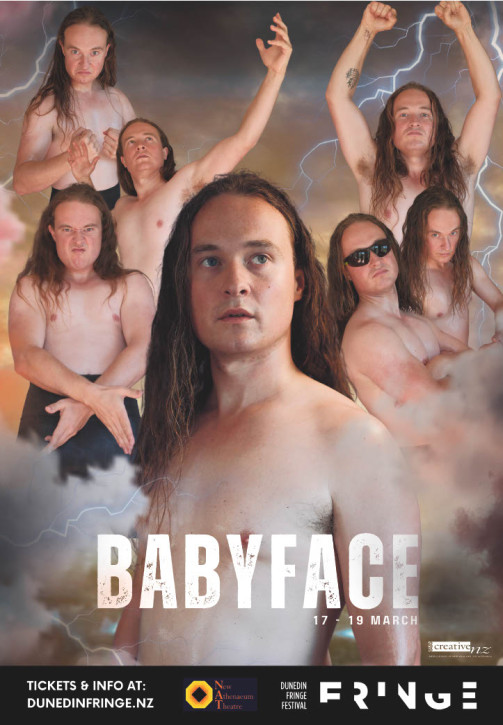 When it came to higher education, Nick kept his options open, studying Physics and Music at Otago University. However, a theatre course cemented his interest in performance and after graduating with a Bachelor of Arts (Honours) he headed to Drama School in Melbourne to hone his performance skills.
“I was 23 at the time, and it ended up being the best educational experience I could have had. There was no grading – that wasn’t the point. We worked on developing as artists, focusing on craft and taking away the expectation of having
to be good.
“It became a really good lesson for me in letting go of the pressure to perform to an audience and, instead, learn what it is to be in communion with an audience.”
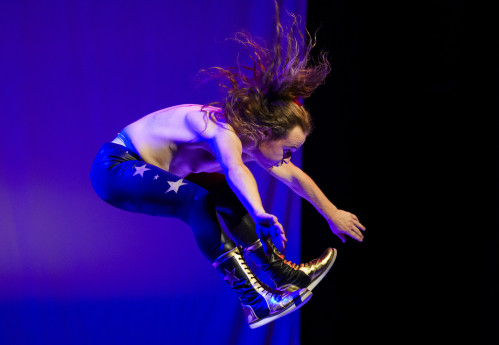
For his first play, Nick mined his own childhood for ideas, creating a story inspired by his experiences. Babyface is the story of 10-year-old Kahu, a boy who has an alter-ego called Whiplash, a WWE-style professional wrestler.
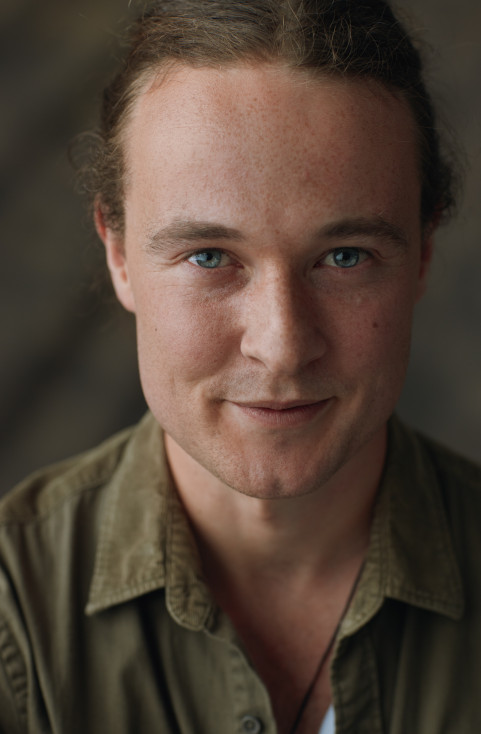
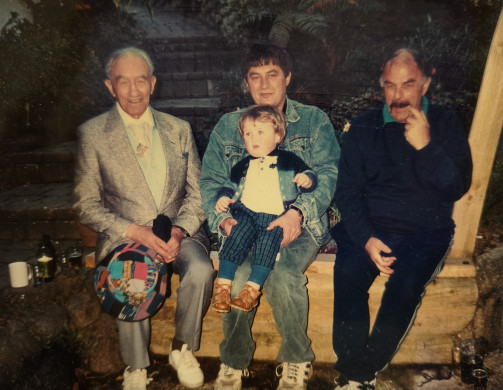
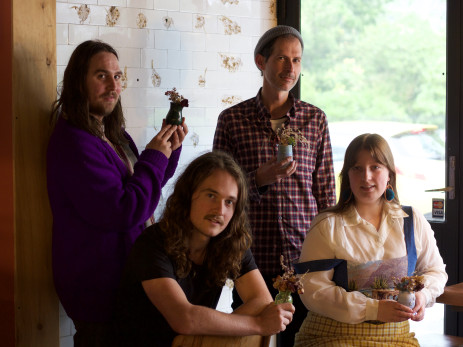
Above: Continuing with his passion for live music, which started as a teenager,
Nick performs and records with his current band, Laney Blue; top: Avon Tipa
(Nick’s great grandfather), Peter Tipa (Nick’s father), Desmond Tipa (Nick’s
grandfather), baby Nick Tipa. PHOTOGRAPHS: SUPPLIED
“I spent some years growing up in Middlemarch, which is a town of 250 people, an hour outside Otepoti. As a 10 to 13-year-old I watched a lot of WWE professional wrestling. For a time I was telling people when I grew up I wanted to be a wrestler, so weirdly this play is me fulfilling my childhood dream.”
Kahu, who is dealing with the separation of his parents and in the process of packing up his bedroom, finds objects that send him back to memories of the small town he is about to leave. Interspersed throughout the play are wrestling matches where the world instantly changes and Kahu becomes his alter ego. In the play, Nick takes on the role of at least 17 characters, and since it’s a solo show, he wrestles himself.
“I did a bunch of research, so when the wrestling fans turn up I’m not going to embarrass myself. There are moments of throwing myself, hitting myself with a chair and trying to create an actual wrestling match. The show is fun, and one person wrestling themselves is inherently comedic.”
An enjoyable aspect of writing and preparing for the play was research. Nick says this allowed him a deeper dive into a world he had
only understood as a child.
“I looked into the history of big-time wrestling, where it came from – the carnival circuit in the 1800s – and also wrestlers from Aotearoa who had an impact on the world stage. It’s really a form of semi-improvised theatre, live-streamed to the world.”
Following the success of Babyface at the Dunedin Fringe Festival, Nick is keen to take the show around the motu as well as Adelaide and Edinburgh.
Encouraging people to venture out and experience live performances is something Nick is passionate about.
“Bringing people together to have a shared experience – that’s the reason for doing anything at all. Without there being something to draw people together, to gather around and reflect upon, it’s far too easy to be antagonistic, lose empathy and be limited in our understanding of the ways one can be human. You know what it is – it’s wānaka. It’s sitting and reflecting together, and that’s what makes it valuable.”
As part of the NZYWF, Nick was also selected to be part of a rōpū of emerging voices to wānaka at Puketeraki Marae and present their work during the festival weekend. For Nick it was an amazing experience to be on the whenua, spend time in whakawhanaukataka and explore the relevance of the written word in modern storytelling.
“I met so many amazing young writers and got to hear the work of these amazing young voices – Tahu, Maori, Tauiwi, Pakeha. It was
completely inspiring. There was really good kōrero about how in te ao Māori stories are told in a multitude of ways, whether it’s through whakairo, tukutuku, raraka and that words are only one way to tell stories.
“But today I think about how important words and written stories are in the way it translates into different forms of media, whether that’s film, TV, radio or social media. Writing to some degree is still core to those processes.”
Above: Students from Te Kura o Hato Opani in Otautahi take a group photo with Nick and the cast of Taki Rua
Productions following a te reo Maori performance of Patricia Grace’s, Te Kuia me te Pungawerewere;
top: In character – Nick on stage at the Dunedin Fringe Festival for his solo-play Babyface, the story of
a young boy and his wrestling alter-ego, Whiplash.
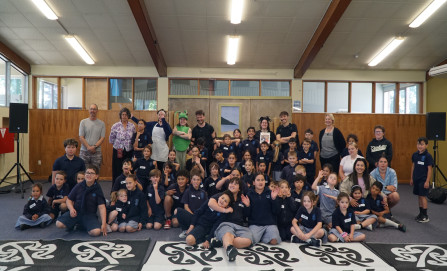 Above: Students from Te Kura o Hato Opani in Otautahi take a group photo with Nick and the cast of Taki Rua
Productions following a te reo Maori performance of Patricia Grace’s, Te Kuia me te Pungawerewere;
top: In character – Nick on stage at the Dunedin Fringe Festival for his solo-play Babyface, the story of
a young boy and his wrestling alter-ego, Whiplash.
Among the 21 poets, writers, researchers, playwrights and musicians selected to take part in the wanaka at Puketeraki Marae, more
than half were whakapapa Māori, and six identified as Kāi Tahu.
Supporting the next generation of Kāi Tahu writers is important to Nick. “When we nurture the talent of our writers we are nurturing our people as a whole and the proliferation of our tikaka and reo as well. It’s through writing that our stories get told; our history, our kōrero, our pūrākau, our ātua, and all of those other things that are important to us as Tahu and takata Maori katoa.”
Boosted by a recent writers’ residency at the Robert Lord Cottage in Otepoti, Nick has already started developing ideas for his next
projects.
“I have a few new play ideas I think are going to be good stepping stones on the path to working up a larger piece. I don’t know if it will come together, but I’ll do my best. It will be in large part in te reo Maori and an exercise to get out of my own way and let that creativity flow.
“I’m not trying to be matatau, just being where I’m at and trying to tell a story that has relevance to whanau out there, especially whānau Kāi Tahu.”
Despite putting his formal reo Maori studies through Te Wānanga ā Aotearoa on hold, Nick has found opportunities to flex his reo skills, recently touring with Taki Rua Productions, bringing a stage adaptation of Patricia Grace’s story Te Kuia me te Pungawerewere to audiences in Te Waipounamu. The play is entirely in te reo Māori.
Long-term, Nick is excited to be part of the ongoing movement to strengthen and normalise the use of te reo Māori.
“There’s some reo strategy happening at Moeraki, and I’m stoked we might get to see some kura reo set up or online. I’m feeling a real
passion about learning with the hapu and learning from the whānau. It hits different when you’re at the marae and learning. Hopefully, next year will be the year.”
 Top
Top