A landmark verdict for pounamu
Aug 19, 2026

 Poutini Ngāī Tahu whānau gather outside the Manakau District Court. PHOTOGRAPHS: SUPPLIED
A LANKMARK VERDICT FOR POUNAMU
On 1 April this year, whānau from throughout Te Waipounamu gathered in the Manukau District Court to hear what many believed would become a landmark verdict
in the protection of pounamu. Kaituhi NIKKI-LEIGH WILSON-BEAZLEY reports.
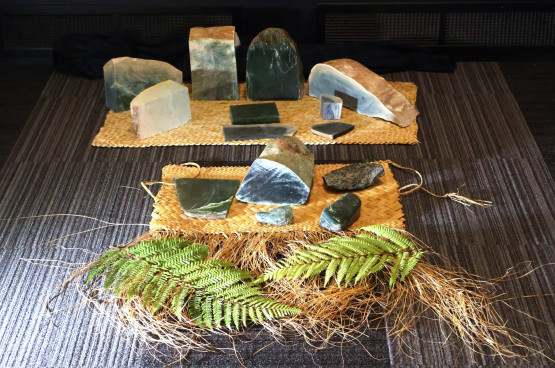 Above: 14 pounamu stones returned by Customs on 1 November 2024 (separate incidents)
FOR FIVE DAYS THEY SAT THROUGH PROCEEDINGS AS A MOTHER AND son faced charges relating to the illegal export of nearly 18 kilograms of pounamu after being stopped at Auckland Airport in 2024. When the judge delivered the verdict, guilty on all charges, the reaction from those gathered was instant – tears, embraces and karakia outside the courtroom as the realisation of what had just been witnessed sank in – the first successful prosecution under the Customs Export Prohibition (Pounamu) Order 2021.
“It was emotional,” says Te Amo Tāmainu, who attended the proceedings representing Poutini Ngāi Tahu. “Not just because of the outcome, but because protection’s been there for generations, and this was the first prosecution.”
Boyuan Zhang and his mother Xin Li were intercepted by New Zealand Customs officers at Auckland International Airport in July 2024 while preparing to board a flight to China, after 17.9 kilograms of pounamu was discovered concealed across multiple suitcases within the pair’s luggage.
Under current legislation, raw and partly processed pounamu cannot legally be exported without ministerial consent, which in turn would need to be based on advice from Te Rūnanga o Ngāi Tahu. This restriction doesn’t apply to jewellery or finished pieces, and individual exporters can carry less than five kilograms without approval.
During the hearing, the court heard arguments around how the five-kilogram threshold should be interpreted. Zhang argued that he believed the weight of the pounamu could be spread across members of the travelling group, even when those individuals were not physically carrying the stone themselves. Judge Richard McIlraith later ruled that
misunderstanding the law did not remove criminal liability.
The guilty verdict established a significant legal precedent in the protection of pounamu. For many involved in the case, however, the proceedings also reflected a much wider issue that has been growing across Te Tai o Poutini for years.
“This is a significant moment as it sets a precedent for the protection of our taonga,” says Chantal Tumahai of Ngāi Tahu Pounamu. “It shows that Ngāi Tahu and New Zealand Customs take the illegal export of pounamu seriously.”
“This is a significant moment as it sets a precedent for the protection of our taonga,” says Chantal Tumahai of Ngāi Tahu Pounamu. “It shows that Ngāi Tahu and New Zealand Customs take the illegal export of pounamu seriously.”
Together, the legislation established the framework through which Ngāi Tahu manages and protects pounamu throughout the takiwā, including restrictions around the export of raw and partially processed stone.
Within Te Tai o Poutini, the responsibility of protecting and managing pounamu has long rested with the hapū of Kāti Māhaki and Kāti Waewae, who remain the kaitiaki of pounamu in the takiwā. “Protection of pounamu is vital to Poutini Ngāi Tahu,” Chantal says. “It is much more than a resource to us, it is a living taonga with spiritual,
historical and cultural significance that we need to safeguard for future generations.”
The case also arrives amid growing concern around the illegal trade of pounamu throughout the West Coast and beyond. Recent investigations have highlighted increasing issues relating to unlawful extraction, online trading and international export, with significant quantities of pounamu now being recovered through Police and Customs operations.
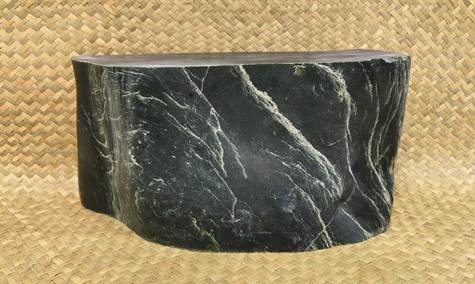 Above left: One piece of the pounamu that the defendants’ father and husband had attempted to export in May 2024.
Right: The Arahura Awa on Te Tai o Poutini.
In April this year, police seized around one tonne of allegedly illegally sourced pounamu during a major operation targeting commercial theft on the West Coast. Earlier this month, Customs also revealed that almost 300 kilograms of pounamu had been intercepted at the border over the past decade. Most involve passengers travelling through airports, although there have been cases of seizures through international mail and freight channels.
Kāi Tahu has also raised concerns around the scale of online trading through platforms such as TradeMe, Facebook Marketplace and Etsy, where buyers are often unable to determine whether pounamu has been sourced legally or ethically.
For Chantal, the guilty verdict reinforced the role of Kāi Tahu as kaitiaki in a practical and enforceable way.
“Yes, it affirms that our role as kaitiaki is not symbolic, but it is supported and enforced under the law that anyone who exports pounamu without written approval from Ngāi Tahu will be at risk of legal action.”

Key to the successful prosecution is the long-standing relationship between Ngāi Tahu Pounamu and New Zealand Customs. Chantal says the relationship has been built over many years through the sharing of cultural knowledge and expertise relating to pounamu, allowing for the protection of pounamu within the Kāi Tahu takiwā and beyond.
“For the past 11 years that I have been in my role, Ngāi Tahu Pounamu has had a strong working relationship with Customs,” she says. “We share our cultural knowledge and insight about pounamu from within the Te Tauihu takiwā.”
Chantal says Ngāi Tahu Pounamu has previously assisted Customs in connecting with Ngāti Kuia after pounamu uplifted at the border was identified as being from within their rohe, allowing it to be returned appropriately.
“What made that relationship work? Trust, respect and a lot of whakawhanaungatanga,” she says. “Having people working within Customs who understand tikanga and kawa when it comes to pounamu makes it that much easier.”
Te Amo says collaboration between iwi and government agencies was central to the outcome of the case. “We wouldn’t have achieved thatif we didn’t have the relationships with Customs,” she says. “We worked together as a collective, and that was really significant.”
Despite the significance of the prosecution, many Kāi Tahu believe the current system still has significant gaps. The iwi has long sought stronger compliance and enforcement powers relating to unlawful fossicking and extraction, however, there remains a heavy reliance on agencies such as Customs, Police, local councils and the Department of Conservation to intervene where required.
Concerns have also been raised around whether the current five-kilogram export threshold remains fit for purpose, particularly as international demand for pounamu continues to grow. Critics argue the law was developed in a very different environment to the current one, where online marketplaces and international trading networks make the movement and sale of pounamu significantly easier.
Those involved in the case believe the verdict will likely influence how pounamu protection is approached moving forward, particularly around enforcement, education and public awareness.
“This case is setting a precedent for protecting pounamu, inspiring stronger enforcement, sharing awareness of what is right from wrong and how to go about obtaining pounamu legally,” Chantal says. “There is still a need for continued collaboration between Ngāi Tahu, government agencies and wider New Zealand for stronger education and legal reforms, to ensure ongoing protection is in place and to further prevent illegal activity.”
Kāi Tahu has authentication systems in place for licensed carvers and retailers, including traceability codes and iwi trademarks intended to help consumers identify legally sourced pounamu.
For those who travelled to Manukau District Court, the verdict was more than a successful prosecution; it reinforced through the courts a responsibility that Kāti Māhaki and Kāti Waewae have carried for generations.
For Chantal, the significance of the case extends well beyond the courtroom itself: “This is a historic moment for our whānau, hapū and iwi.”
 Top
Top