A world of his own design
Aug 19, 2026

A WORLD OF HIS OWN DESIGN
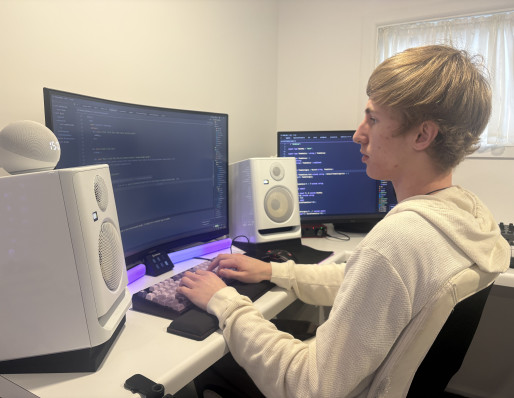
Nico Cook (Kāti Māhaki) first fell in love with programming when he was about seven and logged into Minecraft for the first time. In a world of blocks, creatures, quests and challenges, he realised programming could be a tool for creation, expression and for forging a world completely of his own design. Nā Nikki-Leigh Wilson Beazley
WHAT BEGAN AS CURIOSITY QUICKLY BECAME SOMETHING MORE. While most children his age were simply playing the game, Nico found himself fascinated by what was happening beneath the surface. “I started playing and realised everything in the game was customisable. That was the beginning of the journey for me.” Hidden among Minecraft’s endless landscapes was an in-game tool known as a command block, allowing players to manipulate the game itself through code.
For Nico, discovering that was the moment he realised just how much of the game could be customised. To him, it felt less like playing a game and more like discovering a new language.
Not long afterwards, he enrolled in a series of free programming classes at the New Brighton Library. The sessions lasted only a few months, but they gave him something far more valuable than technical skills. They showed him a pathway.
“I went along for about six months, and it really ignited the flame. From that point on I knew I wanted to keep learning.”
The years following were largely self-directed. While other teenagers were spending their free time on social media or sport, Nico was teaching himself new programming languages, experimenting with software development and steadily building his understanding of technology.
At age 14, he entered the New Zealand Informatics Competition (NZIC), a programming competition typically contested by senior secondary school students from across the country. While many competitors entered as part of a school team, Nico entered alone, and while many of the members of those teams were several years
older than him, he managed to place sixth in Canterbury and 12th in New Zealand.
“I remember coming away from that thinking maybe this wasn’t just something I enjoyed doing. Maybe it was something I could actually build a future around.”
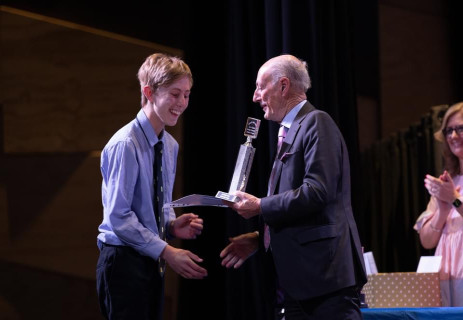
The result earned him a place in New Zealand’s Olympiad training programme and led to training camps through the University of Canterbury. It also exposed him to a wider community of young programmers who shared the same passion for technology and problem solving.
Like many self-taught programmers, much of Nico’s learning came through open-source software – programmes and applications whose code is freely shared online for others to study, improve and build upon. While most people would see pages of symbols, commands and functions, Nico saw the thinking behind them. He could recognise patterns in the way a problem had been approached, the decisions that had been made and, in some cases, even the individual behind the work.
“Programming is a language. After a while you start to recognise how different people think. There are developers whose work I can look at and immediately know who wrote it.”
Programming, despite its reputation as a solitary pursuit, is often deeply collaborative. Developers learn from one another, build on each other’s ideas and contribute to projects from across the globe.
“You’ll see somebody solve a problem in a way you never would have considered. Then you learn from it, add your own ideas and build on top of that. It’s almost like a conversation.”
The opportunities continued throughout high school. Teachers began approaching him with projects of their own, including a Canterbury teaching collective looking to develop a website for educators. What began as a request for assistance eventually became Nico’s responsibility to design and build from the ground up. That website went on to be used by teachers and principals throughout the region.
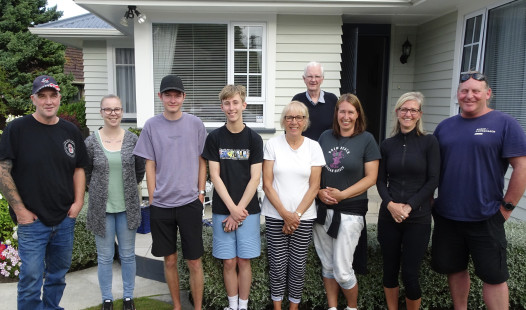 Above: Whānau Christmas 2022. From left: Daryl Coutts , Zoe Coutts, Jacob Elliott, Nico Cook, Pam Coutts,
the late Eric Coutts, Katrina Coutts (Nico’s mum), Fiona Elliott, and Jason Cook (Nico’s dad).
“The special part about it was seeing what I’d made in action. It wasn’t really about building the website itself, it was seeing people use it and knowing it was helping them.”
At Shirley Boys’ High School’s annual athletics day, teachers were relying on spreadsheets and manual processes to record results throughout the event. Seeing an opportunity to improve the system, Nico developed a custom platform that allowed scores, records and student results to be managed in one place.
As the event unfolded, teachers began offering suggestions and ideas for improvements. Sitting on the sidelines with his laptop, Nico made changes as they were requested, refining the software while it was actively being used.
“It was really cool because people would come over and ask if it could do something different and I’d make the changes while they were using it. Being able to adapt it on the spot and see it working straight away was a really rewarding experience.”
Last year, at just 16 years old, he established NebulaDev, a freelance web design and software development business that sees him taking calls from clients in the evening while still attending school the following morning.
“Every day is different. One day I’m talking to a coffee machine manufacturer about building an app and the next I’m developing software for another project.”
The business has evolved alongside a growing list of projects and achievements including completing his first year of Computer Science studies at university and receiving A and A+ grades across his papers, while still attending school. The results placed him among the top 10 percent of students taking the courses nationwide and earned him the Webb-Holmes Scholarship for highest academic achievement in the programme. He was also elected as student representative on his school’s Board of Trustees. However, when asked what he is most proud of, Nico’s focus remains firmly on the work itself.
“The biggest sense of achievement comes from creating something that people genuinely use. Whether it’s a website, a piece of software or a tool that saves someone time, it’s a great feeling knowing you’ve made somebody’s day a little easier.”
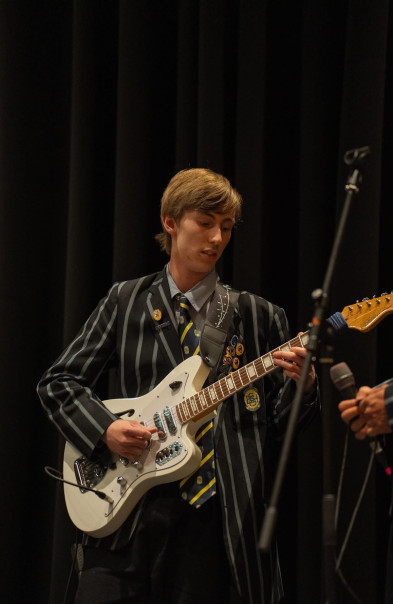
Alongside software development, music has become one of Nico’s other great passions. He began learning guitar at around the same time he started programming and has continued to pursue both ever since. Equally as dedicated to music as he is to programming, Nico has earned a place in the Shirley Boys’ Jazz Big Band, one of New Zealand’s leading secondary school jazz bands, spending much of his time rehearsing, performing and competing alongside some of the country’s most talented young musicians.
“To me, programming and music are both art forms. A lot of people see programming as something purely technical, but I’ve never really looked at it that way. Whether it’s a piece of software or a piece of music, you’re creating something that didn’t exist before.”
Along the way, Nico has performed at festivals and competitions throughout the South Island, helping his Jazz Big Band secure multiple gold awards and Best Big Band honours at Southern Jam. He was also selected for the All Stars Band at the Christchurch Big Band Festival and occasionally fills in on guitar for the Sideline Swing Big Band.
Throughout much of that journey, he has been supported by Judith Bell, his jazz conductor, and Professor Tim Bell, a computer scientist whose encouragement helped nurture his interest in programming. Mentors in both music and technology, the pair have played an important role in shaping the two passions that continue to define much of Nico’s life.
“Being on stage and having a conversation through music feels a lot like programming. You’re creating something, sharing it with other people and seeing how they respond to it. That’s what I enjoy about both.”
While programming introduced him to communities of developers around the world, music provides a different kind of connection. “Music sort of solves the missing places that programming maybe doesn’t. Programming can be quite an isolated thing sometimes, whereas music brings people together. A lot of my closest friendships have come through music.”
Looking to the future, Nico hopes to bring together the skills he has spent years developing through programming, music, design and storytelling.
“I’d love to create a video game, and a music album. A game especially ties together everything I’ve learned. You’ve got the programming, the art, the story writing, the music and then the sharing of it.”
At just 17 years old, he has plenty of time to do so. “The biggest thing for me is making a difference. Whether it’s a piece of software, a website, a game or a piece of music, if something I’ve created helps somebody, stays with them or gives them a positive experience, that’s what matters most.”
 Top
Top