He kāhere kei te haere a forest-in-waiting
Aug 19, 2026

HE KĀHERE KEI TE HAERE A FOREST IN WAITING
Ten years ago, the whānau of Moeraki started to turn their gaze from Te Kerēme and the post-settlement era to what comes next. They’ve been quietly planting
and watering seeds of all sorts and starting to bring whānau home. Kaituhi NIC LOW reports.
TORI ROSS NOSES HER TRUCK ACROSS A NARROW BRIDGE, BARELY WIDE enough for one vehicle. The stream flowing underneath runs into a mirror-perfect hydroelectric holding pond that looks, if you squint, like a lake. Verdant farmland rolls west towards the blue ranges behind Te Kohurau, but we’re heading east towards the coast, past tangles of pink-tipped willows and forests of gorse. It’s whenua that’s been badly neglected in the past. The weeds were well over head height back when Moeraki’s Whiria Te Waitaki team started looking after this block.
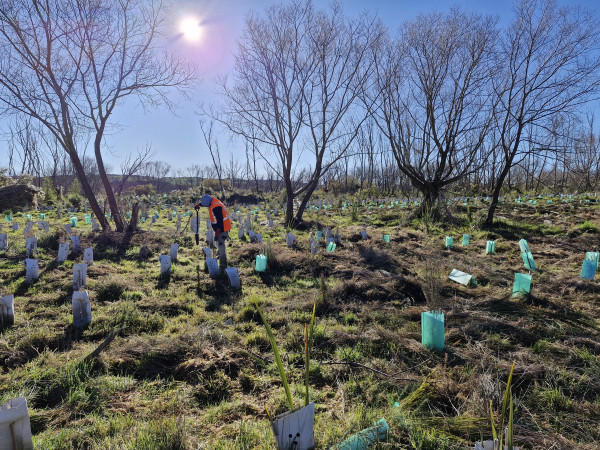
Moeraki’s Whiria Te Waitaki team started looking after this block. Now, everywhere you look, green shoots shine through. Hundreds, thousands, tens of thousands of tipu, from tī kouka to harakeke to makomako, push up towards the light. Round a bend we reach the frontier of the work, where mountains of cleared willow trees stand ready
for a bonfire that may well be visible from space. In five years the Whiria team has planted more than 135,000 natives here, all in the service of restoring the mana of a significant site.
The area is associated with Te Huruhuru, a chief of the Ngāi Te Ruahikihiki and Ngāi Taoka hapū. He lived in tumultuous times, helping ambush Te Rauparaha near Kaparatehau/Lake Grassmere in 1833 and likely drivng from his home at Lake Hāwea by northern raiders in 1837. The survivors relocated to the lower Waitaki, where Te Huruhuru was a chief. When the first Pākehā Explorers arrived, he provided them with information and maps and likely learned to read and write. Edward Shortland described him as, ‘a man of singularly pleasing mannerand address’. Te Puna a Maru, where we are today, encompasses the seasonal kaik where he and his wife Mokehe and their hapū lived. Through the work of Whiria it is slowly being revealed; restoring the connection between people and place.
At the end of the track, we park up beside the awa. Kauri Tipa (Ngāi Tahu, Ngāpuhi, Ngāi Te Aotaumarewa) tilts back his black leather cowboy hat and points out the latest areas they’ve cleared and planted. He was one of the original crew, back in 2021. He grew up in Ōtautahi, and while his whānau attended marae kaupapa at Moeraki, he’d rarely visited the Waitaki. At 16, he landed his first job with Whiria and relocated to Moeraki. Now he works daily on the whenua alongside his uncles and cousins. He’s still learning the stories of the area but knowing there are ancestral connections gives the mahi purpose. “That’s our why. Our tīpuna came here and worked and lived off the land here. Why can’t we, why shouldn’t we?”
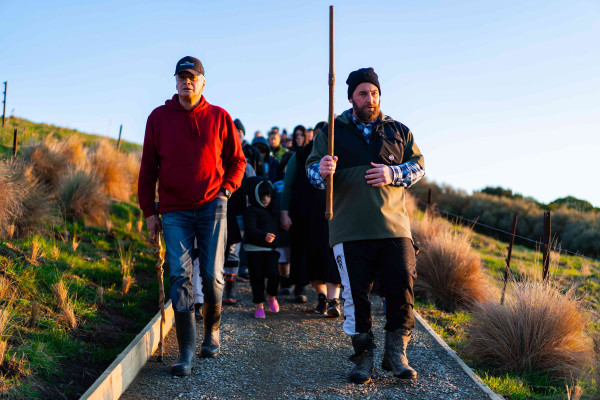 Upoko David Higgins and Kaiwhakahaere Justin Tipa lead the blessing for the reopening of the Katiki Point walkway, 2022. PHOTOGRAPH: RICHIE MILLS
Since the time of Te Huruhuru there are many reasons why Moeraki whānau haven’t been able to work, live off the land or even live in Moeraki. In TE KARAKA issue 96, our feature on Tūtakahikura outlined some of those reasons — clearance of land and destruction of mahika kai, unjust reserves, lack of work, lack of services — which, like so many other pā, meant that few whānau could remain as ahi kā. People scattered, moved to the cities, went up north. Those who stayed put their energy into getting food on the table and fighting the claim.
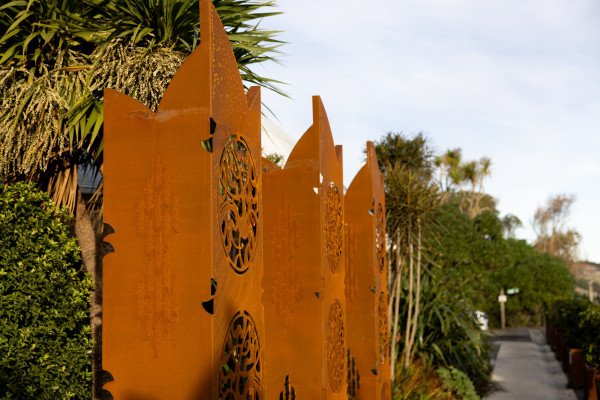
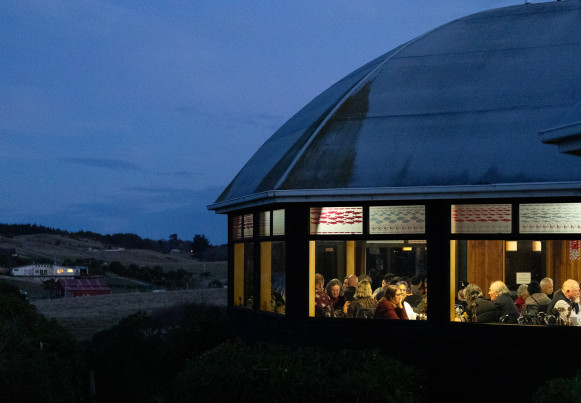 Boulders Café by night; previous pages: A series of contemporary pou designed by Ngāi Tahu artist Ross Hemera, now welcome manuhiri to the
Boulders Café. PHOTOGRAPHS: JASON BOBERG
As upoko David Higgins says, there was no chance to dream. “I used to go over to the urupā and sit there with the old fellas and talk to them. When they went through the Smith-Nairn Commission [an 1879 inquiry into land purchases], they weren’t aspiring to anything because they didn’t know what was going to come out the other end.”
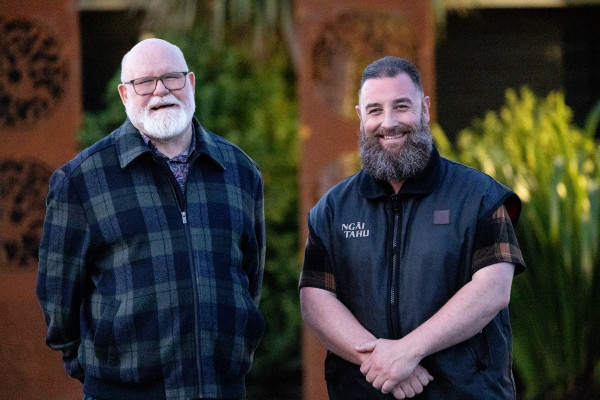 CEO Trevor McGlinchey and Kaiwhakahaere Justin Tipa. PHOTOGRAPHS: JASON BOBERG
It’s only very recently, with Te Kerēme behind them and the settlement firmly under control, that the hapū has been able to think about rebuilding their own backyard. “Ten years ago, we started reshaping our rūnaka,” David says. They started by encouraging families to move back, and Patrick and Nola Tipa were the first to take up the wero. But for people to return they needed homes, jobs, education. They needed good healthcare, healthy whenua and awa. Fully addressing these challenges is intergenerational work. Last year, that slow process took a leap forward with constitutional change, with monthly rūnaka meetings and volunteer executives replaced by something new.
“Closing in on three decades post-settlement, the time felt right for a discussion on what being fit-for-purpose looks like for Te Rūnanga o Moeraki,” says kaiwhakahaere Justin Tipa (Ngāi Tahu, Ngāti Mamoe). “The new structure is about keeping up with the pace of growth within the Te Rūnanga o Moeraki ecosystem and ensuring we have things in place to deliver for our whānau into the future.”
On the drive south towards Otago, Kaihīnaki is among the most significant Kāi Tahu sites on this stretch of coast. That’s been the case since the Araiteuru waka arrived, but recently, something has changed. Outside the Moeraki Boulders Cafe, new laser-cut steel pou from Ngāi Tahu artist Ross Hemera signal that the hapū now owns the place. And inside the cafe, I meet the man tasked with taking the operations of the rūnaka forward, CEO Trevor McGlinchey.
Sitting down to bacon and eggs while the winter sun rises from the sea at his back, Trevor tells me he started out as a freezing worker and apple picker before moving into social services. In his late 20s he founded Te Mahi o Waitaki Trust to help disadvantaged whānau in Ōamaru. Since then, he’s done long stints as Chair of Te Rūnanga of Moeraki and held a range of executive roles in education and social services across the motu, all with a focus on Māori wellbeing. It’s his responsibility to coordinate the vision of the hapū across its many businesses and activities — in new ways.
For decades, the monthly rūnaka meeting has been the heart of Kāi Tahu politics — endless Sunday hui full of debate and digression, laughter and anger and cups of tea, run by a volunteer executive, part governance, part operational, part social. At Moeraki, those meetings and the volunteer executive are no more. And Trevor, as a former chairperson, is not sad to see rūnaka meetings go.
“The monthly meeting cycle sucked up the energy of the staff and didn’t deliver outcomes in a way that you would expect an organisation that had a multi-million-dollar capital base to operate.” He gives a wry smile. “I think someone on the executive described it as operating something like a netball club.”
Now, the rūnaka has an ‘executive board’ which operates more like a company board, with a wider range of responsibilities that can be delegated to staff. That board appointed Trevor as the CEO, and part of his job is ensuring whānau are actively involved in more meaningful ways. “Our whānau obviously still want to be connected, to understand what’s going on and be a key part of strategic decision-making, but [we’re] taking the mundane out of the system.”
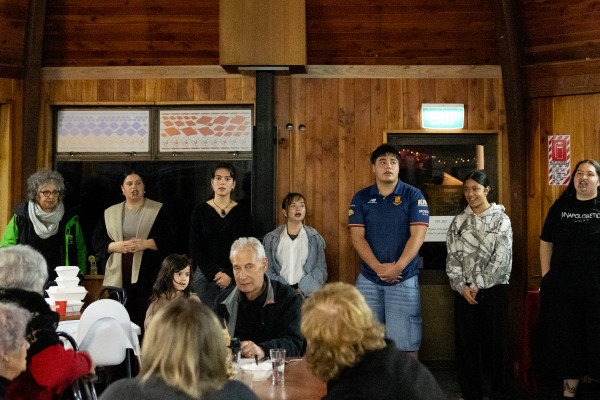 Moeraki whānau gathered at the Boulders Café. PHOTOGRAPHS: JASON BOBERG
Whānau are still welcome to attend executive meetings online, but the new focus instead is whānau hui held around four times per year. There, leaders provide updates and seek guidance on key kaupapa, such as the annual plan and budget, or responding to climate change impacts like the erosion of their urupā. The thousands of smaller decisions required to get the work done aren’t brought to the whānau. The result: a big increase in the number of people turning up compared to the rūnaka meetings of old, from 25-30 people to close to 50.
Better efficiency means renewed energy for cultural mahi interspersed throughout the year, from Matariki to kapa haka to numerous wānaka. The week before my visit, the rūnaka took 63 whānau members to Awarua, Waihopai, Ōraka and Rakiura, connecting with their relations as they went. As David had told me, “That’s huge for our little pā… It was cool to arrive at Half Moon Bay and look at all the big fishing boats there and say, ‘all those are our cousins’. And you could see the smiles of pride in their faces.”
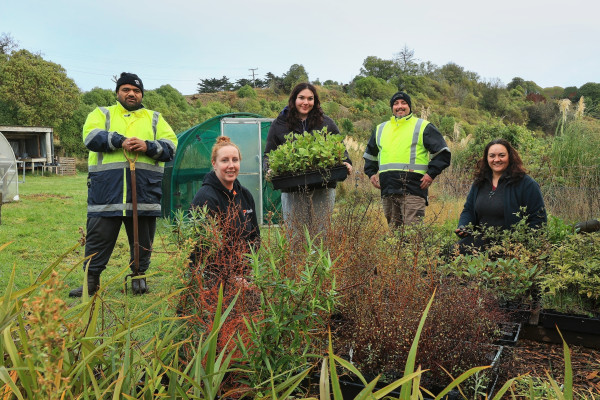 Above, l-r: Pita Fa’au. Tori Ross, Ranui Te Maiharoa, Damien McNamara and Stephanie Barlow. PHOTOGRAPH: SUPPLIED
With the cultural side in hand, David says the new leadership structure means it’s far easier to grab opportunities when they come along. When the Jobs for Nature fund ended in 2025, many iwi and hapū had to shut down their ranger programmes. Whānau lost their jobs and regeneration and pest control work started going backwards. At Moeraki, Whiria Te Waitaki was on the chopping block.
“Trevor and the team came over to us here and Justin one day at a rūnaka meeting,” David recalls, “and he said, ‘Well, we’ve got to keep Whiria going. We need a million dollars. What do you think?’” David snaps his fingers. “Done. That quick. Amazing. We knew that we had to do that. The other day we did another one – Milford Sound Tourism. Bang.”
Previously, economic opportunities had “driven past the gate.” The new willingness to pounce comes from whānau having confidence in the changed structure and new leadership. It’s also possible because economically the hapū is in a good place. Earlier savings got a major boost from last year’s relativity payment and the Waitaki Kawenata agreement. They’re now well placed to ramp up rebuilding the whole community.
“How can we do that in order to fan the flame of ahi kā within our village?” Trevor says, “And then from that strong base, how does that radiate out and attract others to participate and be at home?”
Last year two new papakāika houses went up across the road from the marae, with more planned. In January 2025 Ana Faau and her husband Pita moved into one, bringing their five tamariki into the pā. Jamie Carroll moved in next door with her two tamariki. They were drawn to the whanaukataka that comes from village life, and having their kids grow up at the marae where manaakitaka is simply absorbed. Everyone benefits. In the previous 20 years there were no kids in the pā.
“All of a sudden, I’ve got a whole lot of kids,” David says. “That’s a delight for someone of my age, to have these little ones rolling around all over the place... Those kids will never forget their upbringing.”
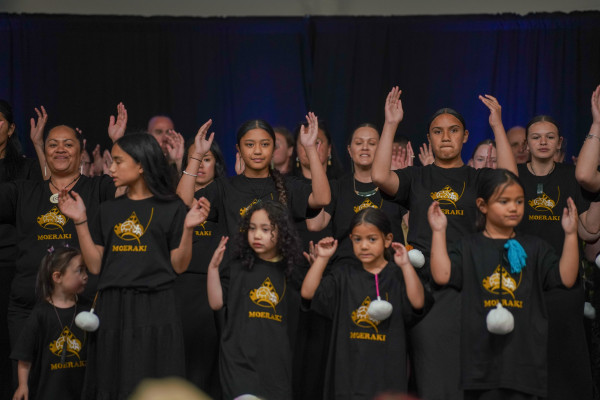 Moeraki whānau performing at Hui-ā-Iwi, Kaikōura 2024. PHOTOGRAPH: RICHIE MILLS
As kids grow up in the district they need kaupapa-Māori development pathways. Te Pōhā, the youth leadership programme, works with rakatahi teaching life skills, mahika kai and mahi toi. They’re regularly out and about on the whenua, learning about their ancestors and the importance of being kaitiaki. It also means regular involvement at Uenuku. When they have important manuhiri, Trevor says, “those kids will come and support the pōwhiri, they’ll come and do the cooking, they’ll serve, they’ll support our day and showcase what they’re able to do outside of the government system.”
In a small community, young people also need jobs if they’re to stick around. Whiria Te Waitaki and Te Hā o Maru, the health and social service arm, offer pathways in environmental work and health respectively. Since the hapū bought the cafe in 2024, there’s now a hospitality pathway as well. Last summer they ran a hospitality course for 20 local teenagers, with another scheduled for later this year. The programme is open to all kids in the community, part of the desire to care for everyone in the takiwā.
You’ve probably heard the slogan ‘by Māori, for Māori’. But it’s not one that Mani Malloy-Sharplin subscribes to. Mani is Toihau Chief Executive of Te Hā o Maru. “I don’t actually agree with that,” he says. “I think for us to be proper kaitiaki of all of those people living within our takiwā, it should be ‘by mana whenua, for everyone.’ So, our services are open to every demographic in our region, Filipino, Māori, Pasifika, Pākehā the whole lot.”
Mani has whakapapa to Tuahiwi, Kaikōura and Te Pātaka Kai a Rākaihautū. He grew up in the Bay of Plenty where, as a kid, he was in and out of hospital with severe asthma and croup. “Urgent,” is how he describes his early years in the Pākehā health system. His mother worked as a home-birth midwife. She was “hard for the old natural remedies… she had a huge belief in what the female body can do.” He remembers her coming home upset after big days at the hospital, frustrated by interventionist doctors. “So, I grew up with a bit of a mistrust of the health system.”
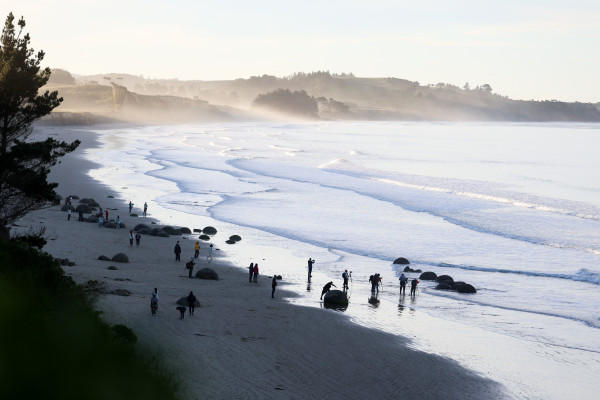 Moeraki whānau, coastline and boulders. PHOTOGRAPH: JASON BOBERG
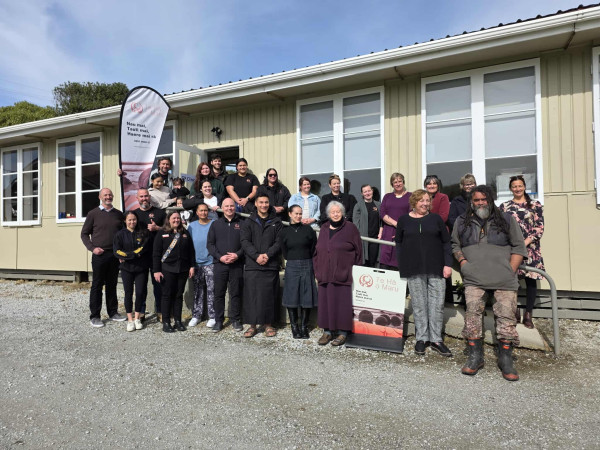 Above: Te Hā o Maru kaimahi and whānau gathered outside their tari in Ōamaru; right: The Whiria Te Waitaki team have planted some 135,000 natives over
the past five years. PHOTOGRAPHS: SUPPLIED
Given this, he never set out to work in health. But while running programmes for at-risk youth, he met remarkable Māori nurses and social workers who took a holistic kaupapa-Māori approach. When someone presented with severe anxiety or depression, for example, before turning to medication they focused on the spiritual side. Tohunga would come in to do karakia and provide spiritual support to the person — and their whānau. Next was social health: whānau connections, engagement with your marae and hapū, cultural activities, diet, finances. Mani says that nine times out of 10 if those issues could be resolved, people’s health dramatically improved. Rongoā also played a big part. “It was really amazing to witness these mātanga that I was mentored by.”
This kaupapa Māori lens underpins Te Hā o Maru, which opened in Ōamaru in 2022. Many of the staff whakapapa to Moeraki, and the team offers everything from rongoā to social work, Whānau Ora Navigators, GP services and crisis support. Their first duty is helping the marae. If they get the call, “we drop tools and we support as ngā ringaringa
me ngā waewae o Te Rūnanga o Moeraki. We embody the values,” Mani says.
The hapū provides the values and tikaka – but not the money for operating costs. “To date we haven’t taken a cent off the rūnanga,” Mani says. In his view, almost all the ills they treat stem from colonisation and systemic Western racism, “so they can pay for it,” he laughs. Providing hauora in Waitaki presents unique challenges. Whānau are spread out, and many subscribe to the good old kiwi attitude of ‘you only go to the doctor on your deathbed.’ There’s a significant meth problem in the wider community, with waste-water testing showing the highest per-capita use in the country. In just six months last year, 12 people in the district committed suicide, an incidence rate Mani says is 10 times the national average. And being on the border between Otago and Canterbury sometimes means the district gets overlooked. People need to travel to Dunedin for addiction services, and Te Hā has been unable to secure funding for suicide prevention despite the horrifying numbers.
“We love our community, so we will just create a service for suicide prevention,” Mani says. “We can’t let the government dictate everything; we just need to look after people.”
For Dr Lily Fraser (Kai Te Ruahiki, Kāti Huirapa), looking after people starts at the clinic door: “having your name pronounced correctly puts you on the right foot.” Lily, who spent a long time working in Te Ika a Māui, returned home three years ago so her daughter could grow up with a stronger Kāi Tahu identity, and to start Te Whare Koiora, a GP practice under the mantle of Te Hā o Maru. Her strong Pūrākaunui whakapapa allows her to find connections with many from Moeraki and Puketeraki, where she runs a weekly satellite clinic.
According to Mani, when Te Hā o Maru opened four years ago, some Pākehā patients would say things like, “‘oh, my grandmother used to go down Moeraki to the Māori hall. She was a Māori, but I’m not.’ So, they were Māori, but it was shameful. And that really drove us to make it normal and cool to be Māori.”
For years now Te Hā o Maru has been running public events like concerts, free hāngī or performances with school kapa haka groups. People are joining their books in part because they want to spend time in a Māori environment and get to know the Māori team. Together, this has produced surprising results. Between 2018 and 2023, Waitaki’s total population grew 5.2 percent, whereas the Māori population grew 22.8 percent. New arrivals and births account for some of this, but Mani believes the rest is down to people starting to embrace their whakapapa. “What we’re seeing is those whānau who were shy to say they’re Māori go, ‘Yeah, I’m Māori, and I feel really good about it.’”
Back at Te Puna a Maru on the banks of the Waitaki, Whiria project manager Tori Ross is one of those who’s recently reconnected. She’s the first in her whānau to do so after growing up in Palmerston North. She trained as an archaeologist in Dunedin. But five or six years ago, working on a “very boring” archaeology job on the Moeraki peninsula, she ended up in a car with David. He asked where she was from. “I said I was from here. Flora Orbell was my tūpuna. And he was like, ‘Mine too!’” She beams at the memory. “So, I just kept coming back.” Occasional visits became daily visits after getting the job with Whiria. “Becoming part of the pā, becoming one of the Moeraki whānau, has been awesome.”
It’s a common story, proof that the hapū is fanning the flames of ahi kā and attracting people to come home. Of all the people I talked to, all but two had moved into the area to be close to their hapū: a kind of reverse-urbanisation. Another of the Whiria team, Stephanie Barlow (Kāi Tahu, Kāti Mamoe, Waitaha, Ngāti Kahungunu), moved back from Australia last year seeking whakapapa and reo, and hands-on knowledge of the bush. “I’d like to plant rongoā plants that were used by Ngāi Tahu… so that we can come in here and this can be like a medicine cabinet.”
A kai cabinet, too. Damian MacNamara (Kāi Tahu, Kāti Mamoe) has been involved with Whiria as a drone operator from the outset. After a stint at Waihao as general manager, he’s recently joined the team on the tools and is happy working out on the whenua. “It’s about regenerating the land to a point where my kids and us can come out and camp in the weekend,” he says. “If we want to chuck a hīnaki in and feed ourselves, we could.”
By now it’s late afternoon. The winter sun is sinking in the west. The last golden light strikes thousands of native saplings. The Whiria team are nearly done for the day, but they won’t be done at this site for several years — the time it takes for this forest-in-waiting to stand on its own. There have been challenges – dry spells, floods, snow, theft. Whether people grew up locally or have recently returned, life isn’t always easy, either. It’s a small, isolated place. Living here means spending a lot of your time in the car. The harsh weather dictates everything. But is it worth it?
“It feels amazing, having known what it looked like at the start,” Damian says, “coming back now and actually seeing not quite the end goal — that’s having trees above your head, walking through a native forest — but it’s getting there. These are the first steps.” Trevor stresses they’re still at the beginning, with a huge amount
of work to come. But the vision remains strong. “In terms of aspirational stuff, jeez, man,” David says, “I don’t know where we’re going to stop.”
 Top
Top