In safe hands
Aug 19, 2026

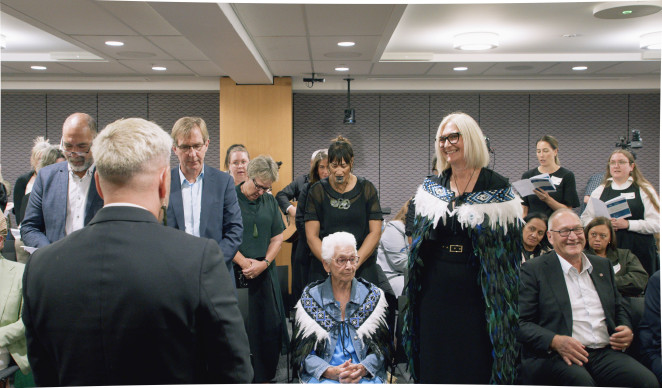
Amanda Malu at her pōwhiri, welcoming her into her new role with Oranga Tamariki in Wellington. PHOTOGRAPHS: SUPPLIED
IN SAFE HANDS
As the new Secretary for Children and Chief Executive of Oranga Tamariki – Ministry for Children, Amanda Malu oversees an agency of nearly 5,000 people working to protect our most vulnerable tamariki. She comes to the role with deep roots in the children’s sector and a vision for an organisation that truly serves those at the front line. Kaituhi ANNA BRANKIN reports.
WHEN WE LAST SPOKE TO AMANDA MALU IN 2018, SHE WAS THE CEO OF Plunket and determined to overhaul one of New Zealand’s most beloved institutions, with a focus on equitable care for all pēpi. She spoke then of being a woman on a mission, and the description fits just as well now – although these days, that mission is bigger and more complex as she heads up one of the most scrutinised agencies in Aotearoa.
Amanda took on the role as CE of Oranga Tamariki in February, and the first months have been, by her own description, intense. There was no chance to settle in, no grace period to find her feet. “Day one, my team sat me down and said, ‘here’s a decision you need to make today.’”
But she is up for the challenge, and says that one of the first things she did was make her intentions unmistakably clear to staff: she has signed a five-year contract, and she means to see it through. In an organisation that has cycled through multiple chief executives in recent years, this simple act of commitment has already made a difference. “It’s the thing that people are most relieved about – not that I’m here, but that I’m here for the long haul,” she says. “Meanwhile, I’m just determined to make sure that in five to ten years, things are in better shape than when I arrived. That’s the plan, really.”
It is easy to see why Amanda was drawn to Oranga Tamariki, and equally easy to see why she is a good fit for the role. Her career has been shaped by a consistent thread: a deep affinity for organisations with a purpose beyond themselves, and a talent for galvanising people behind a shared direction. She spent four years at the Families Commission, rose through the ranks at Plunket from chief marketing officer to CEO, and then went on to serve as the Deputy Chief Executive, Service Delivery at ACC and the Chief Executive of Education New Zealand.
The aspiration to work at Oranga Tamariki emerged during Amanda’s years at Plunket, as she found herself increasingly frustrated by the limits of advocacy from outside the system. As an NGO – and one reliant on government funding – Plunket could push for change, but only so far. “You’re such a small voice in comparison. I realised that if I do want tomake lasting change, the only way I’m going to be able to do it is from the inside.” Now she is on the inside, and she is not underestimating what that means. “There’s so much to navigate, and so many agencies and people to influence. But you definitely have more opportunity in a role like this.”
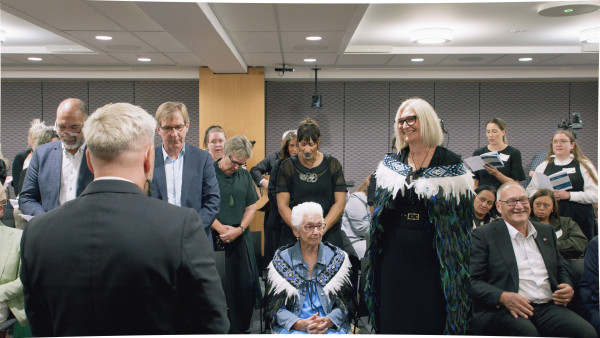 Amanda Malu addressing colleagues and whānau during her pōwhiri.
In her first few months, Amanda has made a point of getting out of Wellington as often as possible – visiting sites, youth justice residences, talking to staff and to the children and young people in care. “That has been really grounding. It gives me a strong sense of what we’re here to do, and it helps me understand where we need to focus.”
The challenge she has fixed most firmly in her sights is the pressure on frontline staff. Reports of concern have risen sharply across the country, and everywhere she visits, she hears about stretched caseloads and overworked staff who are struggling to do more with less. “I’m so proud of the fact that our people care so much, they turn up every
day knowing that the list of tasks and the amount of work they have to do is just growing. At the same time, I want to change things so that they can focus on what’s most important – the relational, human-to-human work that only they can do.”
Amanda’s response to this challenge is not simply to add resource, but to entirely change the organisation’s approach. She talks about reading reports by the Independent Children’s Monitor when she was preparing for the role, which spoke to a tension between the national office and frontline staff. This led to one of her key ambitions: to pivot
all operations so that in five years, that tension is no longer mentioned. “Everything we do here should be about making it easier for our social workers to do their job,” she says. “We have three floors of staff sitting in an office in central Wellington, and as I see it, we’re here to support the workers on the frontline across the country.”
The weight of her role as Secretary for Children and Chief Executive is something that Amanda is very conscious of. “I don’t ever want to find myself signing things off without considering what it really means for the children at the end of that decision. I want to make decisions like I would for my own family, to fight for the children in my care just as I would for my own children.”
She is also very aware of the public narrative that surrounds Oranga Tamariki – a narrative that is too often driven by headlines rather than the daily reality of the work. “Travelling around over the past couple of months, it’s really clear to me that the vast majority of the work that we do is very valued by the families we work with, and is actually all about keeping children out of the care system,” she says. “But those stories are simply less newsworthy than the cases where things don’t go as smoothly.”
Amanda feels the pressure of negative coverage most keenly on behalf of her staff, who she knows would never make the decision to remove a child from their family lightly. “It’s the hardest decision for any social worker to make,” she says. “These are people with huge hearts and the absolute best of intentions, who sometimes have to make really tough decisions in order to put the needs of the child first.” She is clear that Oranga Tamariki doesn’t always get everything right, and equally clear that the organisation navigates extraordinary complexity on a daily basis.
That complexity points to another of Amanda’s missions – improving the interagency approach to children’s wellbeing. As a result of Dame Karen Poutasi’s 2022 review of Oranga Tamariki, there is now a hub in Auckland that brings together staff from the health, education, justice and social sectors alongside Oranga Tamariki, which Amanda says is making a huge difference. “There is genuine information sharing happening around the needs of children, and how we can work together to address them. Our next step will be scaling what works locally into something consistent across the whole country. We’ve got to turn it from rhetoric into reality.”
Other important partnerships include those with iwi, including Te Rūnanga o Ngāi Tahu, and Amanda is committed to growing these. The long-term aim, she says, is for many of the services currently delivered by Oranga Tamariki to be led by iwi. “Ultimately, no whānau wants the state intervening in their lives. If we can empower iwi, and support and enable them to be able to work with whānau – whether at the early stages of prevention, or perhaps delivering some of our services – then that is fantastic. That would be an incredible outcome.”
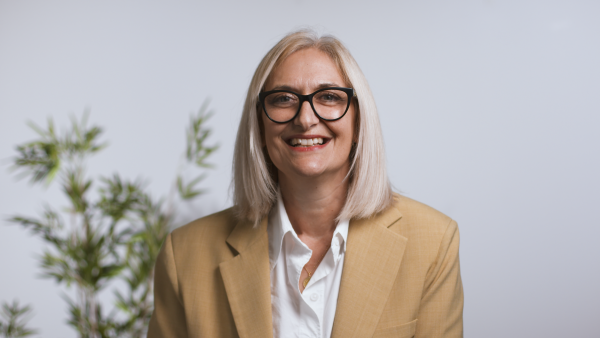
Amanda has already visited Te Rūnanga o Ngāi Tahu and met with Rakihia Tau, chair of Te Tauraki, the organisation that leads health and wellbeing kaupapa for the iwi. It’s a relationship that matters to her personally as well as professionally. “Because of my own whakapapa, it is significant to be able to work with the iwi as a strategic partner, and to have their support,” she says.
Amanda is also thinking creatively about how iwi might contribute in ways that go beyond formal service delivery. Her sister planted an idea in her head that she hasn’t been able to let go of: a database of whānau who might be interested in becoming caregivers. “One of our biggest challenges is we often cannot find places for children that we
take into care. Especially because, in the case of tamariki Māori, we try to find homes with a whakapapa connection. Foster carers do the work of angels, in my mind.”
The work is deeply important to Amanda, but she knows it also requires balance. Although Amanda’s husband and adult children are used to her holding demanding roles, they have been especially protective of her since she began this one, keeping a watchful eye on her tendency to work too hard. “The work doesn’t end at five o’clock on a Friday. There’s always something happening,” she acknowledges.
“I have to be very strategic about making sure I’m across everything that absolutely needs my attention, and otherwise making sure I unplug from time-to-time and look after myself.”
Finding that balance appears to be paying off. Despite a hectic first few months, Amanda is still certain she’s exactly where she needs to be. “I’m really enjoying it,” she says simply. “I get to lead an organisation full of amazing people who do the most incredible work, and my job is just to make it as easy as possible for them to keep doing that.”
 Top
Top