REVIEW: Mārama
Aug 18, 2026

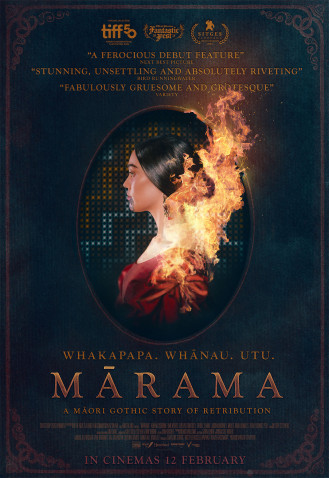
MĀRAMA (2025)
Nā TARATOA STAPPARD (Ngāti Toa,
Ngāti Raukawa me Ngāti Tūwharetoa)
SWEETSHOP & GREEN, VENDETTA FILMS, MPI MEDIA GROUP
REVIEW nā SIAN SMITH
Typical horror films are intended to thrill, scare, and mostly, entertain. Masked killers, like Ghostface from Scream, sneak into the homes of their victims, who are unaware of the terror that is about to be unleashed upon them.
Mārama is not one of these films. It does however have its own ‘masked’ killers, whose pervasive acts of violence know no bounds. Behind a smile of paternalism, they weaponise taoka, both tangible and intangible, against Māori. They claim appropriation as appreciation, while reminding the audience that taoka Māori remain in collections around the world. From behind this mask, Mārama unveils traumatic and gut-wrenching truths that make this film extremely hard to watch. Yet this is exactly why it is such an urgent and groundbreaking film.
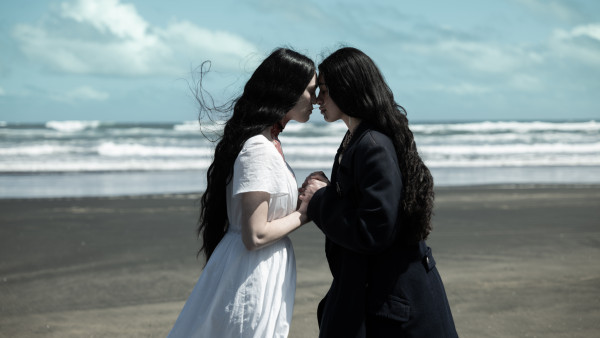 Above: Mārama (Ariāna Osborne) stands face to face with Hinemoana (Te Rauhi Daniels) who tells her to use her gift.
Released at the 2025 Toronto International Film Festival, Mārama deals with the depth of violence toward wāhine Māori entrenched in colonisation. Writer and director Taratoa Stappard was partly inspired by the films of Jordan Peele, such as Get Out (2017), describing his debut film as a Māori Gothic Horror. Although rife with violence and theft on the most intimate level, Mārama is a profound statement about whakapapa. Its depth and layers convey the immense mana of wāhine Māori as whare tāngata.
Mārama shows this in its critical perspective on our relationships with whales. Its antagonists regard whales as animals to be profited from, correlating the brutality of their killing with sexualising wāhine Māori. The emotive response from the film’s protagonist played by Ariāna Osborne, utterly pulls the audience into her perspective.
As a Kāi Tahu wahine, I cannot help but feel caught in the tension between our whakapapa connections with whales and their place in our colonial history. We are descendants of Paikea. At the same time, many of us are also descendants of whaling communities. Mārama challenged me to think about the compromise of worldview that our tīpuna likely experienced, as people who consider whales both kaitiaki and kin. How did they find ways to protect our connection with whales in these spaces that exploited taoka species for financial gain? How did they create space for upholding their mana?
Mārama ultimately tells us that whakapapa empowers us to heal. Atua and ancestors communicate through taoka puoro, the exchange of hau, and in the mauri of taoka and people. In a scene by the ocean, Hinemoana calls Mārama there with tumumtumu kōhatu, taoka puoro that evoke our connection to Papatūānuku. She says to Mārama, “Kei kōnei koe. Ka mua ka muri.”
The film opens with a scene, showing a woman standing by the same ocean. Her image is mirrored above the film’s title, as if hanging from the sky. These two figures appear as Hinetītama and Hinenuitepō, embodying their duality. From its beginning to its end, Mārama shows us that our atua wāhine who shape the realms around us – our ancestors – are here with us. And our mana comes from them.
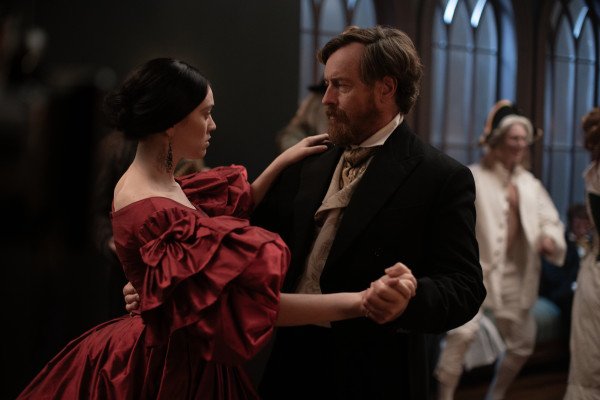 Nathaniel (Toby Stephens) asks Mārama to dance. PHOTOGRAPHS COURTESY THE PUBLIC GOOD
 Top
Top