Salt of the earth
Aug 19, 2026

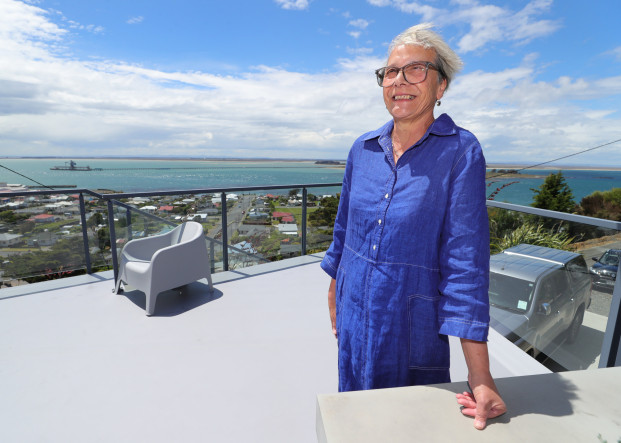
SALT OF THE EARTH
Nā ANNA BRANKIN
Three recipients of New Year Honours from Murihiku – two of them also finalists for New Zealander of the Year’s Local Hero category – share a postcode, the customary practice of muttonbirding, and a reluctance to make a fuss about their success.
THE TĪTĪ SEASON IS WELL UNDERWAY WHEN TE KARAKA CATCHES UP with Russel and Teresa Trow and Gail Thompson, and it’s thanks to the recent addition of Starlink that they’re able to sit down and reflect on decades spent protecting the environment. As always, Russel and Teresa are spending the April–May season on Kundy Island, just off the
southern tip of Rakiura, while Gail is on Kaihuka, off the east coast, with her children and mokopuna.
Russel and Teresa, married for nearly 58 years, received the King’s Service Order in the 2026 New Year Honours for services to wildlife conservation. They were also finalists for the Kiwibank New Zealander of the Year – Tower Local Hero category, recognised for more than four decades of voluntary work pulling taoka species back from the brink of
extinction. Meanwhile Gail was appointed a Member of the New Zealand Order of Merit (MNZM) for her services to Māori and conservation, acknowledging a lifetime of work spanning customary fisheries, mahika kai restoration, marine protection and wetland advocacy across the deep south.
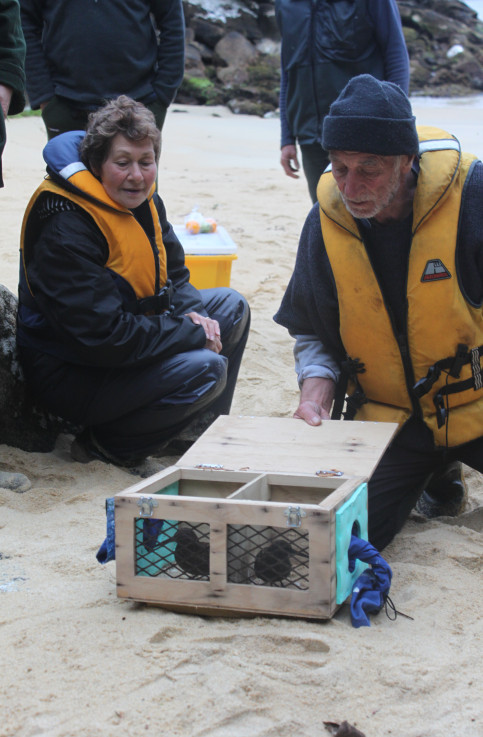 Teresa and Russel releasing tutukiwi from Tini Heke (Snares Island) on Kundy Island. PHOTOGRAPHS: SUPPLIED
Russel was four or five years old the first time he travelled to the Tītī Islands. His grandfather, John Morrison, was already monitoring the bird population back in the 1930s and 40s, sending samples and keeping records that are now held in Te Papa. “It’s just something we do, it’s part of being from this place,” Russel says simply of the conservation work he has continued across eight decades. “You know what I mean? It’s just cool to be part of it.
Growing up in Bluff, his wife Teresa had heard plenty about the islands but had never been until she and Russel were married. “It was certainly a different way of living,” she says. “We had to come across on boats back then. It took us about seven and a half hours to get here, and we’d come down for the whole season – two months.” What began
as a new world has become, across nearly six decades of her marriage to Russel, the place she feels most at home.
A sense of duty to the islands and the bird species living there always came naturally to the couple, but they say that the work that led to their award was originally ignited by others – notably Margaret Bragg and Jane Davis, who began protecting the tīeke (saddlebacks) after rats invaded Big South Cape Island in the 1960s and caused catastrophic losses. When Margaret and Jane stepped back, the Trows stepped up. From a founding population of around 30 birds, the couple has been instrumental in transferring more than 400 tīeke across 10 island locations. Meanwhile their beloved Kundy Island, once struggling under the pressure of invasive weka that wiped out species including tutukiwi (Snares Island snipe), mioweka (banded rail), and mātātā (fernbird), is now a thriving sanctuary and a source population for other islands and mainland sanctuaries like Ōrokonu.
Last year alone, 50 tīeke were taken to Ōrokonui, an ecosanctuary just outside Ōtepoti. Four breeding pairs have since raised 17 chicks – an update that the couple says brings them immense satisfaction. “It’s just so good to know that they’re up there, and to know that we help to save the species,” Russel says. “It’s really cool, eh?” Teresa agrees,
saying that she has something of a soft spot for the tīeke after all the work they’ve put into saving the species.
The work is meticulous and seasonal, governed by breeding seasons, weather and the logistics of setting up mist nets and portable aviaries on the remote islands with the support of DOC staff and helicopter crews who, the couple say, are “the best”. And it is entirely voluntary – the Trows and other Kāi Tahu whānau are not paid for their time.
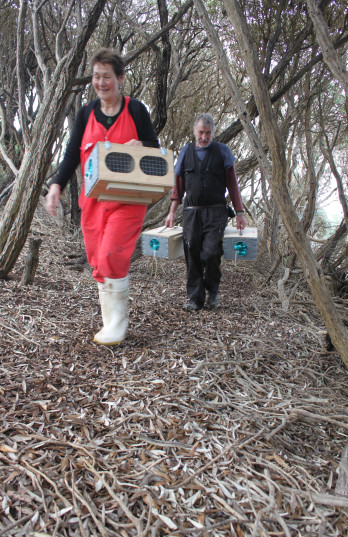 Teresa and Russel Trow shifting tīeke in their transfer boxes from Kundy Island to Te Wharepuaitaha Island PHOTOGRAPHS: SUPPLIED
Their work has also led to a pioneering genetic exchange programme, transferring birds between isolated islands in the hopes of building genetic diversity. If successful, this could inform conservation practice across other species. “We haven’t been back to see the results yet,” Russel explains, “because we want to have about three breeding
seasons. But if it works, it’ll be a good thing for other species.”
The Trows insist that they are only a small part of a wider team, notably DOC staff Ros Cole, Joe Hitchcock and Sharon Tate, ecologist Peter McClelland and iwi member Tane Davis, as well as a growing roster of their nieces and nephews who are now learning the skills themselves. “We’ve been training them up,” Russel says with evident
satisfaction. “They’re even bigger greenies than we are, I think. It’s good to see that the young ones want to look after the islands and their birds.”z
When news of the honour arrived, Russel’s first instinct was suspicion. “I thought somebody was scamming us or having me on,”he says. Teresa found it overwhelming. “I felt proud,” she says. “But it did feel a bit funny. We don’t feel that this award belongs to just the two of us. We feel it belongs to all the muttonbirders who look after these islands.”
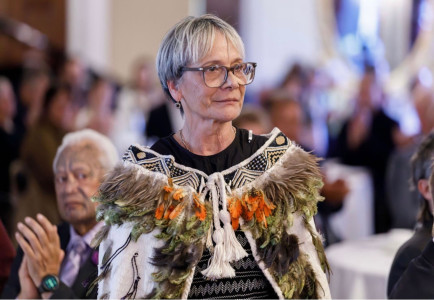
Before Gail Thompson gets around to discussing her own achievement, she wanted to make sure that the Trows were properly acknowledged. “They are a couple who are creating new mātauranga based on today’s environment. People don’t actually realise that in the future their knowledge will be gold. And they don’t realise it themselves.”
Another lifelong muttonbirder, Gail Thompson has spent much of her adult life stewarding customary fisheries and mahika kai restoration along the Murihiku coastline. She was a founding member of the Guardians of Fiordland Fisheries in 1997, sat on the Southland Conservation Board for more than 20 years, and was a founding member and co-chair of what is now Whakamana Te Waituna, the collaborative body credited with protecting the Waituna Lagoon and its surrounding wetlands. Her MNZM cites outstanding services to Māori and conservation, but like the Trows, she is quick to deflect the praise.
“I’ve never really thought about everything I’ve done until I read it all summarised like that. At the time, I was just doing what needed to be done,” she says. “And everything on that list was a team effort by a lot of people, not just me.”
Gail’s path into environmental advocacy came through the strong fishing community in Awarua, where “everyone’s got an opinion about the sea and how it should be managed”, and through a formative period learning from kaumātua like George Ryan and Tiny Metzger, driving them to meetings and sitting in listening and learning. “I was privileged by the fact that in those days, women didn’t have to work,” she reflects.
“I could do those sorts of things as long as I was home in time to pick the kids up from school.”
Gail describes those years as a kind of osmosis. “I didn’t realise how much I was learning until someone would say something and straight away I’d say, ‘no, that’s not right. George told me it was actually…’” she laughs.
Eventually, it was Gail who held the representative roles and sat on boards and committees across Murihiku. Over the years, she says she’s developed thick skin and an appreciation of the importance of building relationships. She remembers the early days of advocacy for Waituna Lagoon, when the community was openly hostile. “I just kept showing up, absorbing the jabs, and focused on making connections wherever I could, one person at a time,” she says. “It’s quite remarkable really, working through all these differences and realising that most of the time, we all have the same goal when it comes to protecting the environment.”
Among Gail’s proudest achievements is the mātaitai reserve she helped to establish around Kaihuka – a protection mechanism that means no commercial or recreational fishing is permitted around the island from June through to late March each year: in effect, the only time anyone can fish there is when the muttonbirders are in residence.
time anyone can fish there is when the muttonbirders are in residence. “We got that across the line 15 years ago, in a different political climate,” she says. “There’s no way we’d be able to achieve that now.” The payoff has been obvious, with fish and shellfish populations around the island noticeably recovered.
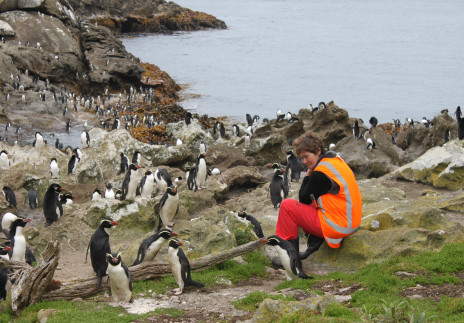 Teresa Trow sits amongst the Snares Crested Penguin on Tini Heke (Snares Island).
Gail says that receiving her MNZM was bittersweet, having lost her beloved husband Bubba several years ago. He was, she says without hesitation, ahead of her. “If he was alive, he would’ve got it before me.” She describes a man who knew their island better than anyone, who was involved in tuna restoration and who had a way of getting in the door with Crown agencies that defied logic. “He was stubborn and all that sort of stuff, but he liked to have all the facts.” Despite this, she knows that Bubba would be proud of her, and that their children and mokopuna are continuing their legacy.
Ask Russel, Teresa and Gail what motivates them, and you get some version of the same answer: it’s just what you do. Gail talks about the
Tītī Islands as a place that teaches you to value what you have, and to look after it: “if you don’t look after your environment down here,” she says, “the birds aren’t going to come back. And once they’ve gone, you know, they’re gone.”
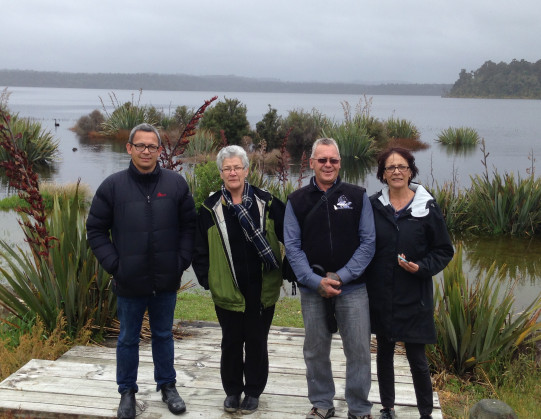 From left, Dean Whaanga, Louise Fowler, the late Bubba Thompson and Gail Thompson.
 Top
Top