Te Whare Haka o Te Ahikaaroa A lifelong commitment to Kapa Haka
Aug 19, 2026

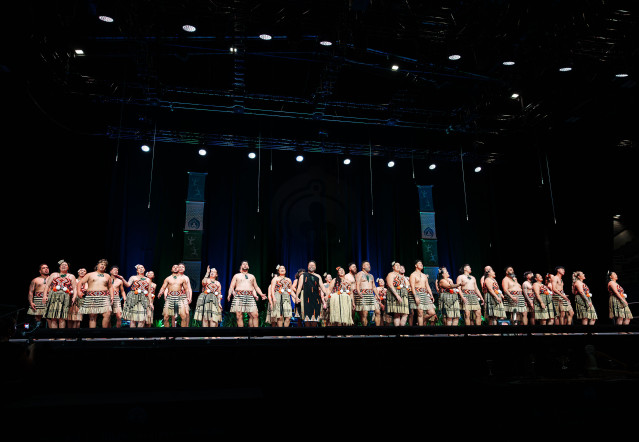
TE WHAREHAKA O TE AHIKAAROA A LIFELONG COMMITMENT TO KAPA HAKA
Nā SASCHA WALL
Kapa haka is a record of our people: our losses, our achievements and our moemoeā. A vehicle for learning, teaching and carrying the mātauraka of our tīpuna into our contemporary lives. Te Ahikaaroa has understood this since 1993 when its founders decided that keeping the fire burning was worth showing up for, week after week, decade
after decade. What began over a beer and evolved over a kapu ti has since grown into a puna reo, a kura-a-iwi, and a competitive kapa that has nurtured generations of Kai Tahu and pan-tribal whānau. Now under the capable and talented leadership of Thomas Aerepo-Morgan, the Otautahi-based ropu continues to achieve and surpass
the aspirations first envisioned by its founders, Rangimarie Parata Takurua and Tauira Takurua.
“IT STARTED IN A BAR, LIKE ALL GOOD THINGS,” RANGIMĀRIE SAYS, laughing. “What happens when you get more than three Māori in an Irish bar at the same time? You start making plans.” They called themselves Te Ahikaaroa, the long burning fire, recognising a lifelong commitment to kapa haka. “Haka is the vehicle to keep our connection to our reo, to our pūrākau, to our waiata and mostly our whānau.” Most members of the founding group had come through Māori boarding schools, carrying with them the muscle memory of singing and moving together, that they wanted to continue. Once the small group had formed, they booked their first practice at Te Iringa o Kahukura, Cashmere High School, where Tauira was teaching alongside fellow founding member, Whaea Miriama Setterington.
The rōpū grew over time the way all good things do, slowly and then all at once. For the first four years they didn’t compete, honing the strong, distinguishing feature that continues to this day: “We’ve always, I think, prided ourselves on having a group that can sing,” Rangimārie says
“I think that would probably be one of our signatures. And then, ironically encouraged by Tauira’s father from Ngāti Porou, we decided to sing in our Kai Tahu dialect – that was a steep learning curve! And most importantly, we started singing about our own pūrākau.” From the beginning, the uniforms were made by hand, guided by Taua Reihana
(Doe) Parata QSM. “Everything was ground up, home grown, homemade.”
Rulon Nutira was there amongst it before he could even walk. His mother was one of the aunties in those early lines and he was one of the babies who were, as he describes, “dragged to practice,” sitting on the floor while the pakeke moved and sang above and around him. At that point, he didn’t realise what he was absorbing. “It was just
normal,” he says. “Turn up, make friends with everyone who’s not already your cousin, run around. The kaupapa was just part of life.”
By the time Te Ahikaaroa reached its first Te Matatini in Waikato in 2000, the group had already changed shape in ways no one had entirely planned. With more pēpī and tamariki appearing in the lines, practices that had started over drinks had shifted, in the way that life shifts when children arrive, to cups of tea and a different kind of kōrero.
It was over one of those cups of tea that something honest surfaced whakamā about the loss of te reo Māori and the barriers to enrolling kids in kōhaka reo. Rangimārie remembers telling her cousin to bring her baby along to kohaka. “She said, ‘I can’t do it. I’ve already failed in the Pākehā system. Why would I want to go and fail in the Māori
one?’” So from the collective determination of the group, made up of many educators, Nōku Te Ao was born in 2002, a full-immersion early childhood centre built to meet whanau wherever they were in their haereka.
“Nōku te ao – the world is mine,” Rangimarie explains. “That’s what we wanted to cultivate in our kids: that they’re masters of their own universe.”
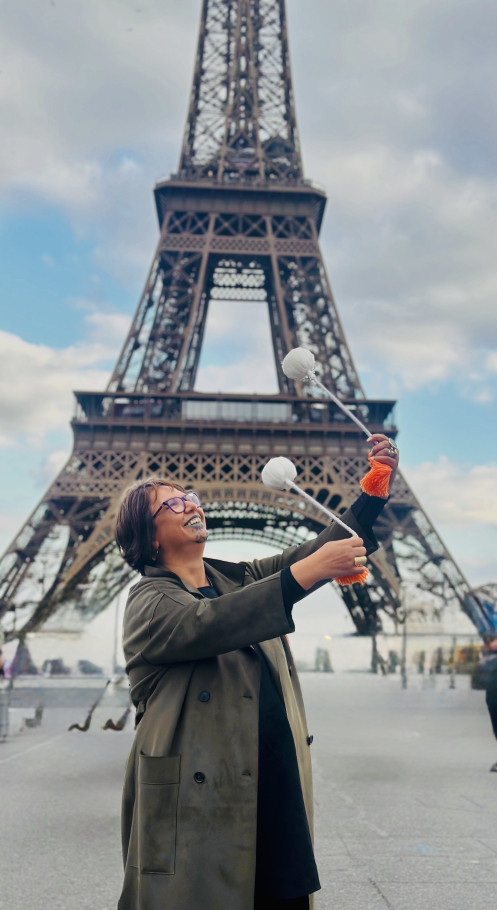 Rangimārie Parata Takurua in front of the Eiffel Tower in Paris, 2025 PHOTOGRAPHS: SUPPLIED
The babies of Nōku Te Ao grew, and the question of where they would go next became impossible to ignore. Too many tamariki were disappearing into a system that hadn’t been built for them and Te Ahikaaroa had the collective skills to do something about it. In 2015, Te Pā o Rākaihautu opened its doors. “We didn’t need another school,”Rangimārie says. So what they set out to build was a pā wānaka, a village dedicated to learning, surrounded by people who “first and foremost love these kids like their own.” Rangimārie speaks on the fundamentals of student success: “two core things our kids need to thrive are to feel loved and to be well-fed. These kids are loved by their kaiārahi and are fed by our mara kai. They know what soil grows kai well and that there is a connection between their kai and the health of Papatūānuku. They know how to prepare the soil, to plant the kai, and harvest it.”
Te Pā o Rākaihautū is a place where the front yard is the moana and the backyard, the mauka.
By the end of 2025, Te Pā o Rākaihautū had its largest ever cohort of Year 13 graduates all achieving their NCEA L3, with 70 percent achieving University Entrance before exams. And with haka a core part of the curriculum, it feeds the ranks of Te Ahikaaroa.
Like all rōpū, Te Ahikaaroa has evolved through different eras, successive leaders leaving their mark and building on what came before. Tauira Takurua led the first decade, using the skills that came naturally to him as a descendant from a long line of composers, including his Nanny Tuini Ngāwai, Ngoi Pewhirangi and his father,
Anaru Takurua in Tokomaru Bay. That kind of talent, Rangimārie says, is “just in the water where he grew up.”
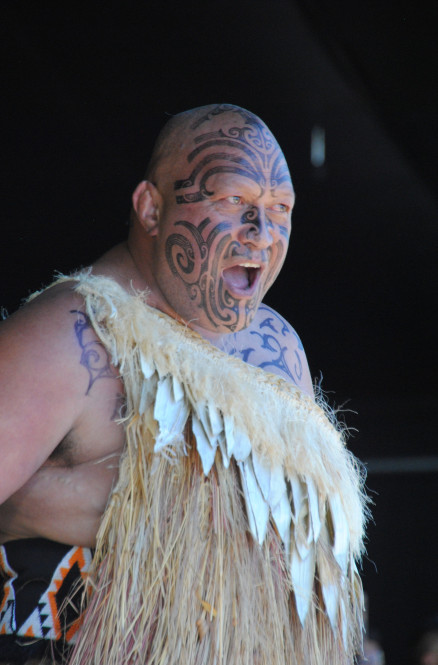 Tauira Takurua
Tauira’s style is “coasty,” melodic and built up by tunes that stick and carried by strong voices that can hold them. He composed the waiata that gave the rōpū its spine, and established the whakapapa of strong singing that still defines Te Ahikaaroa today. Tauira took them from that first practice at Cashmere High School to the national stage.
When Tauira and Rangimārie moved north around 2002, Haani Huata-Allen stepped up. Described as generous, hard-working, steady, Haani had recently arrived in Ōtautahi and, along with her siblings and whānau, kept Te Ahikaaroa burning and flourishing for the next decade. Waipounamu Te Karu joined the rōpū during those years, aged 17, and remembers being surrounded by aunties who had been part of the kaupapa from the beginning, sharing kupu and actions along with the strong values that underpinned them.
Haani’s instruction on balance was direct: you can go and play hard on the weekend, but you better be on the floor at nine o’clock the next morning and still give one hundred percent. “That was a huge lesson in commitment and discipline,” Waipounamu says. “Haani would say: your lack of sleep, that was your choice. You still better give me everything.”
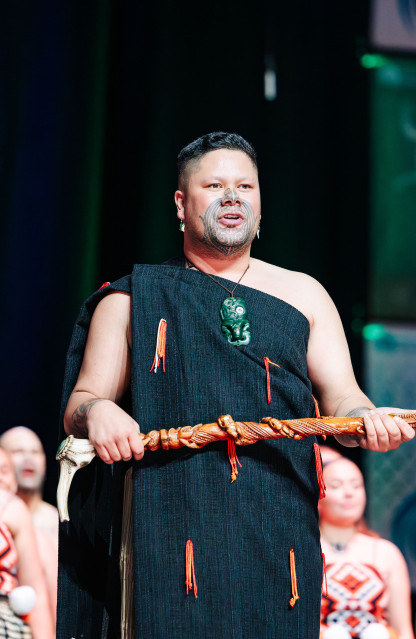 Thomas Aerepo-Morgan
Tauira and Rangimārie returned around 2011, just as Haani was moving back up north, so the rākau was passed back. The style of haka shifted after the earthquakes and the notes got higher with mature voices, the singing pushed into new but somewhat familiar territory. For Waipounamu, then in her late 20s, the challenge had begun to feel familiar in a way she wasn’t ready to settle for. She left to find a new challenge, but has since returned. The reason she came back? Thomas Aerepo-Morgan. “I was told by Thomas to come back to the group. When he took over, he brought this new flavour, new energy,” she says. “That’s what I was looking for.”
The handover happened at Te Matatini Herenga Waka, Herenga Tāngata in Tāmaki Makaurau in 2023, but it had been building for longer than that. In the weeks before the competition, Tauira began pulling Thomas forward during the practices leading up to their performances, asking for his ear on the singing, his eye on the lines and his judgement on what needed lifting. Everyone in the rōpū could see where it was heading.
Then came the day of their performance. “We all knew Uncle Tau was the man,” Rulon says. “But Thomas walked out on stage as our kaitātaki.” The formal leadership handover came the following morning, at Te Taua Moana marae in Devonport. Tauira rose to give his mihi and when he finished took his korowai and placed it on Thomas’s shoulders. The rōpū erupted. Rulon, who had been called up to sit beside his uncle beforehand without knowing why, watched Thomas’s face the moment it happened. “I could see the unleashing,” he says.
Rangimārie had seen Thomas coming for a long time. She had first met him as a young boy in Bluff, where she had gone to help his aunty Aimee Kaio with some mahi. Aimee had mentioned a nephew who was coming for tea and described him as “just absolutely haka mad and really keen to meet [Rangimārie].” Thomas had grown up watching
Te Ahikaaroa perform from the depths of the south, absorbing the rōpū and its performance style from a distance. “He knew every lyric, every move and where I was standing in every performance,” she remembers.
By the time Thomas arrived in Ōtautahi, encouraged by his aunty and uncle to join Te Ahikaaroa, he was already carrying a thousand compositions in his head. “That’s the superpower that Tauira has always held for the group,” Rangimārie says. “We were looking for who was going to keep those beautiful compositions coming. Thomas arrived already with lots of ideas and waiata he wanted to test with his uncle.
It became very clear very quickly that he had what the group needed.” She says that Tauira was the first to acknowledge Thomas’ own superpower, saying: “You can take it where I couldn’t. I’m not Kāi Tahu.
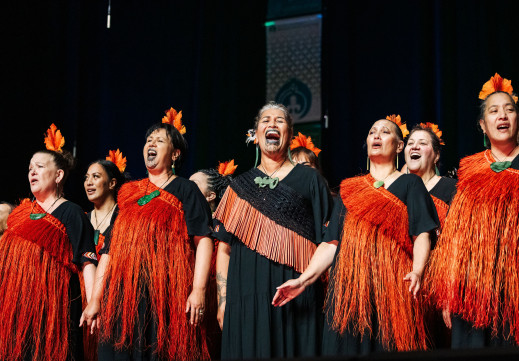 Above: Te Ahikōmau, Waitaha Matatū Regional Competition 2026. PHOTOGRAPH: ERICA SINCLAIR
Below: Te Arani Huia, Waipounamu Te Karu, Horowai Wetini at the International Taptoe Belgie, in Oostende, Belgium 2025.
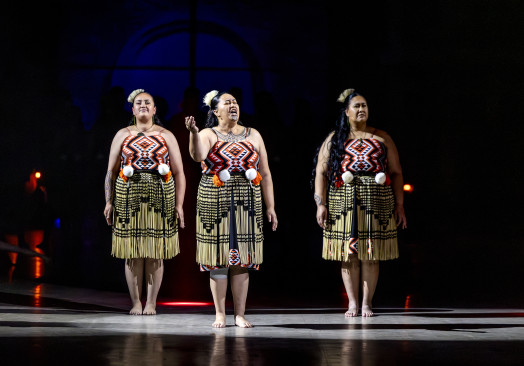
I don’t know your dialect. You can take it where it needs to go now.” What he has done with that trust is something the rōpū still reaches for words to describe. Waipounamu says: “He can sing, he can haka, he can do the poi and execute all of those perfectly. His knowledge for his age is out the gate. But it’s his passion and his belief in his iwi, how proud he is of his Ngāi Tahutanga, that comes through in everything.” Rulon adds: “Thomas is coming through with a new generation of reo speakers who are faster-paced and energetic. But it’s the mita that sets it apart. I don’t think what he’s doing has ever been done in the world.”
“I’m big on igniting potential,” Thomas says. “Everyone has it. They’ve just got to realise their own. We preach it here: remove the boulders of resistance so our people can thrive on their own terms.” He speaks of multiple generations sharing the practice floor and the responsibility that sits in that image. “That intergenerational approach is crucial to how we run things. Our culture is one of the most beautiful vessels for transmitting mātauraka and shaping our own unique approach to whānau development.”
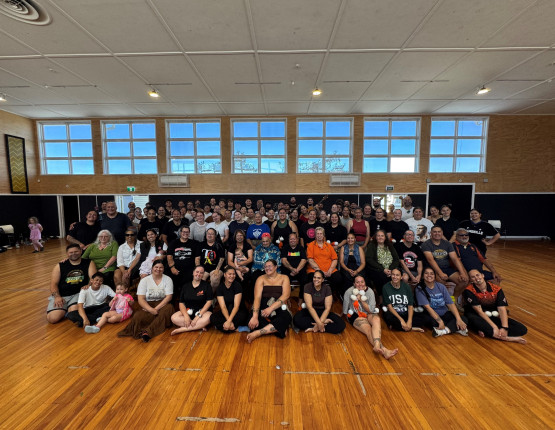 Four Generations, Te Whare Haka o Te Ahikaaroa, March 2026.
This is his fourth campaign as leader. Each one has elevated further than the last. Waipounamu, who has been in the group across those four campaigns, says candidly: “It’s one hundred times elevated from when I first joined, compared to now. And it just keeps going.”
In 2025, Te Ahikaaroa stepped onto a stage none of them had expected to find themselves on. The International Taptoe Festival in Belgium – a long-running military tattoo tradition, brass bands and bagpipes and sellout crowds of roughly 10,000, that had never previously included kapa haka.
Thomas took a delegation of 15 and changed that. Rulon laughs as he remembers the call coming through to his wife. Thomas rang her, to test out the idea as he hadn’t told anyone yet. Rulon describes the moment she got off the phone and mentioned that Thomas wanted to take Te Ahikaaroa to Belgium. “My wife said, ‘Why not?’ And I said,
if kapa haka is going to take us there, let’s go. Let’s take who we are to the world.”
Te Ahikaaora arrived in Belgium early and ran a rehearsal near a local school. Rulon described how the children came out of their classrooms and sat down on the ground to watch. The teachers stood along the walls as Te Ahikaaroa moved through their bracket. For them, just another practice, had the teachers in tears by the time they finished.
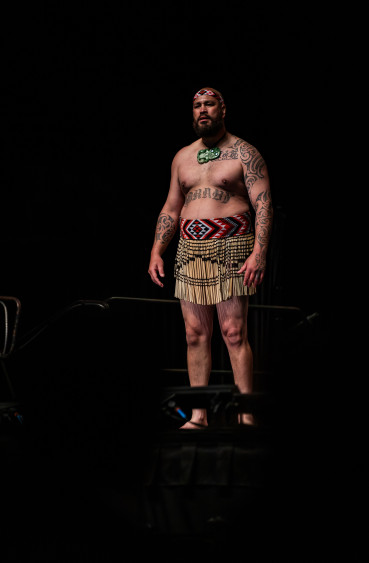 Rulon Nutira, Waitaha Matatū Regional Competition 2024
The children sat in silence, eyes wide open. “They didn’t understand what we were saying,” Rulon says. “But they could feel it. They could feel the energy we were portraying. And they came running up to us afterwards.” Thomas reflects on that moment in terms of what it revealed about haka itself. “Each takahi, each wiri, each head turn is deliberate,” he says. “It stands as a physical acknowledgment of our times, our people, the kōrero being shared into space.”
On a stage in Belgium, that language transcended all borders. The performances themselves were held in a packed arena. Te Ahikaaroa opened singing the New Zealand national anthem and returned to close the final night. A sellout crowd, eight to ten thousand people, a bill full of military bands and cultural performers from across the world.
“It’s definitely opened up new opportunities and areas to explore,” says Thomas. After Belgium, they went to Paris and performed in front of the Eiffel Tower. Rulon laughs at the memory of it. “How many people can say that?”
In the preparation for the Waitaha regionals, Thomas wrote and composed a waiata – Aoraki Matatū – acknowledging the lifelong mahi of Tā Tipene O’Regan, as well as the passing of several rangatira whose lives contributed to the advancement of Kāi Tahu. When the time came, Thomas took Te Ahikaaroa to the whare of Tā Tipene in New Brighton. The group was too big to fit inside, so they set up on the beach opposite his home, and delivered one of the most significant pieces in their 30-plus year history. Performing in the Kāi Tahu mita, the performance moved Tā Tipene to tears.
At this year’s Waitaha Kapa Haka Regionals, two groups from Te Whare Haka o Te Ahikaaroa took to the stage. One, the current competitive rōpū under Thomas, elevated, energetic and pushing forward into the future. The other, Te Ahikōmau, the ‘OGs’ who have been singing and dancing together for more than 30 years, reunited to perform waiata from the group’s earliest days and to honour the late Hemi Te Hemi. Their wānaka have been running alongside Thomas’ group. “We are so excited about our next generation,” Rangimārie says. “And us in our fifties and sixties took a wee while to warm up but can still belt out some of our favourite waiata, even though we were
very careful to choreograph out any sudden moves or knee drops.”
It is not just sentiment that brings the founders back to the stage, but the same instinct that opened Nōku Te Ao and built Te Pā o Rakaihautū: the understanding that you do not carry something forward by leaving the origins behind. You bring them with you, allowing the past to steady and strengthen every step into the future.
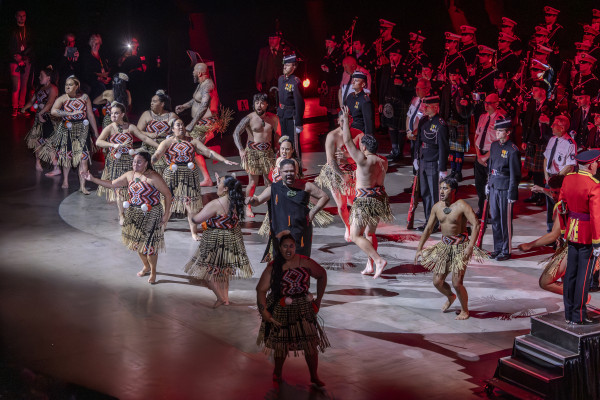 Te Ahikaaroa, at the International Taptoe Belgie, in Oostende, Belgium 2025.
Rulon laughs about how his son corrects his father’s words at the parakuihi table and often clocks the kapa actions before he does. Waipounamu’s daughter swings a poi in the car on the way home from practice, having absorbed the words to waiata that are still accompanied by the pattering of tiny feet that, like Rulon, are brought along to practice. The babies of those years are now among the pakeke who have evolved into the leaders holding the fort for now. “My daughter said to me, ‘Oh my god, Mum. We were looking around, it’s us. We have to do this now,’” Rangimārie says, and there is something in her voice that is not quite laughter and not quite tears. “And I thought, yes. That’s exactly right. That’s the whole point.”
Thomas speaks about looking ahead with the kind of clarity that comes from knowing exactly who you are, what you are building, and what is on the horizon for our people – a once-in-a-lifetime performance with Six60, a trip to Rarotonga in July to perform with Te Pā o Rākaihautū senior students at the Te Maeva Nui Festival and of course the next
campaign to prepare for Te Matatini, returning to Waikato where it all began for Te Ahikaaroa in 2000.
Rulon, who was carried onto the practice floor as a baby and is now a member of the competitive group, perfectly encapsulates its essence: “Te Ahikaaroa is not just kapa haka,” he says. “Kapa haka is just something we do. The kaupapa is much, much bigger. The oranga of the whānau, the oranga of the iwi. Without the people in the back, we can’t stand on stage looking pretty. Without the teachers at Te Pā, the babies at Nōku Te Ao, the ones who hold the finances and the constitution and all of that, without all of those things, none of it stands. Our goal should be to be world class at kaupapa. And just do kapa haka.”
 Top
Top