Whāia te ara o te Kareao: Taoka from the Ngāi Tahu Archive
Aug 19, 2026

Whāia te Arao te Kareao: taoka from the Ngāi Tahu Archive
Kareao is the official website of the Ngai Tahu Archive. Named after the ubiquitous supplejack, Kareao is an apt metaphor
for the website which leads from one point to another, linking, connecting, and ultimately taking explorers in directions
of discovery. Whaia te ara o te Kareao is a regular TE KARAKA feature sharing important and interesting stories from the
Ngai Tahu Archive with our readers, which they can explore further on Kareao.
Te Paipera Tapu o Te Koro Mautai Nā HELEN BROWN
The Ngāi Tahu Archive recently received into its care an 1868 edition of Te Paipera Tapu (The Holy Bible) that was formerly owned by Te Koro Ihumatanui Mautai (c.1804–1884). Te Koro was a respected lay preacher who worked alongside Christian missionaries in the second half of the 19th century to prepare Māori candidates for confirmation. He was widely acknowledged for his effectiveness and dedication. His treasured bible was returned home to his hapū of Ngāi Tūāhuriri late last year by Richelle Gott via the television show My Family Mystery. Her late father John Morris Gott was gifted the bible in the mid 1960s when he was a police constable at the central police station in Christchurch. He was learning te reo Māori at the time and it is believed to have been given to him by a family friend or his kaiako to assist him in his studies. No connections between the Gott family and Ngāi Tūāhuriri (or Te Koro) have yet been established. So, while Te Paipera Tapu has returned home and is now safely housed in our tribal archive, an element of mystery around its provenance prevails.
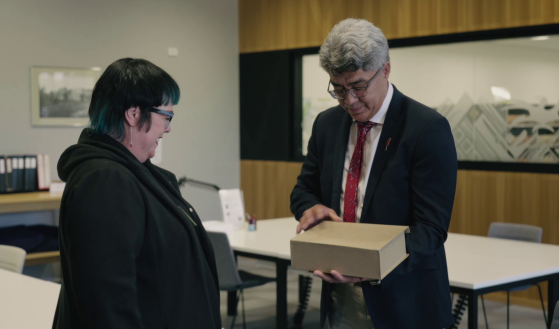 Ūpoko o Ngāi Tūāhuriri Te Maire Tau receiving Te Paipera Tapu o Te Koro Mautai from Richelle Gott during filming
for My Family Mystery at the Ngāi Tahu Archive, 6 October 2025. Photograph courtesy of My Family Mystery.
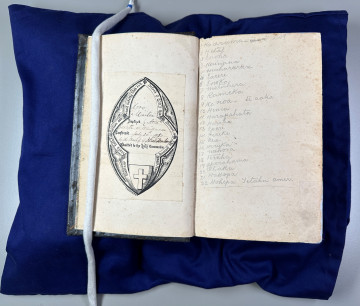
Above: Inscribed bookplates pasted onto the fly leaves at the front and back of the
bible record the baptism of Te Koro by Archdeacon Govett at Waikanae in 1848, and
his confirmation by Bishop Henry Harper, Bishop of New Zealand. A list of Māori
transliterations of biblical names also appears on the front fly leaf and is probably
written in Te Koro’s hand. The names show a Christian lineage, or whakapapa of sorts,
descending from ‘Arama’ (Adam) through to ‘Hakopa’ (Jacob) and ‘Joseph’ (Hohepa).
Other handwritten annotations appear throughout the bible. Te Koro has corrected
the spelling of his name on the back bookplate, writing ‘Te Kooro Mautai’ in pencil
above the incorrectly rendered ‘Maitai’.
Te Paipera Tapu o Te Koro Mautai, Ngāi Tahu Archive.
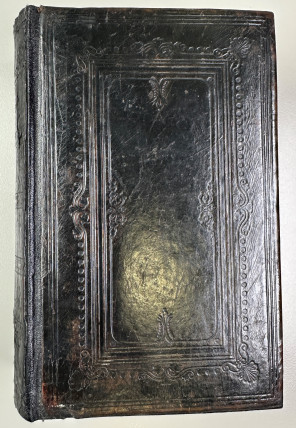 Left: The elaborately decorated full morocco leather cover of Te Paipera Tapu,
published and printed in London by W.M. Watts for the British and Foreign Bible
Society in 1868. The original gold tooling has worn off due to much use. Conservation
work has been undertaken to restore the structural integrity of the binding.
New endpapers have been inserted and several pages have been carefully mended
to enable handling, and to ensure the longevity of this significant taoka.
Te Paipera Tapu o Te Koro Mautai, Ngāi Tahu Archive
Te Koro Mautai
Te Koro was a son of Ihumatanui and his wife Raua.1 He spent his childhood at Ōmihi. During the wars with Ngāti Toa,
he was captured and taken north to Kāpiti Island. While enslaved, he spent time at Porirua, Ōtaki, and Whanganui.
He became a lay reader under Archdeacon Octavius Hadfield and imparted religious instruction to his fellow captive
Kāi Tahu. After returning to Canterbury in the 1850s, he worked closely with Reverend James West Stack who published
his biography, Koro, in 1898. It is a rare example of an early biography of a Māori individual.
Stack described Te Koro as a zealous and devoted helper in the work of the Christchurch Maori Mission.2 Indeed, his
Ngāi Tūāhuriri kin referred to him as ‘the Bishop’ on account of his leadership and commitment to the teachings of the
church.3 He had a deep understanding of scripture, which was reflected in how thoroughly he prepared his students
for confirmation. As a lay reader, Te Koro also led Sunday and weekday services, Sunday School, bible classes, and
visited the sick.4 Aside from Sundays and special occasions, Te Koro preferred to dress in rags, a practice that Stack
suggested was a hangover from his days of enslavement. Te Koro lived in a simple raupō whare which he later upgraded
to a wooden house, although he was never comfortable in the new place which he described disparagingly as a ‘white
man’s dog kennel.’5
He advocated and fundraised in the 1860s for a replacement church at Koukourarata and for the construction
of St Stephen’s Church at Tuahiwi. His efforts for the latter required long journeys on foot between Tuahiwi and
Christchurch where he doggedly but successfully canvassed for donations. Te Koro and fellow church warden
Pita Te Hori officiated alongside Governor Grey at the laying of the foundation stone for St Stephen’s in February 1867,
and the church was formally opened in September that year. In addition to spiritual leadership, Te Koro also played a
key role in rūnaka affairs at Tuahiwi, monitoring the behaviour of his own community and dealing with disputes.6
Despite his advancing age, in the early 1870s, Te Koro moved to Te Tai Poutini for a brief period to serve as a lay reader,
and to prepare Kāi Tahu candidates at Arahura and Māwhera for confirmation. On his return to Tuahiwi, he maintained
a close relationship with Stack and his family, even after they moved to Christchurch following the destruction of
the Tuahiwi mission house and school by fire in 1870.7 In 1877 Te Koro conducted his last major mission, supporting
the people of Koukourarata to renounce their adoption of the teachings of the prophet Te Maiharoa and return to the
Anglican faith.
Te Koro lived out his final years at Tuahiwi, lamenting that the rakatahi of his community were not adhering to
Christian teachings. He died in 1884 and has no living descendants. A silver chalice and a painting in the sanctuary
of St Stephen’s Church are dedicated to his memory.
Te Paipera Tapu
Te Paipera Tapu o Te Koro Mautai is a first edition copy of the first complete bible in te reo Māori. Printed in 1868,
its publication was the culmination of 40 years of translation work. Several translations of the New Testament and
extracts from the Old Testament had preceded it, beginning with the earliest scriptures in te reo Māori that were
printed in Sydney in 1827.8 Most of these early publications were the work of North Island-based missionaries.
An exception was He Puka ako i te Korero Maori, a small booklet that included scriptures and prayers in the Kāi Tahu
dialect, published by Waikouaiti-based Methodist missionary Reverend James Watkin in 1841.9
The 1868 edition of Te Paipera Tapu combined earlier translations of the New Testament by William Williams
(progenitor of the first comprehensive Māori language dictionary) and of the Old Testament by Robert Maunsell into
a single volume. These translations were further revised in England by Elizabeth Colenso, Reverend George Maunsell,
and Bishop George Selwyn.10 Maunsell proofed the Old Testament and Selwyn approved the final proofs of the
New Testament before it was sent to press for the British and Foreign Bible Society at William Watts printing
house in London.11
An initial 500 copies of Te Paipera Tapu were produced in three different bindings: ‘red sheep’, ‘speckled calf’
and ‘Morocco leather boards with blind and gold tooling’ (Te Koro’s version).12 The newly minted bibles arrived in
New Zealand in 1869. The Bible Society determined that they would be offered for sale rather than as free gifts.13
We do not know when or from whom Te Koro obtained his copy, however given their close relationship it seems likely
that Stack was involved in providing Te Paipera Tapu to his loyal friend whom he described as “a kind-hearted servant
of Jesus Christ, who, wherever he went, tried to do good to his fellow men.”14
1 James West Stack, Koro, Whitcombe & Tombs Ltd., Christchurch, Wellington and Dunedin, 1909, p.11.
2 Stack, Koro, p.20.
3 Ibid, p.48.
4 ‘The diocesan Maori mission’, Lyttelton Times, 16 November 1869, p.2.
5 Stack, Koro, p.77.
6 Ibid, p.44.
7 Lyttelton Times, 9 May 1870, p.3.
8 “The Bible’s early journey in New Zealand” in New Zealand Bible Society 10, 2018, p.4.
9 Ray Harlow, Otago’s first book: the distinctive dialect of Southern Maori, Otago Heritage Books, Dunedin, 1994.
10 Phil Parkinson & Penny Griffith (eds), Books in Maori, Reed, 2004, p.345.
11 “British and foreign bible society”, New Zealand Herald, 29 April 1869, p.5.
12 Ibid; Parkinson & Griffith, Books in Maori, p.345.
13 “British and foreign bible society”, New Zealand Herald, 29 April 1869, p.5.
14 Stack, Koro, p.90
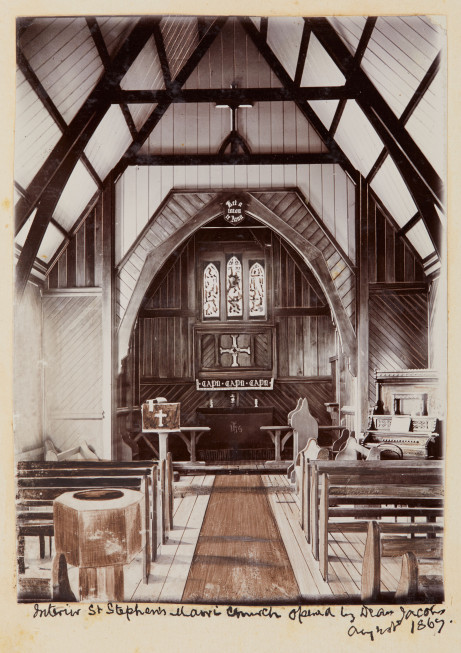
Above: The interior of Te Whare Tipene St Stephen’s Church,
Tuahiwi, c.1898. As an Anglican Lay Reader and Church
Warden, Te Koro would almost certainly have used
his copy of Te Paipera Tapu when leading worship
at St Stephen’s and when preaching, teaching, and
conducting pastoral care amongst his community
elsewhere. The church was built by Herbertson and
Byres from Saltwater Creek with Kāi Tahu supplying
the timber and helping with construction. The timber
board-and-batten church was designed by Reverend
A.G. Purchase and was the first church with a spire
in Canterbury. Officially opened in 1867, St Stephen’s
is the oldest extant Māori church in Te Waipounamu.
PA1-q-1130, Joseph Lowthian Wilson Album 3,
Alexander Turnbull Library (Copy held in Ngāi Tahu
Archive).
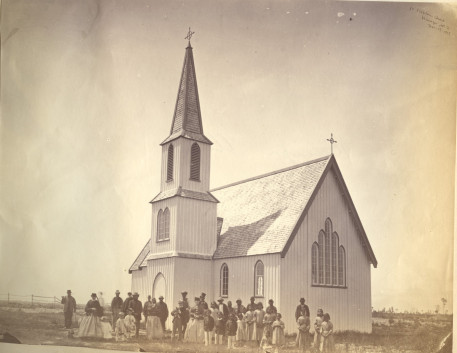
Above: This photograph of members of the Tuahiwi
community in front of St Stephen’s Church was taken
by Dr Alfred Charles Barker on 17 December 1867,
just three months after the church was completed
and formally opened. Te Koro was an active member
of the community at that time, however it is not
known whether he is pictured. Those identified
include: Arapata Koti (standing fifth from left in the
back row with a white beard), and Aperahama Te Aika
(wearing a top hat in the centre of the back row).
CCPAL42312, Christ’s College Canterbury Collection
(Copy held in Ngāi Tahu Archive).
Te Paipera Tapu o Te Koro Mautai features on My Family Mystery (Season 2 Episode 1), which is available to view on TVNZ+.
 Top
Top